Enzyme catalysis 3d
1344×768 · AVIF · CC BY 4.0
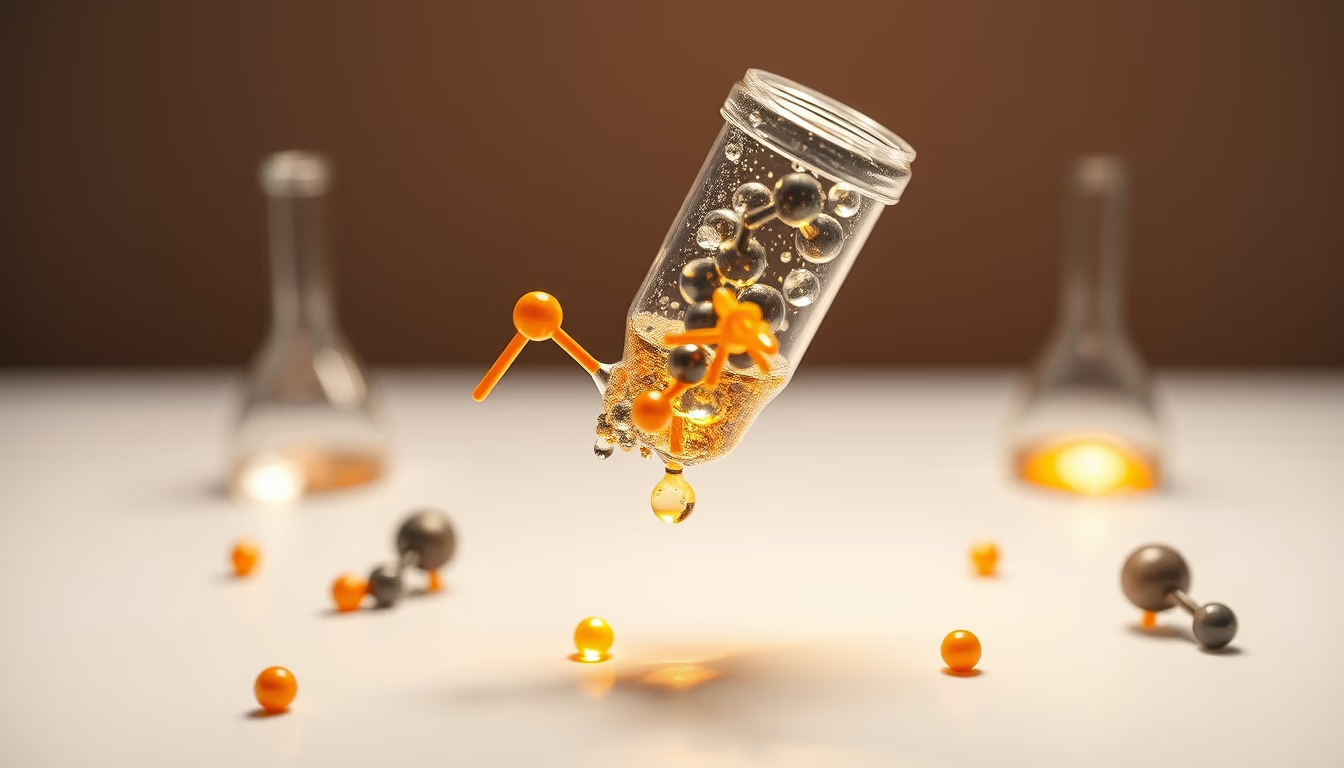
Enzymes are essential biological catalysts that accelerate chemical reactions by lowering activation energy, playing a central role in cellular metabolism.
About this subject
Enzymes are proteins (or occasionally RNA) that act as highly specific catalysts in biochemical reactions. They lower the activation energy required for a reaction to occur, enabling vital processes to proceed at rates compatible with life. Enzymatic activity depends on the three-dimensional structure of the enzyme, which forms an active site where the substrate binds. Two models explain this interaction: the lock-and-key model, which proposes a rigid, pre-formed fit, and the induced fit model, in which the enzyme undergoes conformational changes upon substrate binding. Factors such as temperature, pH, substrate and enzyme concentration, as well as the presence of inhibitors or activators, influence the rate of catalyzed reactions. A classic example is lactase, the enzyme that breaks down lactose in milk; its deficiency causes intolerance. Enzymes are also drug targets: many medications inhibit specific enzymes, such as aspirin, which blocks cyclooxygenase. Understanding enzyme kinetics, described by the Michaelis-Menten equation, is fundamental to biochemistry and to biotechnological applications, including the food and pharmaceutical industries.
Frequently Asked Questions
What is enzyme catalysis?
Enzyme catalysis is the process by which an enzyme accelerates a specific chemical reaction without being consumed, lowering the activation energy required.
What are the main factors affecting enzyme activity?
Temperature, pH, substrate and enzyme concentration, and the presence of inhibitors or activators. Each enzyme has optimal working conditions.
What is the difference between lock-and-key and induced fit models?
In the lock-and-key model, the active site is rigidly complementary to the substrate; in induced fit, the enzyme changes conformation upon substrate binding.
Direct URL
https://pub-c7d6a6ea828543ac903a74a341ccb2e1.r2.dev/imagens/enzyme-catalysis-3d-studio-still-life-p6.avifHow to credit
Include a visible link back to UtilizAí. Copy one of the snippets below:
<a href="https://xn--utiliza-eza.com/en/midia/imagens/enzyme-catalysis-3d-studio-still-life-p6">Enzyme catalysis 3d</a> by <a href="https://xn--utiliza-eza.com">UtilizAí</a>, licensed under <a href="https://creativecommons.org/licenses/by/4.0/">CC BY 4.0</a>.
[Enzyme catalysis 3d](https://xn--utiliza-eza.com/en/midia/imagens/enzyme-catalysis-3d-studio-still-life-p6) by [UtilizAí](https://xn--utiliza-eza.com), CC BY 4.0
License: CC-BY-4.0