Enzyme catalysis 3d
1344×768 · AVIF · CC BY 4.0
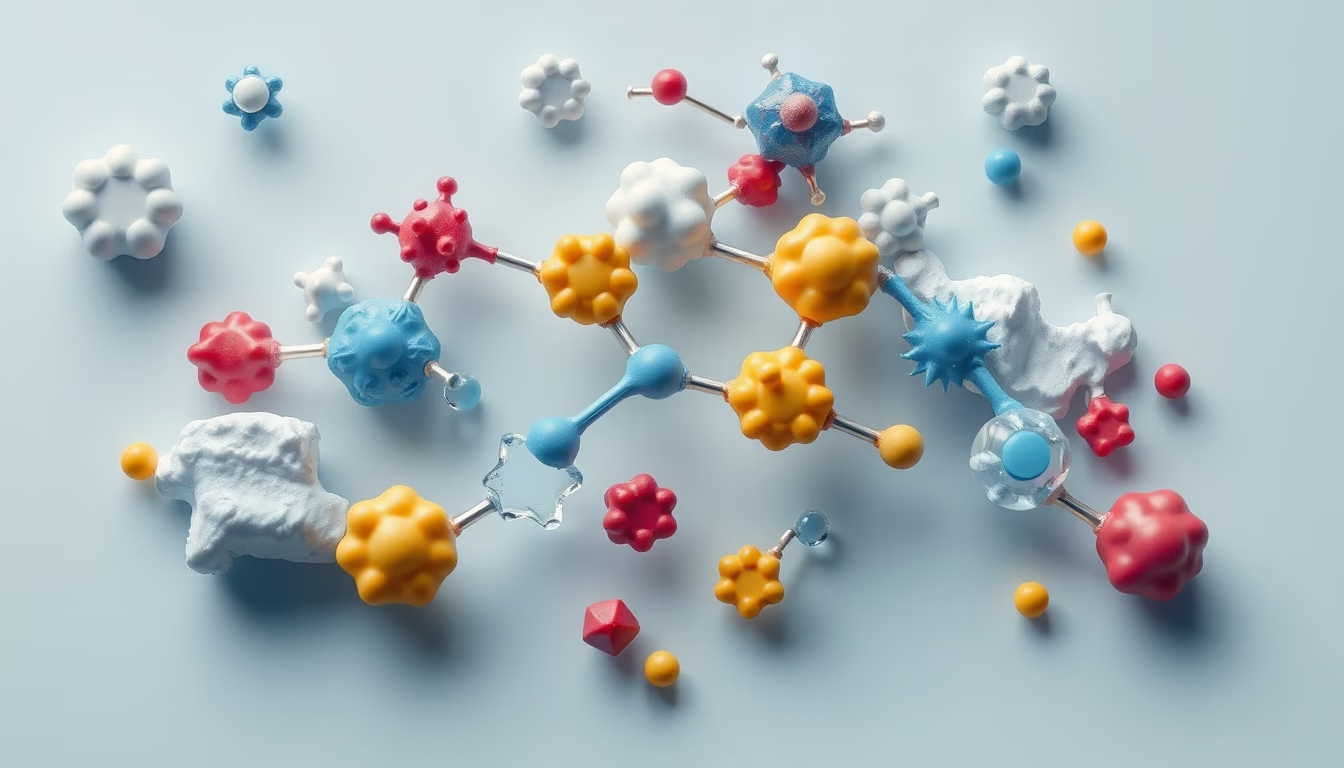
Isometric 3D representation of enzyme catalysis showing the interaction between enzyme and substrate in a flat lay layout.
About this subject
Enzyme catalysis is a fundamental process in biological systems, where enzymes act as highly specific catalysts, accelerating chemical reactions without being consumed. The isometric 3D flat lay illustration highlights the interaction between the enzyme, typically a globular protein, and its substrate, which fits into the enzyme's active site. This fit can be compared to a lock and key, or more accurately, to the induced fit model, where the enzyme's conformation adapts to the substrate. Enzymes are vital for life, controlling everything from digestion to DNA replication. Each enzyme is specialized for a specific reaction, with catalytic rates millions of times faster than the uncatalyzed reaction. Factors like temperature, pH, and substrate concentration affect enzyme activity; for instance, most human enzymes work best around 37°C and neutral pH, but extremophilic enzymes from hot springs withstand harsh conditions. Industry uses enzymes to produce detergents (proteases), corn syrup (amylases), and leather (lipases). Research in enzyme engineering aims to create more stable and efficient biocatalysts for sustainable processes. The 3D isometric representation aids in visualizing the three-dimensional structure and catalytic mechanism, useful for education and design.
Frequently Asked Questions
What is enzyme catalysis?
Enzyme catalysis is the process by which enzymes accelerate chemical reactions in living organisms by lowering the activation energy. Enzymes are proteins with active sites that bind to specific substrates.
What factors affect enzyme activity?
Enzyme activity is influenced by temperature, pH, substrate concentration, and the presence of inhibitors or activators. Each enzyme has optimal conditions for maximum activity.
How are enzymes represented in 3D?
3D representations of enzymes are created using techniques like X-ray crystallography or cryo-electron microscopy. Simplified isometric illustrations help visualize the active site and substrate interaction.
Direct URL
https://pub-c7d6a6ea828543ac903a74a341ccb2e1.r2.dev/imagens/enzyme-catalysis-3d-isometric-flat-lay-p8.avifHow to credit
Include a visible link back to UtilizAí. Copy one of the snippets below:
<a href="https://xn--utiliza-eza.com/en/midia/imagens/enzyme-catalysis-3d-isometric-flat-lay-p8">Enzyme catalysis 3d</a> by <a href="https://xn--utiliza-eza.com">UtilizAí</a>, licensed under <a href="https://creativecommons.org/licenses/by/4.0/">CC BY 4.0</a>.
[Enzyme catalysis 3d](https://xn--utiliza-eza.com/en/midia/imagens/enzyme-catalysis-3d-isometric-flat-lay-p8) by [UtilizAí](https://xn--utiliza-eza.com), CC BY 4.0
License: CC-BY-4.0