English horn rare
1344×768 · AVIF · CC BY 4.0
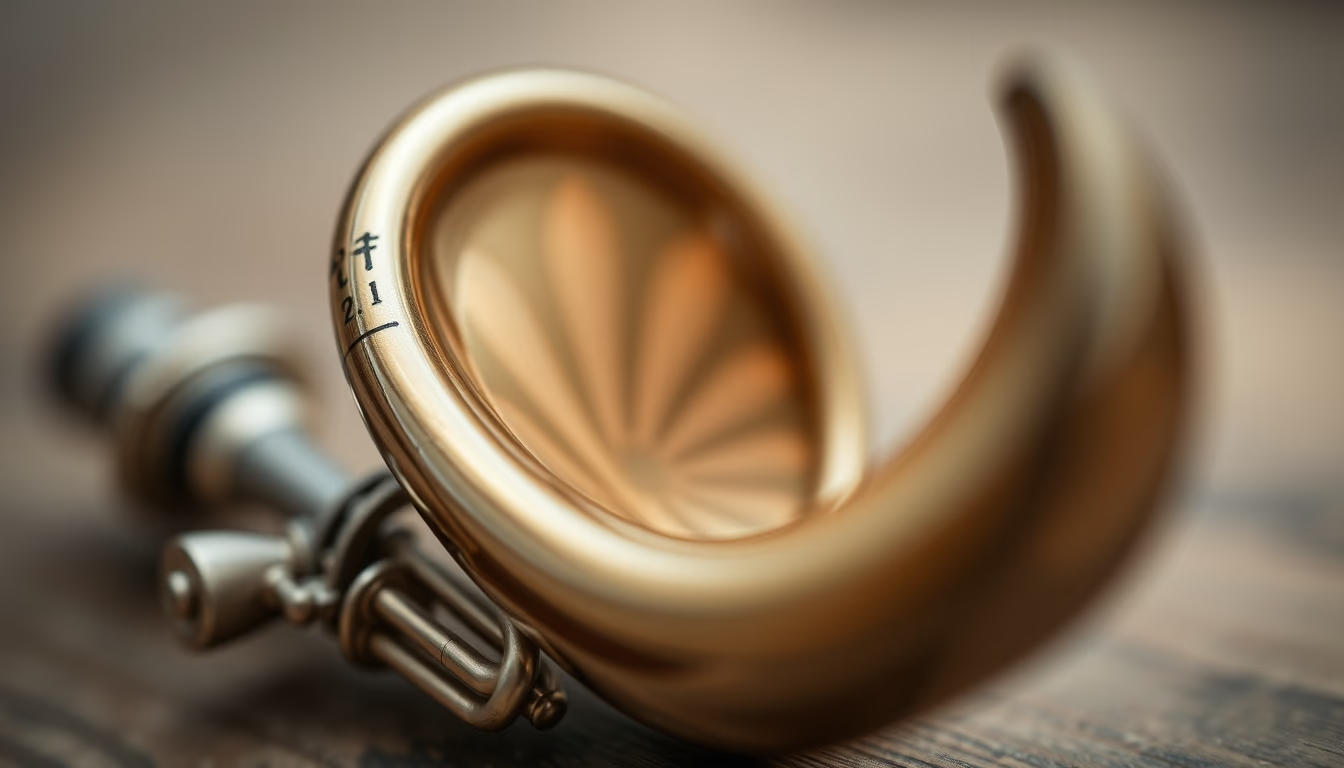
The English horn, also known as the cor anglais, is a double-reed woodwind instrument, a tenor oboe with a lower, richer tone.
About this subject
The English horn, or cor anglais, is a double-reed woodwind instrument that serves as the tenor oboe in orchestral settings. Its sound is lower, fuller, and more melancholic than that of the oboe, often described as pastoral or plaintive. Despite its name, the instrument is not English; the term likely derives from the French "cor anglé" (angled horn) or German "Engellisches Horn" (angelic horn). It first appeared in France around 1720 and was later adopted into the symphony orchestra. Notable orchestral works featuring the English horn include Dvořák's Symphony No. 9 "From the New World" (famous second-movement solo), Sibelius's tone poem "The Swan of Tuonela", and Tchaikovsky's Symphony No. 6 "Pathétique".
The English horn is a transposing instrument, pitched in F, meaning it sounds a perfect fifth lower than written. This requires the player to transpose while reading music, adding to the instrument's technical demands. It is typically made of African blackwood (grenadilla) with metal keys, and its double reed is crafted from Arundo donax cane, often handmade by the performer. The reed's thickness and shape greatly influence tone quality.
In modern orchestras, the English horn is considered less common than the oboe. Many ensembles do not have a dedicated English hornist; instead, the part is often played by the second or third oboist, who must switch between instruments. This rarity contributes to its mystique. Its timbre is especially effective in evoking nostalgia, nature, or sorrow. Beyond classical music, the English horn appears in film scores such as Howard Shore's "The Lord of the Rings" (Shire theme) and John Williams' "Schindler's List".
Playing the English horn requires strong breath support and embouchure control. Intonation can be challenging due to the instrument's length and reed sensitivity. Regular maintenance includes cleaning, reed adjustment, and humidity management. Despite these challenges, the English horn remains a cherished instrument for its unique voice, capable of unforgettable lyrical passages. It continues to be a staple of the orchestral repertoire, though it remains relatively rare compared to its smaller relative, the oboe.
Frequently Asked Questions
Why is the English horn called 'English' if it is not from England?
The name is likely a corruption. It may come from French 'cor anglé' (angled horn) or German 'Engellisches Horn' (angelic horn). The mistranslation into English fixed the name as 'English horn'.
What is the difference between the English horn and the oboe?
The English horn is larger and sounds a perfect fifth lower than the oboe. Its reed is attached to a curved metal tube (bocal) and it has a pear-shaped bell. The oboe is in C, while the English horn is in F.
Is the English horn a rare instrument?
Yes, it is less common than the oboe in orchestras. Many ensembles do not have a dedicated English hornist; the part is often played by an oboist who switches instruments. Its manufacture is also more handmade and expensive.
Direct URL
https://pub-c7d6a6ea828543ac903a74a341ccb2e1.r2.dev/imagens/english-horn-rare-tilt-shift-miniature-p3.avifHow to credit
Include a visible link back to UtilizAí. Copy one of the snippets below:
<a href="https://xn--utiliza-eza.com/en/midia/imagens/english-horn-rare-tilt-shift-miniature-p3">English horn rare</a> by <a href="https://xn--utiliza-eza.com">UtilizAí</a>, licensed under <a href="https://creativecommons.org/licenses/by/4.0/">CC BY 4.0</a>.
[English horn rare](https://xn--utiliza-eza.com/en/midia/imagens/english-horn-rare-tilt-shift-miniature-p3) by [UtilizAí](https://xn--utiliza-eza.com), CC BY 4.0
License: CC-BY-4.0