Electronic music waveform
1344×768 · AVIF · CC BY 4.0
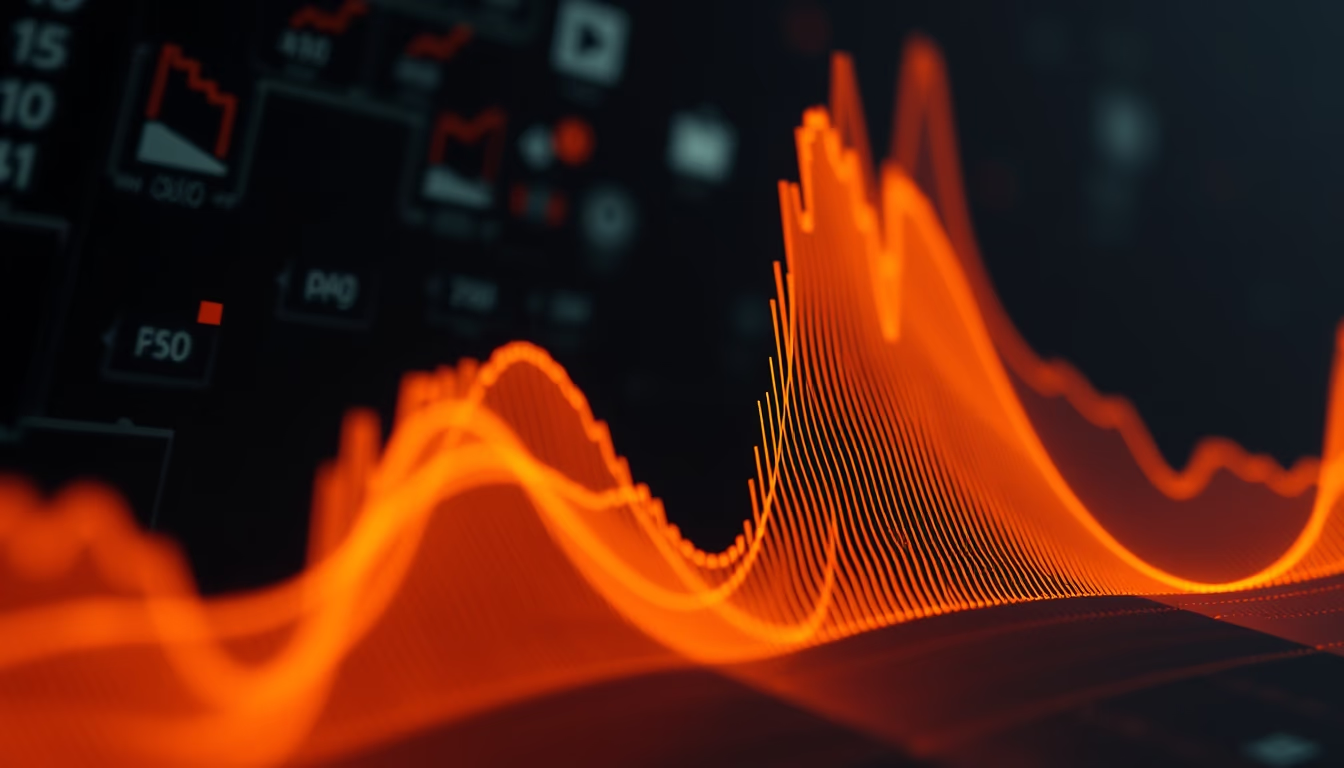
The electronic music waveform graphically represents sound oscillations, essential for synthesizers and modern music production.
About this subject
In electronic music, a waveform is the visual representation of a sound signal over time. Each type of waveform has distinct harmonic characteristics that define the timbre. The basic forms include sine, sawtooth, square, and triangle waves. The sine wave produces a pure tone with no harmonics, while the sawtooth is rich in both odd and even harmonics, generating a bright, cutting sound. The square wave contains only odd harmonics, resulting in a hollow, metallic timbre, and the triangle wave has odd harmonics with decreasing amplitude, sounding softer.
Historically, waveforms were fundamental in the development of early analog synthesizers, such as the Moog and ARP in the 1960s and 1970s. These instruments allowed musicians to sculpt sounds by combining and modulating different waveforms. With the advent of digital synthesis, new possibilities emerged: FM (Frequency Modulation) synthesis, wavetable, and granular synthesis. The waveform shifted from being just an electrical signal to a core concept in patch programming and the musical aesthetics of genres like techno, house, and ambient.
Culturally, the use of waveforms has influenced not only production but also music visualization. Software like Ableton Live, FL Studio, and Max/MSP display waveforms in real time, aiding editors and producers in precise audio manipulation. Moreover, the waveform has become a visual icon associated with electronic culture, appearing on album covers, music videos, and digital art. The common image of a green waveform bouncing against a dark background recalls the oscilloscopes of analog studios, carrying both nostalgic and technical weight.
Interestingly, the waveform also reveals dynamics and rhythmic structure. Peaks indicate higher amplitude (loud sounds or kicks), while valleys represent silence or soft passages. By observing the waveform of an electronic track, one can identify heavy kick drums, sharp hi-hats, and continuous pads. This visualization is especially useful for mastering engineers and audio engineers who adjust compression and EQ based on the waveform's contour. Today, with AI-generated music, new waveform patterns emerge, challenging the boundaries of human creativity.
Frequently Asked Questions
What is a waveform in electronic music?
A waveform is a graphical representation of a sound signal over time, showing amplitude variations. In electronic music, it is the fundamental building block for sound synthesis in synthesizers and software.
How are waveforms used in sound synthesis?
Synthesizers generate sounds from basic waveforms (sine, sawtooth, square, triangle) which can be combined, modulated, and filtered to create complex timbres. Techniques like FM and wavetable synthesis expand these possibilities.
What is the difference between analog and digital waveforms?
Analog waveforms are continuous and generated by electrical circuits, subject to natural imperfections. Digital waveforms are sampled at discrete intervals, allowing mathematical precision and exact reproduction, but may introduce quantization artifacts.
Direct URL
https://pub-c7d6a6ea828543ac903a74a341ccb2e1.r2.dev/imagens/electronic-music-waveform-national-geographic-style-p2.avifHow to credit
Include a visible link back to UtilizAí. Copy one of the snippets below:
<a href="https://xn--utiliza-eza.com/en/midia/imagens/electronic-music-waveform-national-geographic-style-p2">Electronic music waveform</a> by <a href="https://xn--utiliza-eza.com">UtilizAí</a>, licensed under <a href="https://creativecommons.org/licenses/by/4.0/">CC BY 4.0</a>.
[Electronic music waveform](https://xn--utiliza-eza.com/en/midia/imagens/electronic-music-waveform-national-geographic-style-p2) by [UtilizAí](https://xn--utiliza-eza.com), CC BY 4.0
License: CC-BY-4.0