Electronic music waveform
1344×768 · AVIF · CC BY 4.0
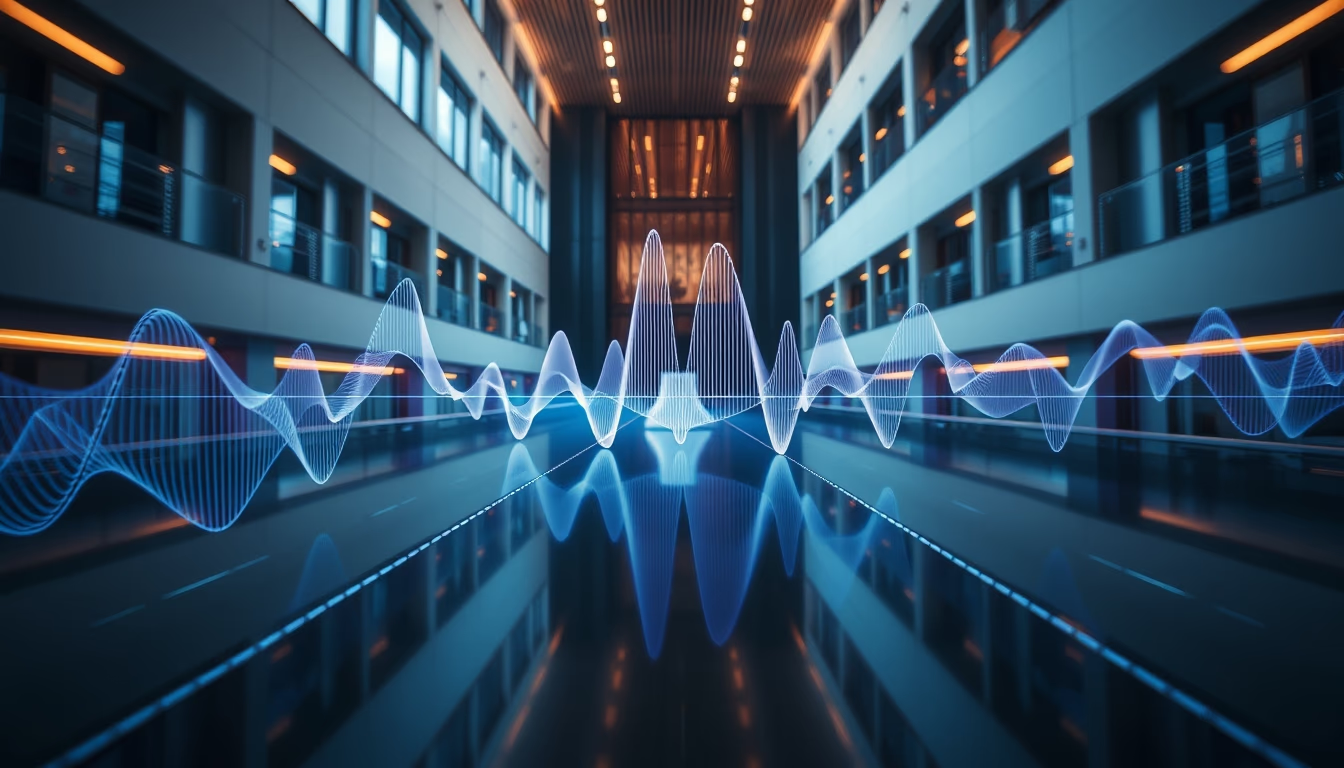
Electronic waveforms graphically represent sound pressure variations over time, forming the fundamental basis of modern music synthesis and production.
About this subject
Waveforms are visual representations of electrical signals that encode sound. In electronic music, common waveforms include sine, sawtooth, square, and triangle, each with distinct harmonic characteristics. The sine wave produces a pure tone with no harmonics, while the sawtooth wave is rich in both even and odd harmonics, creating a bright timbre. These waveforms are generated by oscillators in analog and digital synthesizers, enabling a wide range of timbres.
Creative use of waveforms extends beyond basic synthesis. Techniques like ring modulation, pulse width modulation (PWM), and wavetable synthesis manipulate waveforms to generate complex textures. In 1970s and 1980s electronic music, such as krautrock and Detroit techno, waveform experimentation was crucial for defining futuristic sound identities. Artists like Kraftwerk and Jean-Michel Jarre used oscillators to create sonic landscapes.
Waveform visualization has become an art form in itself. Audio editing software like Audacity and Ableton Live displays waveforms in real time, aiding sound engineers in editing and mixing. Moreover, the aesthetic of waveforms has influenced graphic design and architecture, hence the tag "architectural photography". Structures mimicking the peaks and valleys of audio signals appear in interactive installations that convert sound into light or motion.
Fun fact: the purest waveform, the sine wave, is mathematically described by the sine function; its frequency determines pitch. The square wave, with abrupt transitions between positive and negative, is used in digital circuits and 8-bit synthesizers, evoking early video game sounds.
Frequently Asked Questions
What is the difference between a sine wave and a sawtooth wave?
A sine wave has only a fundamental frequency with no harmonics, producing a pure, smooth sound. A sawtooth wave contains all integer harmonics, resulting in a bright, buzzy timbre often used for lead synth sounds.
How are waveforms used in music production?
Waveforms are the basis of oscillators in synthesizers. By selecting different shapes and modulating their properties (frequency, amplitude, phase), producers create unique timbres. Techniques like PWM and wavetable synthesis expand sonic possibilities.
Why are waveforms associated with architecture?
The visual aesthetic of waveforms, with peaks and valleys, inspires architectural designs and art installations. Buildings and sculptures mimicking these curves create a bridge between sound and space, exploring the materialization of audio.
Direct URL
https://pub-c7d6a6ea828543ac903a74a341ccb2e1.r2.dev/imagens/electronic-music-waveform-architectural-photography-p4.avifHow to credit
Include a visible link back to UtilizAí. Copy one of the snippets below:
<a href="https://xn--utiliza-eza.com/en/midia/imagens/electronic-music-waveform-architectural-photography-p4">Electronic music waveform</a> by <a href="https://xn--utiliza-eza.com">UtilizAí</a>, licensed under <a href="https://creativecommons.org/licenses/by/4.0/">CC BY 4.0</a>.
[Electronic music waveform](https://xn--utiliza-eza.com/en/midia/imagens/electronic-music-waveform-architectural-photography-p4) by [UtilizAí](https://xn--utiliza-eza.com), CC BY 4.0
License: CC-BY-4.0