Drone delivery package
1344×768 · AVIF · CC BY 4.0
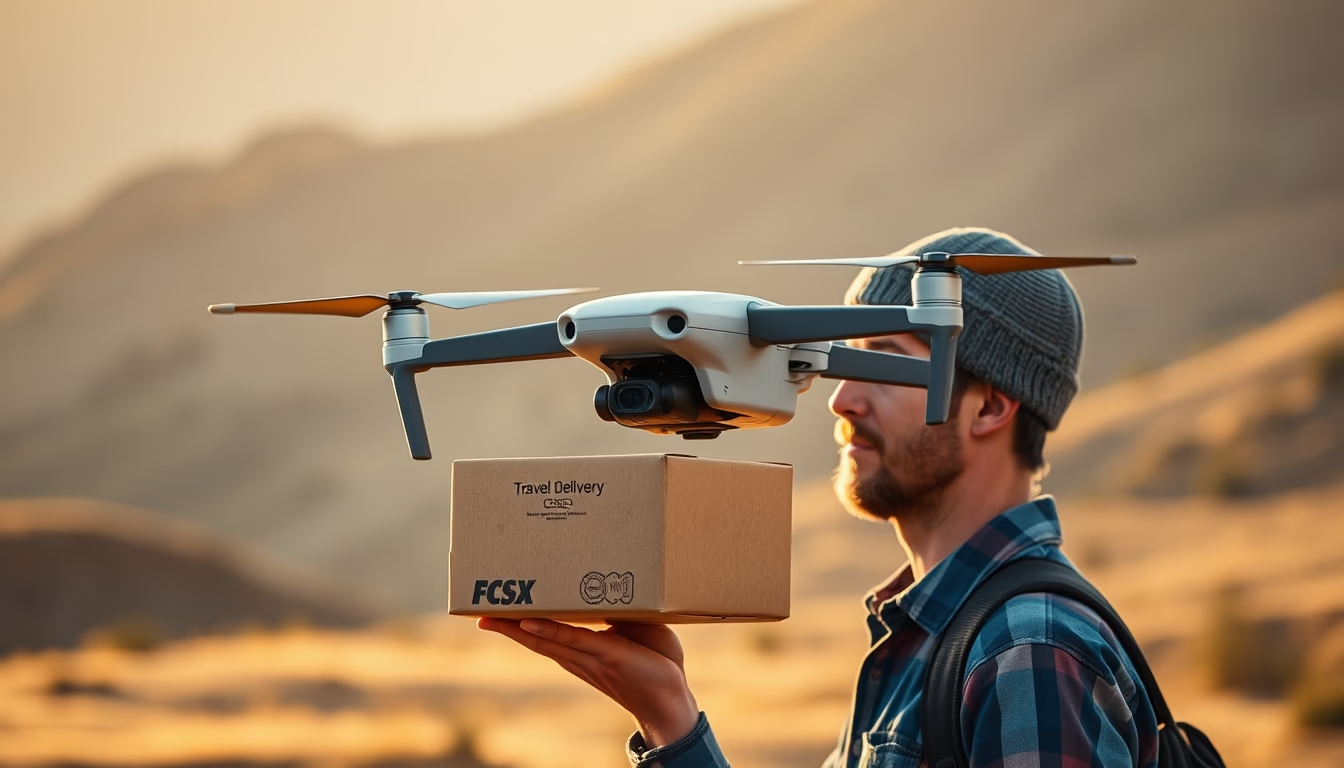
Drone delivery is already a reality in several countries, with companies testing autonomous flights for transporting packages and food.
About this subject
Drone delivery uses unmanned aerial vehicles (UAVs) to transport goods directly to consumers. Companies like Amazon, Alphabet (Wing), DHL, and Zipline are already operating commercially or in large-scale trials. In China, JD.com uses drones to reduce logistics costs in rural areas. In Africa, Zipline delivers medical supplies such as blood and vaccines to remote regions of Rwanda and Ghana.
Delivery drones typically have a flight time of 20 to 60 minutes and carry payloads up to 5 kg. They navigate via GPS, sensors, and collision-avoidance systems, flying at low altitudes (100 to 400 feet) to avoid airspace conflicts. Challenges include airspace regulation, safety against failures and theft, noise pollution, and integration with air traffic systems. In the United States, FAA requires special permissions for beyond-visual-line-of-sight (BVLOS) flights.
The global drone delivery market is expected to grow exponentially over the next decade, driven by e-commerce and the demand for fast, sustainable deliveries. Companies like UPS, FedEx, and Walmart are also investing in drone fleets. In Brazil, ANAC (National Civil Aviation Agency) still regulates drones for experimental use, but pilot projects exist in cities like São Paulo and Campinas, focusing on food and medicine deliveries.
The technology promises to reduce traffic congestion and carbon emissions but faces barriers such as adverse weather, urban obstacles (power lines, buildings), and public acceptance. The 2026 trend points to larger drones capable of carrying heavier loads and urban air traffic management systems (UTM) that coordinate hundreds of simultaneous flights autonomously and safely.
Frequently Asked Questions
How much weight can a delivery drone carry?
Most commercial delivery drones carry up to 5 kg, but larger models like Zipline can transport up to 1.8 kg of medical supplies. Companies are developing drones for payloads up to 10 kg.
Where is drone delivery already operating regularly?
In the US, Alphabet (Wing) operates in Christiansburg, Virginia, and Texas. In Australia, in Canberra and Logan. In Europe, UPS Flight Forward delivers medical supplies in Switzerland. In Africa, Zipline operates in Rwanda and Ghana.
What are the main challenges for drone delivery in Brazil?
ANAC's regulations are still restrictive for BVLOS flights. Urban infrastructure such as power lines and tall buildings, along with public acceptance, are barriers. Pilot projects are underway in São Paulo and Campinas.
Direct URL
https://pub-c7d6a6ea828543ac903a74a341ccb2e1.r2.dev/imagens/drone-delivery-package-travel-photography-p5.avifHow to credit
Include a visible link back to UtilizAí. Copy one of the snippets below:
<a href="https://xn--utiliza-eza.com/en/midia/imagens/drone-delivery-package-travel-photography-p5">Drone delivery package</a> by <a href="https://xn--utiliza-eza.com">UtilizAí</a>, licensed under <a href="https://creativecommons.org/licenses/by/4.0/">CC BY 4.0</a>.
[Drone delivery package](https://xn--utiliza-eza.com/en/midia/imagens/drone-delivery-package-travel-photography-p5) by [UtilizAí](https://xn--utiliza-eza.com), CC BY 4.0
License: CC-BY-4.0