Drone delivery package
1344×768 · AVIF · CC BY 4.0
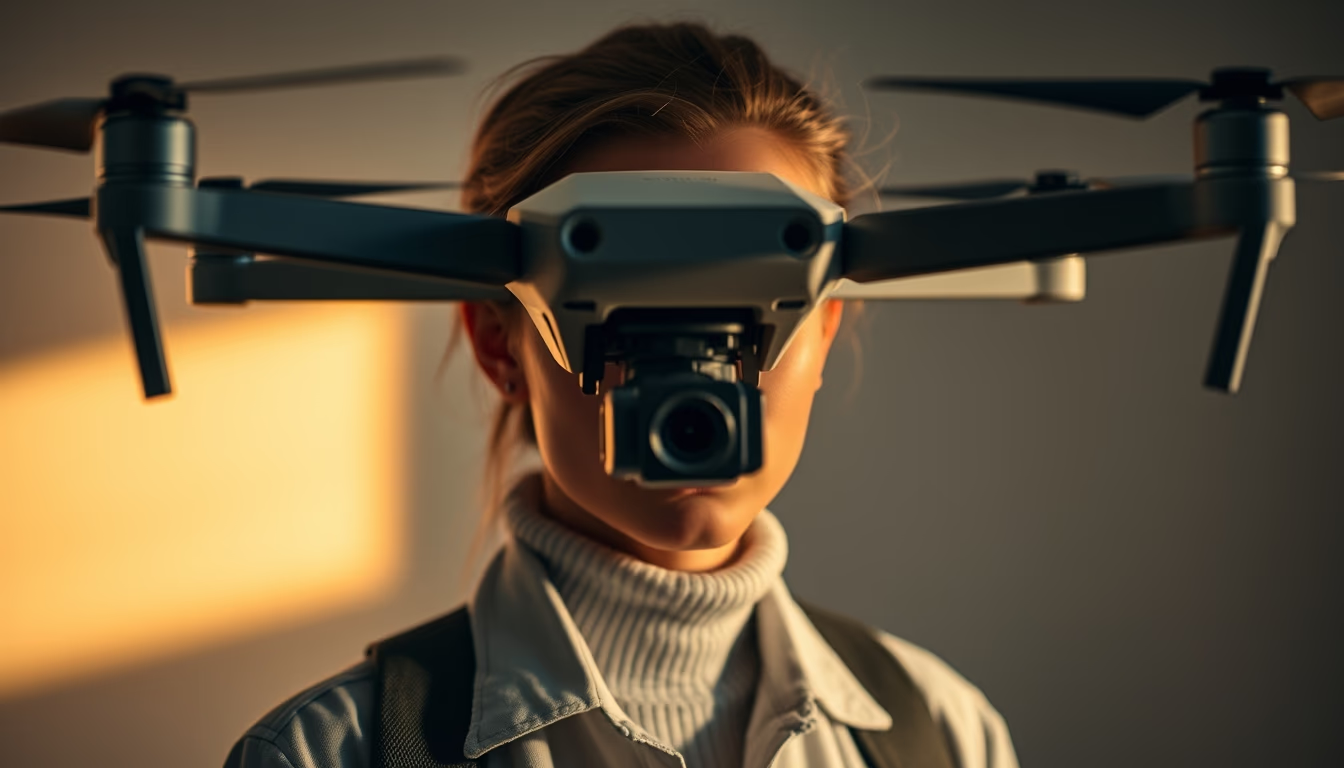
Drone delivery combines autonomous logistics and cutting-edge technology to transport packages in urban and rural areas, reducing time and emissions.
About this subject
Package delivery by drones is a growing application of autonomous aviation, with commercial tests underway since 2013 by companies like Amazon (Prime Air), Alphabet (Wing), and UPS (Flight Forward). In Brazil, initiatives such as iFood and Correios conduct experiments to deliver food and parcels to hard-to-reach areas. Most delivery drones carry up to 2.5 kg of payload and have a flight endurance of about 30 minutes, operating at low altitudes along pre-programmed routes.
Regulation is a major challenge. In Brazil, ANAC requires specific authorizations for beyond-visual-line-of-sight (BVLOS) flights, with limits on altitude and distance from the operator. In the U.S., the FAA has approved BVLOS operations for companies like Wing, while in Europe EASA establishes risk categories. Safety concerns, such as collision avoidance, data privacy, and noise, continue to spark public debate.
The social impact includes reduced last-mile traffic congestion, faster deliveries in rural areas, and emergency medical use, such as transporting medication and blood. Companies like Zipline already operate in Africa delivering medical supplies by drone. By 2026, integration with urban air mobility (UAM) systems, larger drones carrying up to 5 kg, and battery improvements extending range are expected. Fine art photography captures this transformation, highlighting the technological aesthetics of drones hovering over cityscapes with packages attached.
Documenting this evolution visually is important for the historical record of logistics. Images of drones delivering packages, with their aerodynamic designs and navigation lights, become icons of modernity. The fine art photography category emphasizes composition and context, recording not only functionality but also the symbolism of a future where airspace becomes an extension of streets.
Frequently Asked Questions
Which companies lead drone delivery?
Global pioneers include Amazon, Wing (Alphabet), UPS, and Google. In Brazil, iFood and Correios are conducting trials in controlled areas.
What is the payload capacity of a delivery drone?
Most commercial drones carry between 1 kg and 2.5 kg. Larger models, such as those used by Zipline, can carry up to 5 kg of medical supplies.
Is drone delivery allowed in Brazil?
Yes, with authorization from ANAC. BVLOS (beyond visual line of sight) flights require special permits and safety requirements, such as automatic parachutes.
Direct URL
https://pub-c7d6a6ea828543ac903a74a341ccb2e1.r2.dev/imagens/drone-delivery-package-fine-art-photography-p2.avifHow to credit
Include a visible link back to UtilizAí. Copy one of the snippets below:
<a href="https://xn--utiliza-eza.com/en/midia/imagens/drone-delivery-package-fine-art-photography-p2">Drone delivery package</a> by <a href="https://xn--utiliza-eza.com">UtilizAí</a>, licensed under <a href="https://creativecommons.org/licenses/by/4.0/">CC BY 4.0</a>.
[Drone delivery package](https://xn--utiliza-eza.com/en/midia/imagens/drone-delivery-package-fine-art-photography-p2) by [UtilizAí](https://xn--utiliza-eza.com), CC BY 4.0
License: CC-BY-4.0