Dna helix glowing blue
1344×768 · AVIF · CC BY 4.0
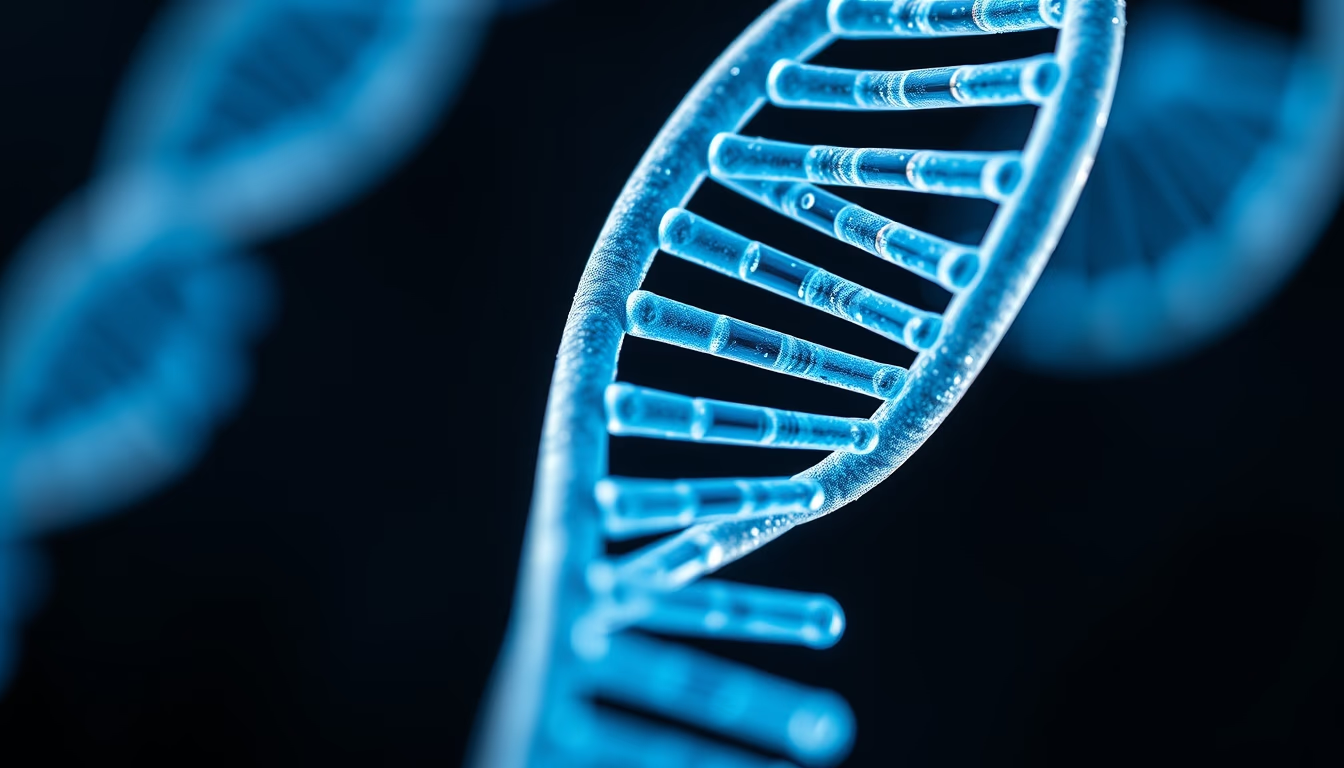
The DNA double helix is the three-dimensional structure that stores the genetic code of all living organisms, featuring complementary base pairs and hydrogen bonds.
About this subject
The double helix structure of DNA was discovered by James Watson and Francis Crick in 1953, based on X-ray diffraction data from Rosalind Franklin and Maurice Wilkins. This helical shape consists of two nucleotide strands winding around a common axis, resembling a spiral staircase. Each nucleotide contains a sugar (deoxyribose), a phosphate group, and a nitrogenous base: adenine (A), thymine (T), cytosine (C), or guanine (G). Bases pair specifically: A with T (two hydrogen bonds) and C with G (three hydrogen bonds). This complementarity is essential for DNA replication and transcription.
The antiparallel orientation of the strands, one running 5'→3' and the other 3'→5', provides stability and allows proper enzyme function. The helix diameter is about 2 nm, with a complete turn every 3.4 nm (approximately 10 base pairs). DNA is not a rigid structure; it can adopt different conformations, such as A-DNA (more compact) and Z-DNA (zigzag), depending on environmental conditions and sequence. In living organisms, DNA typically exists as B-DNA, the most common form described by Watson and Crick.
The discovery of the double helix revolutionized biology, enabling advances in genetic engineering, gene therapy, and genome editing with CRISPR. Besides the cell nucleus, DNA is also found in mitochondria (mitochondrial DNA) and in plant chloroplasts. One fascinating fact: if all the DNA in a single human cell were stretched out, it would measure about 2 meters in length, yet it is compacted into chromosomes within the nucleus. The helical structure is stabilized by hydrogen bonds and hydrophobic interactions between stacked bases.
Frequently Asked Questions
What is the main function of the DNA double helix?
The DNA double helix stores and transmits genetic information necessary for the development, functioning, and reproduction of all living organisms.
How are base pairs organized in the DNA structure?
Nitrogenous bases pair specifically: adenine (A) with thymine (T) and cytosine (C) with guanine (G), joined by hydrogen bonds.
What distinguishes B-DNA from other forms like A-DNA and Z-DNA?
B-DNA is the most common form under physiological conditions, with a right-handed helix and 10 base pairs per turn. A-DNA is more compact with 11 base pairs per turn, while Z-DNA is left-handed and has a zigzag structure.
Direct URL
https://pub-c7d6a6ea828543ac903a74a341ccb2e1.r2.dev/imagens/dna-helix-glowing-blue-macro-closeup-p7.avifHow to credit
Include a visible link back to UtilizAí. Copy one of the snippets below:
<a href="https://xn--utiliza-eza.com/en/midia/imagens/dna-helix-glowing-blue-macro-closeup-p7">Dna helix glowing blue</a> by <a href="https://xn--utiliza-eza.com">UtilizAí</a>, licensed under <a href="https://creativecommons.org/licenses/by/4.0/">CC BY 4.0</a>.
[Dna helix glowing blue](https://xn--utiliza-eza.com/en/midia/imagens/dna-helix-glowing-blue-macro-closeup-p7) by [UtilizAí](https://xn--utiliza-eza.com), CC BY 4.0
License: CC-BY-4.0