Crystal formation amethyst
1344×768 · AVIF · CC BY 4.0
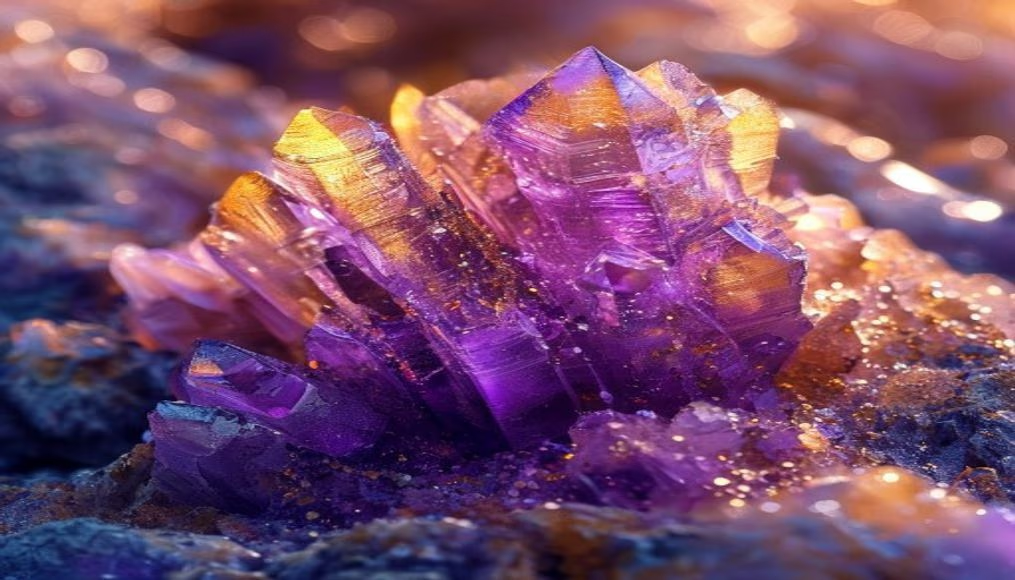
Amethyst crystals, a violet variety of quartz, form in volcanic geodes in Brazil, especially in Rio Grande do Sul.
About this subject
Amethyst is a violet variety of quartz, colored by iron impurities and natural radiation exposure. Crystals form in cavities of volcanic rocks, such as basalts, where silica-rich solutions precipitate slowly over millions of years. Brazil is one of the world's largest producers of amethyst, especially in the Alto Uruguai region of Rio Grande do Sul and the town of Ametista do Sul, named after its mineral wealth. Amethyst geodes can reach enormous sizes, such as those found in the Paredão Mine, which are meters tall.
The genesis of amethyst involves hydrothermal processes. Fractures and cavities in basalts of the Serra Geral Formation, created by intense volcanism about 135 million years ago, were filled with silica-rich fluids. Crystallization occurs at low temperatures (between 50 °C and 200 °C) and low pressure. The violet color is unstable: when exposed to high temperatures, amethyst loses its color and becomes citrine or green quartz. Therefore, natural amethysts should never be heated above 400 °C.
Beyond jewelry, amethyst is valued for its supposed energetic and healing properties in lithotherapy. Scientifically, it is a piezoelectric mineral used in electronic components such as oscillators and frequency filters. Most Brazilian amethyst is exported to China, where it is cut and transformed into jewelry. In Brazil, extraction occurs both in underground and open-pit mines, generating employment and income in small communities.
Trivia: the largest amethyst geode ever found in the world is in Ametista do Sul (RS). It measures 3.5 meters in length and weighs about 35 tons. It was extracted in 2012 and exhibited at international shows. The formation of these crystals demands a perfect balance of temperature, pressure, and chemical composition, making each geode a unique masterpiece of nature.
Frequently Asked Questions
How does amethyst get its violet color?
The violet color of amethyst is caused by iron impurities (Fe3+) in its quartz crystal structure, combined with natural radiation from radioactive minerals in surrounding rocks.
Where can amethyst be found in Brazil?
Main deposits are in Rio Grande do Sul (Alto Uruguai, Ametista do Sul), Minas Gerais, Bahia, and Pará. The mines in Rio Grande do Sul are famous for giant geodes.
Can amethyst permanently lose its color?
Yes, if heated above 400°C, amethyst loses its violet color and may become citrine (yellow-orange) or green quartz. This process is irreversible.
Direct URL
https://pub-c7d6a6ea828543ac903a74a341ccb2e1.r2.dev/imagens/crystal-formation-amethyst-travel-photography-v10.avifHow to credit
Include a visible link back to UtilizAí. Copy one of the snippets below:
<a href="https://xn--utiliza-eza.com/en/midia/imagens/crystal-formation-amethyst-travel-photography-v10">Crystal formation amethyst</a> by <a href="https://xn--utiliza-eza.com">UtilizAí</a>, licensed under <a href="https://creativecommons.org/licenses/by/4.0/">CC BY 4.0</a>.
[Crystal formation amethyst](https://xn--utiliza-eza.com/en/midia/imagens/crystal-formation-amethyst-travel-photography-v10) by [UtilizAí](https://xn--utiliza-eza.com), CC BY 4.0
License: CC-BY-4.0