Corporate skyscraper from below
1344×768 · AVIF · CC BY 4.0
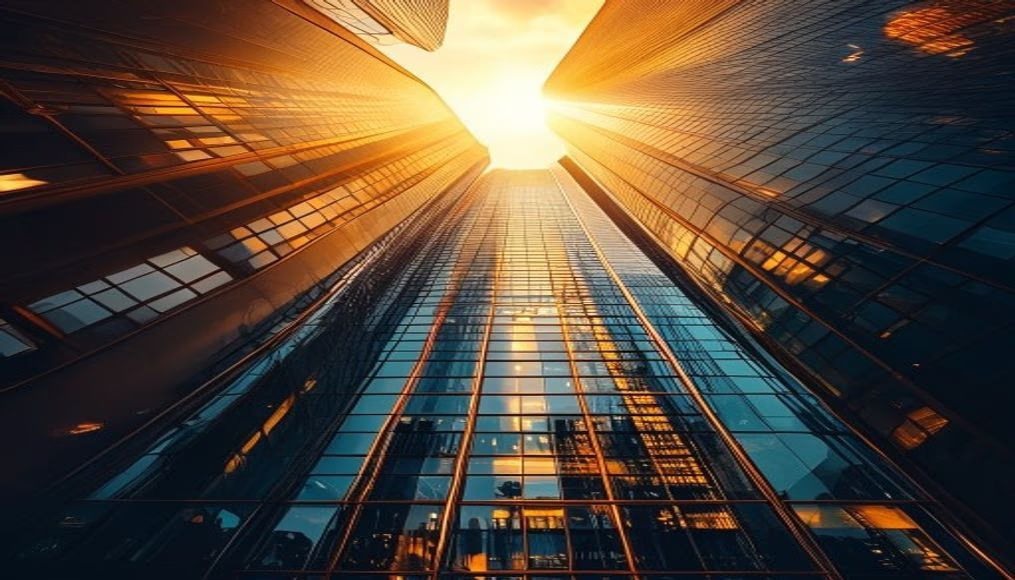
Corporate skyscraper viewed from below reveals the imposing vertical architecture in global financial centers.
About this subject
Corporate skyscrapers are landmarks of economic power and modern architectural design. When viewed from ground level, their dramatic angles create a sense of scale and verticality that dominates the urban landscape. These structures often exceed 200 meters in height and are designed to maximize space in dense metropolitan areas such as São Paulo, New York, and Tokyo. The glass and steel facade reflects the surrounding sky, while the building's base, frequently open to the public, establishes a transition between the street and the corporate interior.
Architectural photography capturing these low-angle upward views not only documents the physical form but also communicates the ambition and identity of the companies operating there. Urban studies show that this perspective reinforces visual hierarchy, where pedestrians feel small against the capital embodied in concrete. In Brazil, notable examples include the Copan Building in São Paulo, though residential, and the Estaiada Bridge, not a skyscraper but highlighting verticality. Globally, the Burj Khalifa and Shanghai Tower are icons of this trend.
Beyond visual impact, these buildings face technical challenges such as wind resistance and energy management. The low-angle perspective also emphasizes the repetitive geometry of windows and the play of light and shadow. In financial centers, clusters of skyscrapers create true 'urban canyons,' influencing microclimate and air circulation. Maintaining these facades requires specialized techniques, such as drone-based cleaning or robotic systems.
Historically, the race for taller buildings began in the late 19th century in Chicago and New York, driven by the elevator and structural steel. Today, sustainability gains prominence, with certifications like LEED and green facades. The view from below captures not only grandeur but also the dialogue between the building and its urban surroundings, a recurring theme in travel photography essays.
Frequently Asked Questions
Why is the low-angle perspective common in skyscraper photography?
This perspective emphasizes the height and grandeur of the building, creating converging lines that guide the eye and convey a sense of magnitude and architectural power.
What are the main engineering challenges in corporate skyscrapers?
Key challenges include resisting wind loads, ensuring seismic stability, managing efficient elevator systems, and meeting sustainability requirements such as energy efficiency.
Where are the largest corporate skyscrapers located in the world?
The tallest are in Dubai (Burj Khalifa), Shanghai (Shanghai Tower), and New York (One World Trade Center). In Brazil, the Mirante do Vale in São Paulo was once the tallest, but now the highlight is the Várzea Building.
Direct URL
https://pub-c7d6a6ea828543ac903a74a341ccb2e1.r2.dev/imagens/corporate-skyscraper-from-below-travel-photography-v10.avifHow to credit
Include a visible link back to UtilizAí. Copy one of the snippets below:
<a href="https://xn--utiliza-eza.com/en/midia/imagens/corporate-skyscraper-from-below-travel-photography-v10">Corporate skyscraper from below</a> by <a href="https://xn--utiliza-eza.com">UtilizAí</a>, licensed under <a href="https://creativecommons.org/licenses/by/4.0/">CC BY 4.0</a>.
[Corporate skyscraper from below](https://xn--utiliza-eza.com/en/midia/imagens/corporate-skyscraper-from-below-travel-photography-v10) by [UtilizAí](https://xn--utiliza-eza.com), CC BY 4.0
License: CC-BY-4.0