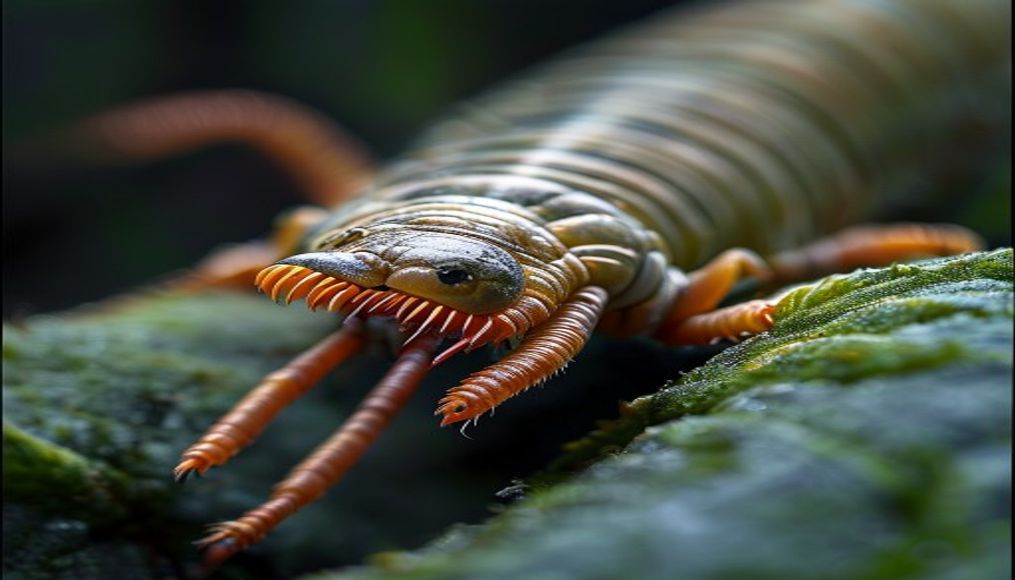
Centipede macro detail
1344×768 · AVIF · CC BY 4.0
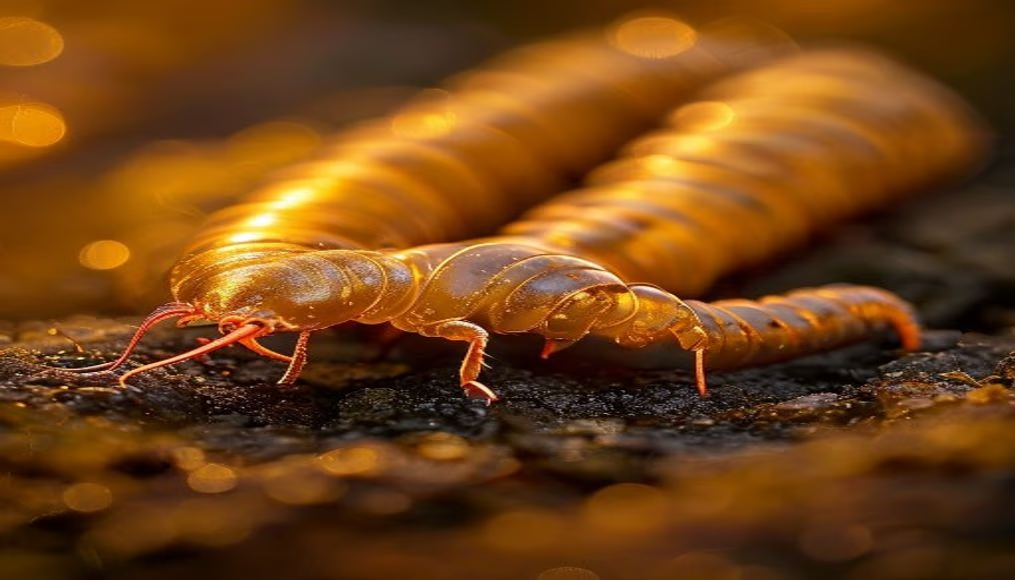
Macro detail of a centipede revealing its segmented body, numerous leg pairs and antennae, adapted to humid environments in South America.
About this subject
Centipedes belong to the class Chilopoda, distinguished from millipedes by having one pair of legs per body segment, whereas millipedes have two pairs. These arthropods are carnivorous and use the first pair of legs modified into forcipules, venom-inoculating structures, to capture prey such as insects, spiders, and small vertebrates. The venom is effective for immobilizing prey but rarely dangerous to humans, causing only local pain and swelling in larger species like Scolopendra gigantea, found in the Amazon.
The elongated, segmented body of centipedes ranges from a few millimeters to over 30 centimeters, depending on the species. Each segment, except the first and last, bears a pair of jointed legs. The antennae are long and sensory, aiding navigation in dark environments. Coloration varies from brown to yellow, often with patterns that camouflage the animal among leaves and soil.
Centipedes are found on every continent except Antarctica, preferring moist habitats such as under stones, fallen logs, leaf litter, and forest soil. In Brazil, they are common in the Atlantic Forest and the Amazon. They are important predators in controlling insect and other invertebrate populations. Interestingly, the number of leg pairs is always odd in adults, ranging from 15 to 191 pairs, and they periodically molt their exoskeleton to grow.
Frequently Asked Questions
Are centipedes dangerous to humans?
Most centipedes pose no serious threat to humans. Their venom causes local pain and swelling, but larger species like Scolopendra gigantea can cause more intense symptoms such as fever and nausea. Allergic reactions are rare.
How many legs does a centipede have?
The number of leg pairs varies by species and developmental stage, but adults always have an odd number, ranging from 15 to 191 pairs. Each body segment except the first and last has one pair of legs.
Where can centipedes be found in Brazil?
Centipedes are common in humid areas such as tropical forests (Amazon, Atlantic Forest), under stones, logs, leaf litter, and in gardens. Urban species may also appear in bathrooms and basements.
Direct URL
https://pub-c7d6a6ea828543ac903a74a341ccb2e1.r2.dev/imagens/centipede-macro-detail-travel-photography-p1.avifHow to credit
Include a visible link back to UtilizAí. Copy one of the snippets below:
<a href="https://xn--utiliza-eza.com/en/midia/imagens/centipede-macro-detail-travel-photography-p1">Centipede macro detail</a> by <a href="https://xn--utiliza-eza.com">UtilizAí</a>, licensed under <a href="https://creativecommons.org/licenses/by/4.0/">CC BY 4.0</a>.
[Centipede macro detail](https://xn--utiliza-eza.com/en/midia/imagens/centipede-macro-detail-travel-photography-p1) by [UtilizAí](https://xn--utiliza-eza.com), CC BY 4.0
License: CC-BY-4.0