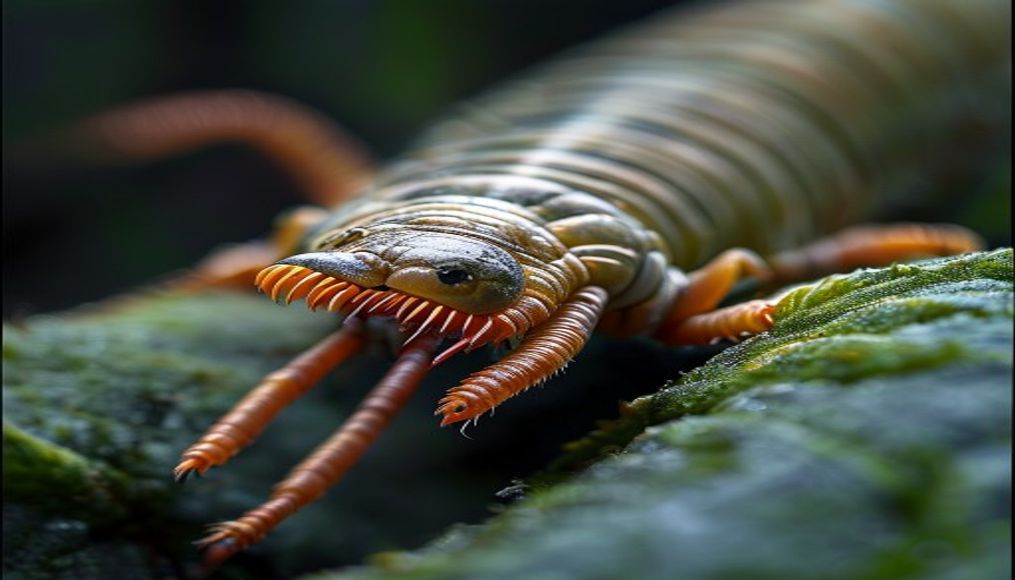
Centipede macro detail
1344×768 · AVIF · CC BY 4.0
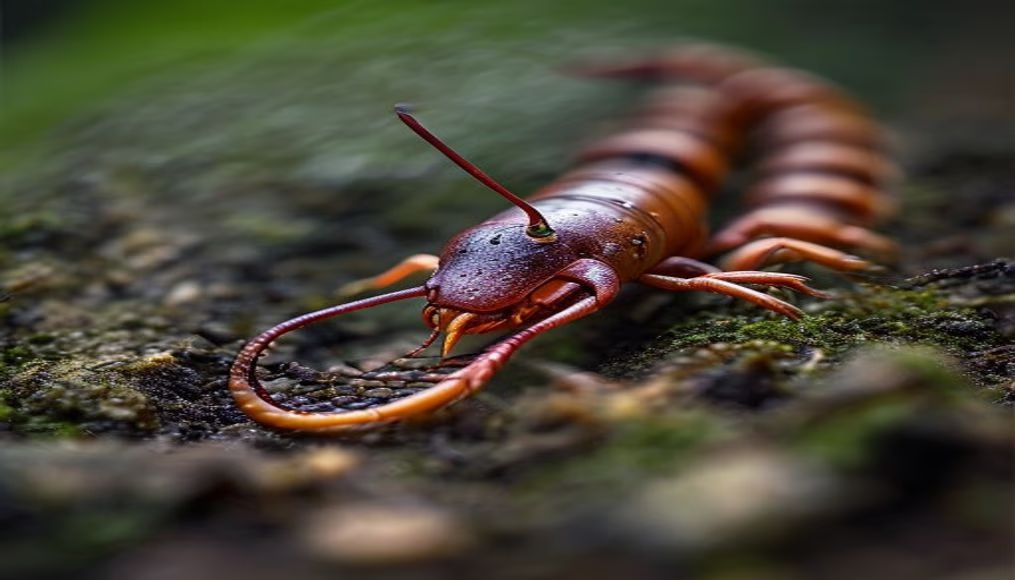
Centipedes are predatory arthropods with segmented bodies and one pair of legs per segment. Learn about their traits and habits.
About this subject
Centipedes belong to the class Chilopoda within the subphylum Myriapoda, distinct from insects by having one pair of legs per body segment. The first pair of legs is modified into forcipules, which inject venom to paralyze prey such as insects, spiders, and small vertebrates. They are exclusively carnivorous, nocturnal hunters, moving swiftly thanks to well-developed legs.
The elongated, flattened body allows them to hide under stones, fallen logs, leaf litter, and moist soil, environments essential to prevent dehydration. Although most species are small (a few centimeters long), the Amazonian giant centipede (Scolopendra gigantea) can exceed 30 cm, making it the largest in the world. Found in South American tropical forests, it preys on creatures as large as small mammals.
Centipedes have poor eyesight, compensated by long, sensitive antennae that detect vibrations and odors. Interestingly, some species are bioluminescent, emitting light for communication or defense. Though their venom can be painful to humans, most species are not dangerous, causing only local swelling and pain. With about 3,300 described species, centipedes play a key role in controlling soil invertebrate populations.
Frequently Asked Questions
Are centipedes dangerous to humans?
Most centipede bites are not dangerous to humans. They cause local pain, swelling, and redness, but serious complications are rare. Large species like the giant centipede can cause more intense reactions, but fatalities are extremely uncommon.
How many legs does a centipede have?
The number of legs varies by species and developmental stage. Adult centipedes have between 30 and 354 legs, always in an odd number of pairs (15 to 177 pairs). Despite the name, they do not always have 100 legs.
Where do centipedes live?
Centipedes live in moist, dark environments such as under stones, logs, leaf litter, soil, and caves. They are found on every continent except Antarctica, with the highest diversity in tropical regions.
Direct URL
https://pub-c7d6a6ea828543ac903a74a341ccb2e1.r2.dev/imagens/centipede-macro-detail-national-geographic-style-p2.avifHow to credit
Include a visible link back to UtilizAí. Copy one of the snippets below:
<a href="https://xn--utiliza-eza.com/en/midia/imagens/centipede-macro-detail-national-geographic-style-p2">Centipede macro detail</a> by <a href="https://xn--utiliza-eza.com">UtilizAí</a>, licensed under <a href="https://creativecommons.org/licenses/by/4.0/">CC BY 4.0</a>.
[Centipede macro detail](https://xn--utiliza-eza.com/en/midia/imagens/centipede-macro-detail-national-geographic-style-p2) by [UtilizAí](https://xn--utiliza-eza.com), CC BY 4.0
License: CC-BY-4.0