Cello in concert hall
1344×768 · AVIF · CC BY 4.0
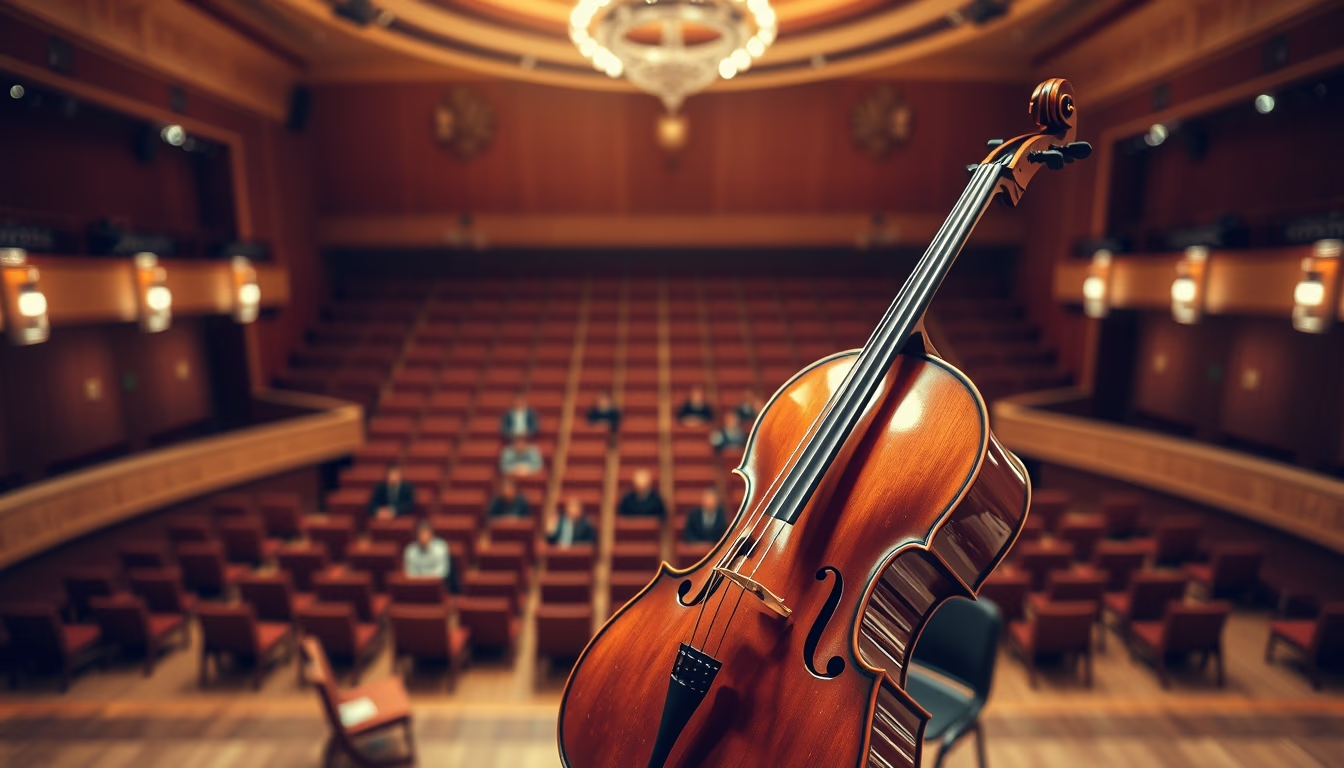
The cello, a bowed string instrument, is a central piece in symphony orchestras and concert halls worldwide.
About this subject
The cello, or violoncello, is a bowed string instrument from the violin family. It is a staple of the symphony orchestra, providing both melodic lines and harmonic support in the tenor range. Originating in 16th-century Italy, the cello evolved from the violone, a Renaissance instrument. Typically made from spruce and maple, it has four strings tuned in fifths (C, G, D, A) and is played with a horsehair bow. The cello repertoire is extensive, with famous concertos by Bach, Beethoven, Dvořák, and Shostakovich, as well as sonatas and solo works. In concert halls, the acoustic design highlights the cello's rich, warm tone, which carries well in both solo and orchestral settings. Renowned cellists include Yo-Yo Ma, Jacqueline du Pré, and Pablo Casals, who advanced the instrument's technique and repertoire. The cello also appears in jazz, folk, and film scores, demonstrating its adaptability. Handcrafted by luthiers, each cello is uniquely adjusted for optimal sound. The concert hall, with its carefully engineered acoustics, provides the ideal environment for the cello's full expression, allowing audiences to appreciate subtle dynamics and tonal colors. The interplay between instrument and space creates a memorable auditory experience, cherished across cultures.
Frequently Asked Questions
What is the difference between a cello and a violin?
The cello is larger, with thicker strings and a lower tuning (C, G, D, A) compared to the violin (G, D, A, E). It is played seated, held between the knees, while the violin is tucked under the chin.
Who are the main composers of cello pieces?
Johann Sebastian Bach (Cello Suites), Antonín Dvořák (Cello Concerto), Joseph Haydn, and Dmitri Shostakovich are among the most significant.
How does a concert hall's acoustics affect the cello's sound?
The hall should provide controlled reverberation and even sound distribution. Materials like wood and plaster help reflect mid and low frequencies, enhancing the cello's timbre.
Direct URL
https://pub-c7d6a6ea828543ac903a74a341ccb2e1.r2.dev/imagens/cello-in-concert-hall-isometric-flat-lay-p12.avifHow to credit
Include a visible link back to UtilizAí. Copy one of the snippets below:
<a href="https://xn--utiliza-eza.com/en/midia/imagens/cello-in-concert-hall-isometric-flat-lay-p12">Cello in concert hall</a> by <a href="https://xn--utiliza-eza.com">UtilizAí</a>, licensed under <a href="https://creativecommons.org/licenses/by/4.0/">CC BY 4.0</a>.
[Cello in concert hall](https://xn--utiliza-eza.com/en/midia/imagens/cello-in-concert-hall-isometric-flat-lay-p12) by [UtilizAí](https://xn--utiliza-eza.com), CC BY 4.0
License: CC-BY-4.0