Cello in concert hall
1344×768 · AVIF · CC BY 4.0
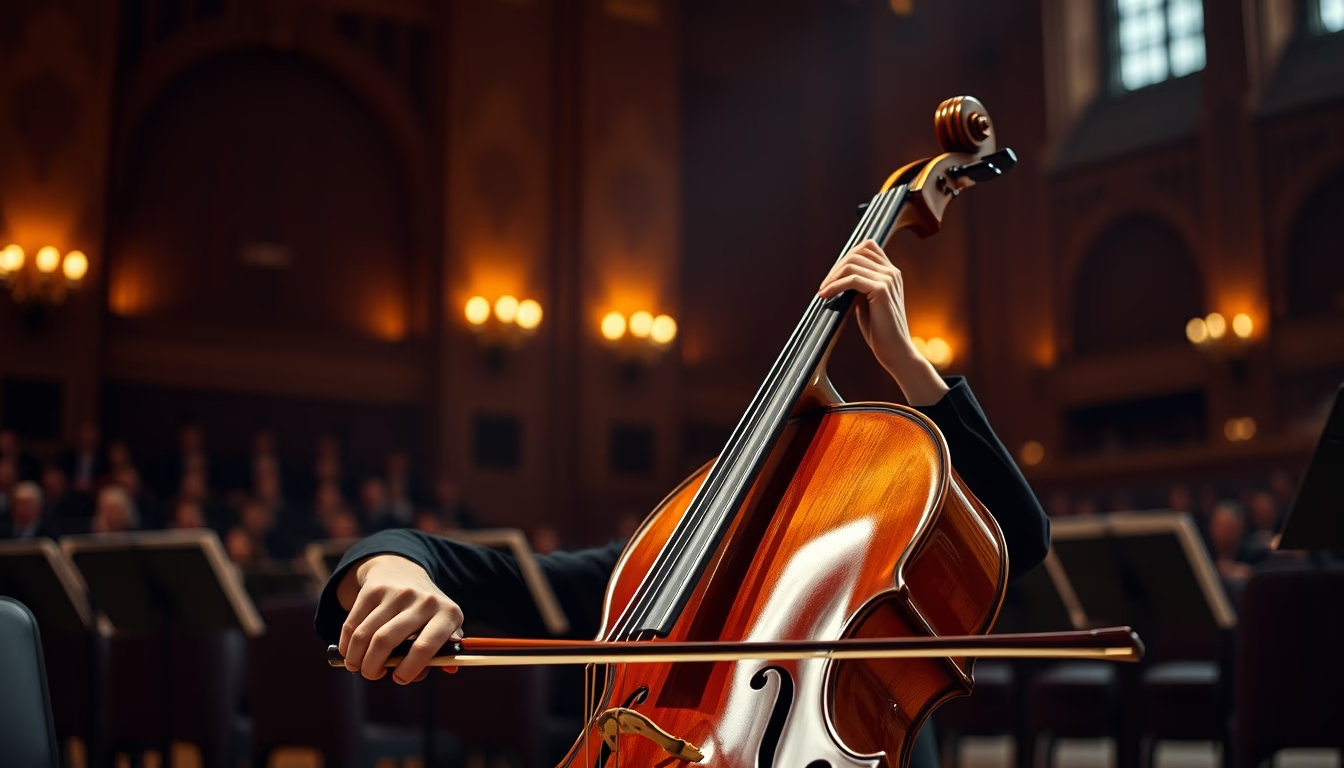
The cello, a bowed string instrument, is a centerpiece in orchestras and recitals in concert halls worldwide.
About this subject
The cello, a member of the violin family, has four strings tuned in fifths (C, G, D, A) and is played between the musician's knees, supported on the floor by an endpin. Its construction combines woods such as spruce for the top and maple for the back and sides, directly affecting the projection and timbre of the sound. From a biological perspective, sound production involves the vibration of strings transmitted to the bridge and the body, which acts as a resonance chamber amplifying mechanical waves to the human ear. The acoustics of a concert hall are designed to optimize the propagation of these waves, with reflective and absorptive surfaces ensuring clarity and envelopment.
The history of the cello dates back to the 16th century in Italy, with luthiers like Andrea Amati and later Stradivari. Unlike the violin, which gained prominence as a solo instrument in the Baroque era, the cello established itself as a harmonic foundation until the 18th century, when composers like Bach and Vivaldi explored its melodic expressiveness. In modern concert halls, the cello is used both in symphony orchestras and chamber recitals, standing out for its tessitura similar to the human voice.
Interestingly, the term "cello" comes from the Italian "violoncello," meaning "little violone" (a Renaissance instrument). Its versatility has allowed it to transcend genres, from classical to jazz and popular music. Bach's famous Cello Suites, for instance, are considered among the most challenging and sublime works in the repertoire. In a live performance, the interaction between the instrument and the hall's acoustics creates an immersive experience, where the listener perceives nuances of harmonics and dynamics that recording often fails to capture.
Frequently Asked Questions
What is the difference between the cello and the violin?
The cello is larger than the violin, with longer and thicker strings, producing a deeper sound. While the violin is played under the chin, the cello is held between the knees. Its tuning is one octave below the viola.
Why is the cello considered similar to the human voice?
Due to its pitch range, which approximates the baritone and tenor vocal registers, and its ability to express emotional nuances through vibrato and dynamics.
How does the concert hall influence the sound of the cello?
The hall's acoustics affect reverberation and clarity. Halls with adequate reverberation time (around 2 seconds) enhance the cello's timbre, while reflective surfaces can distribute sound evenly.
Direct URL
https://pub-c7d6a6ea828543ac903a74a341ccb2e1.r2.dev/imagens/cello-in-concert-hall-fine-art-photography-p1.avifHow to credit
Include a visible link back to UtilizAí. Copy one of the snippets below:
<a href="https://xn--utiliza-eza.com/en/midia/imagens/cello-in-concert-hall-fine-art-photography-p1">Cello in concert hall</a> by <a href="https://xn--utiliza-eza.com">UtilizAí</a>, licensed under <a href="https://creativecommons.org/licenses/by/4.0/">CC BY 4.0</a>.
[Cello in concert hall](https://xn--utiliza-eza.com/en/midia/imagens/cello-in-concert-hall-fine-art-photography-p1) by [UtilizAí](https://xn--utiliza-eza.com), CC BY 4.0
License: CC-BY-4.0