Brazilian factory worker on assembly line with safety helmet
1344×768 · AVIF · CC BY 4.0
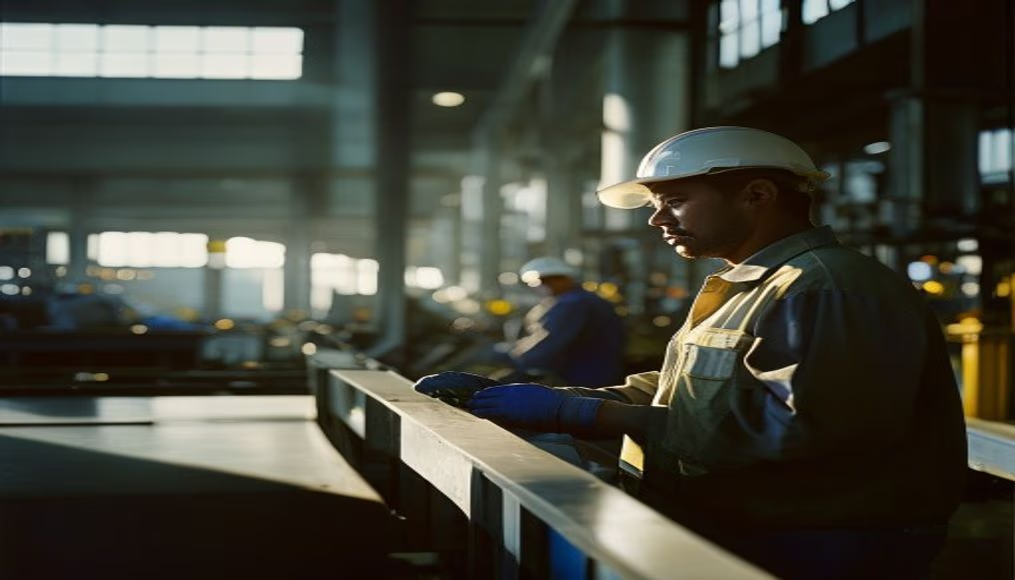
Brazilian factory worker on an assembly line wearing a safety helmet during the morning shift.
About this subject
Brazilian industry employs millions of workers in the manufacturing sector, with notable concentration in the states of São Paulo, Minas Gerais, and Rio Grande do Sul. On assembly lines, safety is paramount: the use of safety helmets is mandatory under regulatory standards such as NR-6 (Personal Protective Equipment). The morning shift, typically from 6 a.m. to 2 p.m., is common in factories operating three shifts.
The modern assembly line was popularized by Henry Ford in the early 20th century, but its large-scale adoption in Brazil began in the 1950s with the establishment of automakers like Volkswagen, Ford, and General Motors in São Bernardo do Campo (SP). Today, Brazil has a diverse industrial base ranging from automotive production to electronics and food processing.
Brazilian assembly line workers face challenges such as repetitiveness, noise, and exposure to chemical agents, making PPE use essential. Brazil's Consolidation of Labor Laws (CLT) and collective bargaining agreements establish breaks, workplace gymnastics, and periodic exams to preserve occupational health. In 2023, Brazil recorded about 10 million industrial workers, according to IBGE.
Interesting fact: the modern safety helmet was invented by American chemist Edward Dickinson Bullard in 1919, inspired by soldiers' helmets from World War I. In Brazil, domestic production of PPE is regulated by the Ministry of Labor and Employment, with compliance certification by INMETRO.
Frequently Asked Questions
What are the main PPEs used on assembly lines?
In addition to safety helmets, common PPE includes safety glasses, earplugs, gloves, safety shoes, and aprons.
What is the typical work shift for an assembly line operator in Brazil?
The standard shift is 8 hours per day and 44 hours per week, with breaks for rest and meals. Night shifts receive a 20% additional pay.
How does NR-6 regulate the use of helmets at work?
NR-6 requires employers to provide helmets with a Certificate of Approval (CA) free of charge and train workers on correct use and maintenance.
Direct URL
https://pub-c7d6a6ea828543ac903a74a341ccb2e1.r2.dev/imagens/brazilian-factory-worker-on-assembly-line-with-safety-helmet-documentary-morning-6.avifHow to credit
Include a visible link back to UtilizAí. Copy one of the snippets below:
<a href="https://xn--utiliza-eza.com/en/midia/imagens/brazilian-factory-worker-on-assembly-line-with-safety-helmet-documentary-morning-6">Brazilian factory worker on assembly line with safety helmet</a> by <a href="https://xn--utiliza-eza.com">UtilizAí</a>, licensed under <a href="https://creativecommons.org/licenses/by/4.0/">CC BY 4.0</a>.
[Brazilian factory worker on assembly line with safety helmet](https://xn--utiliza-eza.com/en/midia/imagens/brazilian-factory-worker-on-assembly-line-with-safety-helmet-documentary-morning-6) by [UtilizAí](https://xn--utiliza-eza.com), CC BY 4.0
License: CC-BY-4.0
Tags
Related images
 Food delivery rider on motorbike in São Paulo traffic
 Food delivery rider on motorbike in São Paulo traffic
 Food delivery rider on motorbike in São Paulo traffic
 Food delivery rider on motorbike in São Paulo traffic
 Food delivery rider on motorbike in São Paulo traffic
 Food delivery rider on motorbike in São Paulo traffic