Brazilian factory worker on assembly line with safety helmet
1344×768 · AVIF · CC BY 4.0
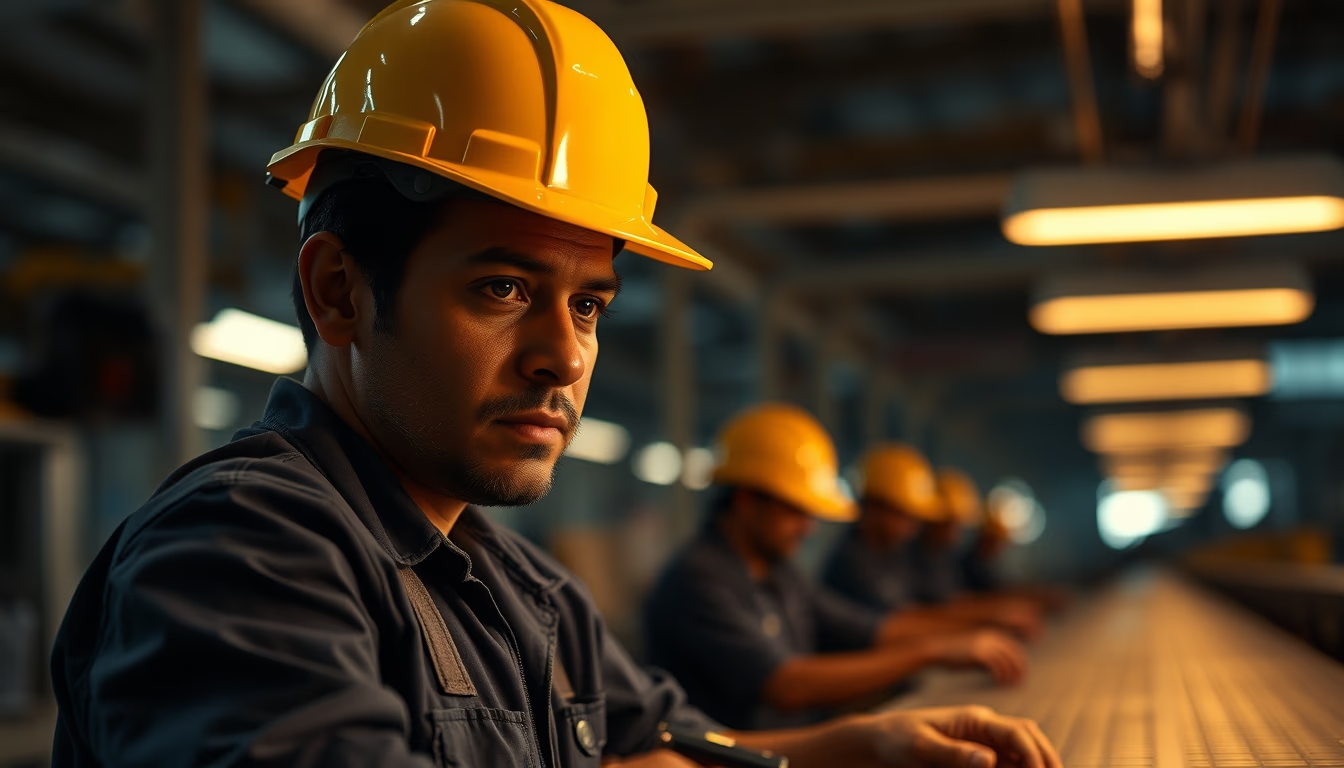
Brazilian factory worker on an assembly line, wearing a safety helmet in a nighttime industrial setting.
About this subject
Brazilian industry employs about 10 million workers in the manufacturing sector, according to CNI data. Assembly lines are common in factories producing automobiles, electronics, and consumer goods, where productivity relies on trained operators and personal protective equipment (PPE). Safety helmets are mandatory under NR-6, a regulatory standard from the Ministry of Labor, which mandates PPE use to prevent accidents. In 2022, Brazil recorded over 600,000 workplace accidents, according to the Observatory of Safety and Health at Work, highlighting the importance of protection. Night shifts are common in factories operating 24 hours, with a 20% night shift premium over daytime wages, as per CLT labor laws. The image captures a moment of concentration and routine, where the worker performs repetitive tasks requiring attention and skill. The factory's artificial lighting contrasts with the outdoor twilight, emphasizing the long shift. The smile on the worker's face may reflect pride or satisfaction despite challenging conditions. In Brazil, the automotive industry is concentrated in São Paulo, Minas Gerais, and Paraná, but there are hubs in other regions, such as the Manaus Industrial Pole. The modern assembly line was popularized by Henry Ford in the early 20th century, but today it is adapted with robots and automated systems. However, human labor remains essential for fine assembly and quality inspection tasks. Brazilian workers often face long hours and low wages, but formal employment guarantees rights such as paid vacation, 13th salary, and FGTS severance fund. The image represents the country's productive workforce, seeking modernization without losing the human element.
Frequently Asked Questions
What PPE is mandatory in Brazilian industry?
Common PPE includes safety helmets, safety glasses, gloves, ear protectors, and steel-toe boots. NR-6 from the Ministry of Labor lists mandatory items based on activity risk.
How does night shift pay work for factory workers?
Night shift pay includes a 20% premium over daytime hourly wages, as per the Consolidation of Labor Laws (CLT). The night hour is reduced to 52 minutes and 30 seconds, between 10 PM and 5 AM.
Why is the assembly line important for Brazilian industry?
The assembly line enables large-scale production efficiently. In Brazil, sectors like automotive, electronics, and food processing rely on this system to meet domestic demand and exports.
Direct URL
https://pub-c7d6a6ea828543ac903a74a341ccb2e1.r2.dev/imagens/brazilian-factory-worker-on-assembly-line-with-safety-helmet-closeup-twilight-5.avifHow to credit
Include a visible link back to UtilizAí. Copy one of the snippets below:
<a href="https://xn--utiliza-eza.com/en/midia/imagens/brazilian-factory-worker-on-assembly-line-with-safety-helmet-closeup-twilight-5">Brazilian factory worker on assembly line with safety helmet</a> by <a href="https://xn--utiliza-eza.com">UtilizAí</a>, licensed under <a href="https://creativecommons.org/licenses/by/4.0/">CC BY 4.0</a>.
[Brazilian factory worker on assembly line with safety helmet](https://xn--utiliza-eza.com/en/midia/imagens/brazilian-factory-worker-on-assembly-line-with-safety-helmet-closeup-twilight-5) by [UtilizAí](https://xn--utiliza-eza.com), CC BY 4.0
License: CC-BY-4.0
Tags
Related images
 Food delivery rider on motorbike in São Paulo traffic
 Food delivery rider on motorbike in São Paulo traffic
 Food delivery rider on motorbike in São Paulo traffic
 Food delivery rider on motorbike in São Paulo traffic
 Food delivery rider on motorbike in São Paulo traffic
 Food delivery rider on motorbike in São Paulo traffic