Bengal tiger in jungle
1344×768 · AVIF · CC BY 4.0
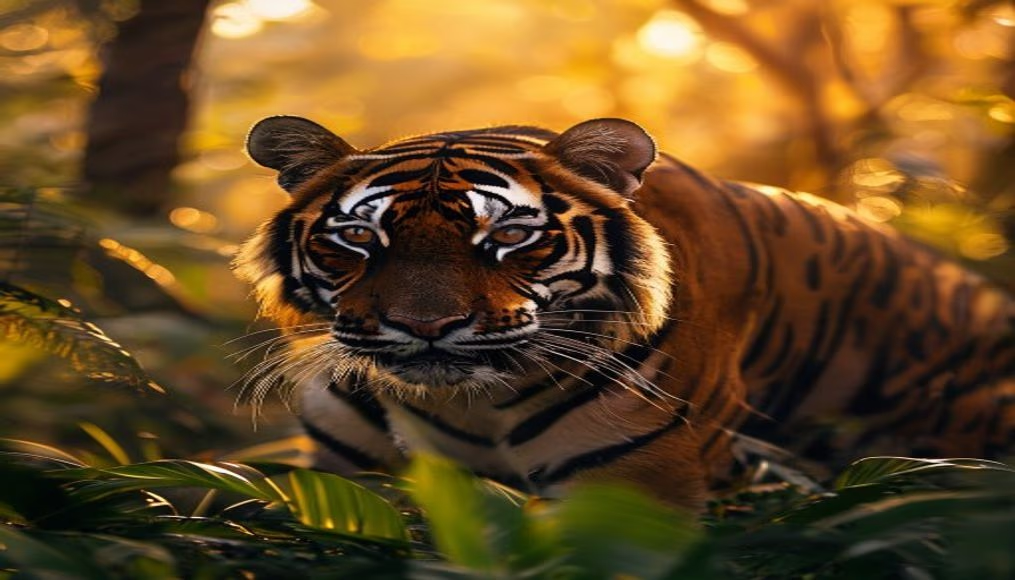
The Bengal tiger, national symbol of India, inhabits tropical forests and mangroves across the Indian subcontinent.
About this subject
The Bengal tiger (Panthera tigris tigris) is the most numerous tiger subspecies, found primarily in India but also in Bangladesh, Nepal, Bhutan, and Myanmar. Its typical habitat includes dense tropical forests, savannas, and the mangrove swamps of the Sundarbans, the world's largest mangrove delta shared between India and Bangladesh. These large felines are solitary and territorial, with home ranges varying from 20 to 100 km² depending on prey availability.
The Bengal tiger's diet consists mainly of medium to large ungulates such as chital, sambar, Asian buffalo, and wild boar. An adult tiger can consume up to 40 kilograms of meat in a single meal, but usually hunts every five to six days. Its dark stripes on an orange coat are unique to each individual, functioning like fingerprints for identification. These tigers are excellent swimmers and often cool off in water bodies during the heat.
Unfortunately, the Bengal tiger is listed as Endangered by the IUCN, with an estimated population of around 2,600 individuals in the wild. Major threats include habitat loss due to deforestation, forest fragmentation, and human-wildlife conflict, as well as illegal poaching for the trade of skins and body parts used in traditional medicine. Conservation projects like Project Tiger in India have helped stabilize some populations, but the species still faces significant challenges.
Culturally, the Bengal tiger holds a prominent place in the Indian subcontinent. It is the national animal of India and Bangladesh, appearing on coins, emblems, and in Hindu mythology where the goddess Durga rides a tiger. In Western literature and film, Bengal tigers are often portrayed as symbols of strength and mystery, notably in Rudyard Kipling's classic "The Jungle Book," featuring the tiger Shere Khan.
Frequently Asked Questions
What is the difference between a Bengal tiger and a Siberian tiger?
The Bengal tiger is smaller and lighter than the Siberian tiger, with narrower stripes and shorter fur. While the Bengal tiger inhabits tropical forests of India, the Siberian tiger lives in the temperate, snowy forests of the Russian Far East.
How many Bengal tigers are left in the wild?
The wild population is estimated at around 2,600 individuals, with India hosting about 70% of them. Numbers have been slowly increasing thanks to conservation efforts.
Can Bengal tigers be found outside India?
Yes, besides India, they occur in Bangladesh, Nepal, Bhutan, and Myanmar. The Sundarbans, shared between India and Bangladesh, harbor a significant population adapted to the mangroves.
Direct URL
https://pub-c7d6a6ea828543ac903a74a341ccb2e1.r2.dev/imagens/bengal-tiger-in-jungle-travel-photography-v10.avifHow to credit
Include a visible link back to UtilizAí. Copy one of the snippets below:
<a href="https://xn--utiliza-eza.com/en/midia/imagens/bengal-tiger-in-jungle-travel-photography-v10">Bengal tiger in jungle</a> by <a href="https://xn--utiliza-eza.com">UtilizAí</a>, licensed under <a href="https://creativecommons.org/licenses/by/4.0/">CC BY 4.0</a>.
[Bengal tiger in jungle](https://xn--utiliza-eza.com/en/midia/imagens/bengal-tiger-in-jungle-travel-photography-v10) by [UtilizAí](https://xn--utiliza-eza.com), CC BY 4.0
License: CC-BY-4.0