Beaker with colored chemicals
1344×768 · AVIF · CC BY 4.0
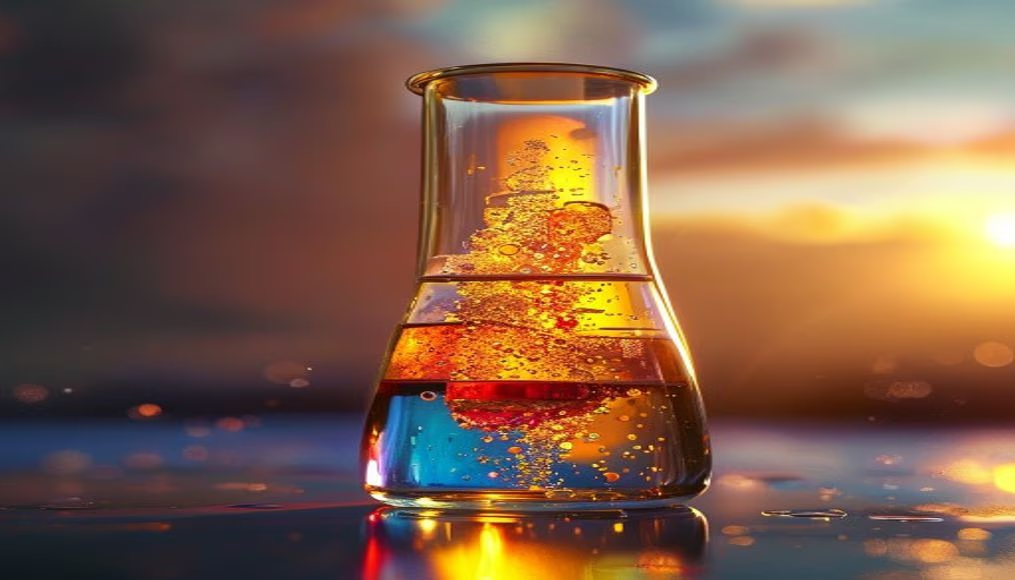
Beaker holds colorful liquids used in chemical experiments to demonstrate reactions and properties.
About this subject
In chemistry laboratories, beakers with colored liquids are common in educational and demonstration experiments. The colors can come from pH indicators like phenolphthalein or bromothymol blue, which change hue depending on the acidity or basicity of the solution. Also frequent is the use of metal salt solutions, such as copper sulfate (blue) or potassium dichromate (orange), which exhibit intense colors due to selective light absorption by metal ions.
A visually striking technique is creating density layers, in which liquids of different densities and colors are carefully stacked without mixing. This can be done with water, oil, alcohol, and dyes, or with saline solutions of varying concentrations. Such experiments illustrate concepts of density, solubility, and polarity.
Beakers are cylindrical containers with a spout, usually made of heat-resistant borosilicate glass. They come in capacities ranging from 50 mL to several liters. Although not as accurate as graduated cylinders or pipettes for volume measurement, they are versatile for mixing, heating, and observing reactions. The transparency of glass allows monitoring of color changes, precipitate formation, or gas release.
Safety precautions are essential when handling colored chemicals, especially if they are toxic or corrosive. Use of gloves, safety goggles, and a lab coat is mandatory. Many colored substances, such as potassium permanganate (purple), can stain skin and clothing, requiring careful handling.
Frequently Asked Questions
Why do some liquids in beakers have different colors?
Colors can come from pH indicators, metal salts, or added dyes. Each substance absorbs specific wavelengths of light, resulting in the color we see.
How to make layered colorful liquids without mixing?
Use liquids of different densities, such as water, oil, and alcohol, adding dyes. Carefully pour the densest liquid first, then less dense ones on top, using a stirring rod to avoid turbulence.
What is the difference between a beaker and an Erlenmeyer flask?
A beaker is cylindrical with a wide mouth and spout, ideal for stirring and heating. An Erlenmeyer flask has a conical shape with a narrow neck, better for titrations and preventing splashes when swirling.
Direct URL
https://pub-c7d6a6ea828543ac903a74a341ccb2e1.r2.dev/imagens/beaker-with-colored-chemicals-travel-photography-v10.avifHow to credit
Include a visible link back to UtilizAí. Copy one of the snippets below:
<a href="https://xn--utiliza-eza.com/en/midia/imagens/beaker-with-colored-chemicals-travel-photography-v10">Beaker with colored chemicals</a> by <a href="https://xn--utiliza-eza.com">UtilizAí</a>, licensed under <a href="https://creativecommons.org/licenses/by/4.0/">CC BY 4.0</a>.
[Beaker with colored chemicals](https://xn--utiliza-eza.com/en/midia/imagens/beaker-with-colored-chemicals-travel-photography-v10) by [UtilizAí](https://xn--utiliza-eza.com), CC BY 4.0
License: CC-BY-4.0