Bacterial colony petri dish
1344×768 · AVIF · CC BY 4.0
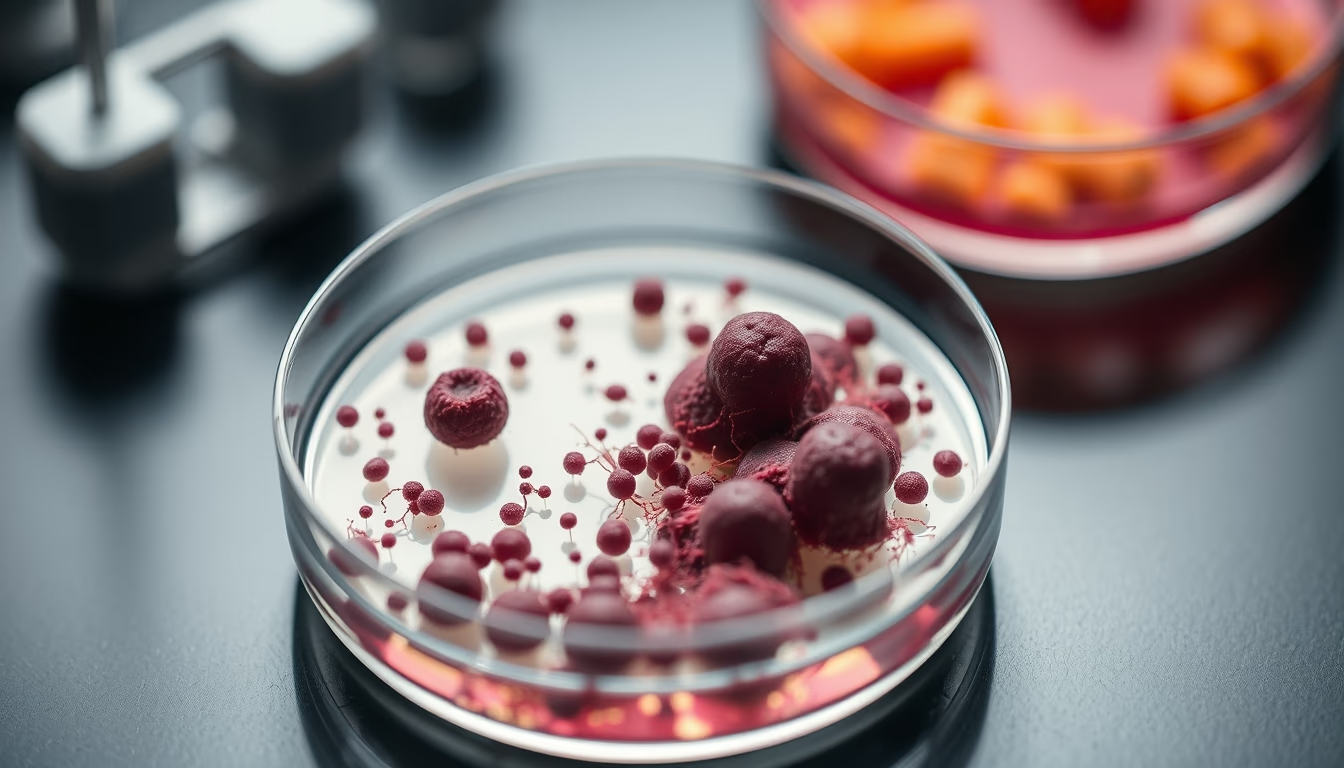
Bacterial colonies on petri dishes are visible clusters of microorganisms, essential for microbiological studies and antibiotic sensitivity testing.
About this subject
Bacterial colonies form when a single bacterial cell lands on a solid culture medium, such as nutrient agar, and multiplies until a visible cluster appears. This process is fundamental in microbiology for isolating and identifying microorganisms, as each colony usually originates from a single cell, allowing pure culture studies and characterization of species.
Colony morphology varies widely: shape (circular, irregular, filamentous), margin (entire, undulate, lobate), elevation (flat, convex, umbonate), color (white, yellow, red due to pigments), and texture (smooth, rough, mucoid). For example, Escherichia coli colonies are smooth and shiny, while Bacillus subtilis colonies are rough and opaque. These features help in presumptive identification.
In the laboratory, colonies are used in antibiotic sensitivity tests, such as the disk diffusion method (Kirby-Bauer), where antibiotic-impregnated disks are placed on the inoculated agar; the diameter of the inhibition zone around the disk indicates susceptibility or resistance. Colony counting on plates (CFU/mL) is employed to quantify microorganisms in food, water, and clinical samples.
Interesting facts: petri dishes are incubated upside down to prevent condensed water droplets from falling onto the agar surface, which could disperse colonies. Selective media like MacConkey agar inhibit Gram-positive bacteria, facilitating isolation of Gram-negatives. Prior sterilization of the medium and aseptic techniques are crucial to avoid contamination.
Frequently Asked Questions
What is a bacterial colony?
A bacterial colony is a cluster of bacteria visible to the naked eye, originating from a single cell that multiplied on a solid culture medium.
How are colonies used in antibiotic tests?
In the disk diffusion test, antibiotic disks are placed on the inoculated plate; the diameter of the inhibition zone around the disk indicates susceptibility.
Why are petri dishes incubated upside down?
To prevent condensed water droplets from falling onto the agar surface, which could disperse colonies and contaminate the experiment.
Direct URL
https://pub-c7d6a6ea828543ac903a74a341ccb2e1.r2.dev/imagens/bacterial-colony-petri-dish-tilt-shift-miniature-p0.avifHow to credit
Include a visible link back to UtilizAí. Copy one of the snippets below:
<a href="https://xn--utiliza-eza.com/en/midia/imagens/bacterial-colony-petri-dish-tilt-shift-miniature-p0">Bacterial colony petri dish</a> by <a href="https://xn--utiliza-eza.com">UtilizAí</a>, licensed under <a href="https://creativecommons.org/licenses/by/4.0/">CC BY 4.0</a>.
[Bacterial colony petri dish](https://xn--utiliza-eza.com/en/midia/imagens/bacterial-colony-petri-dish-tilt-shift-miniature-p0) by [UtilizAí](https://xn--utiliza-eza.com), CC BY 4.0
License: CC-BY-4.0