Amazon rainforest canopy
1344×768 · AVIF · CC BY 4.0
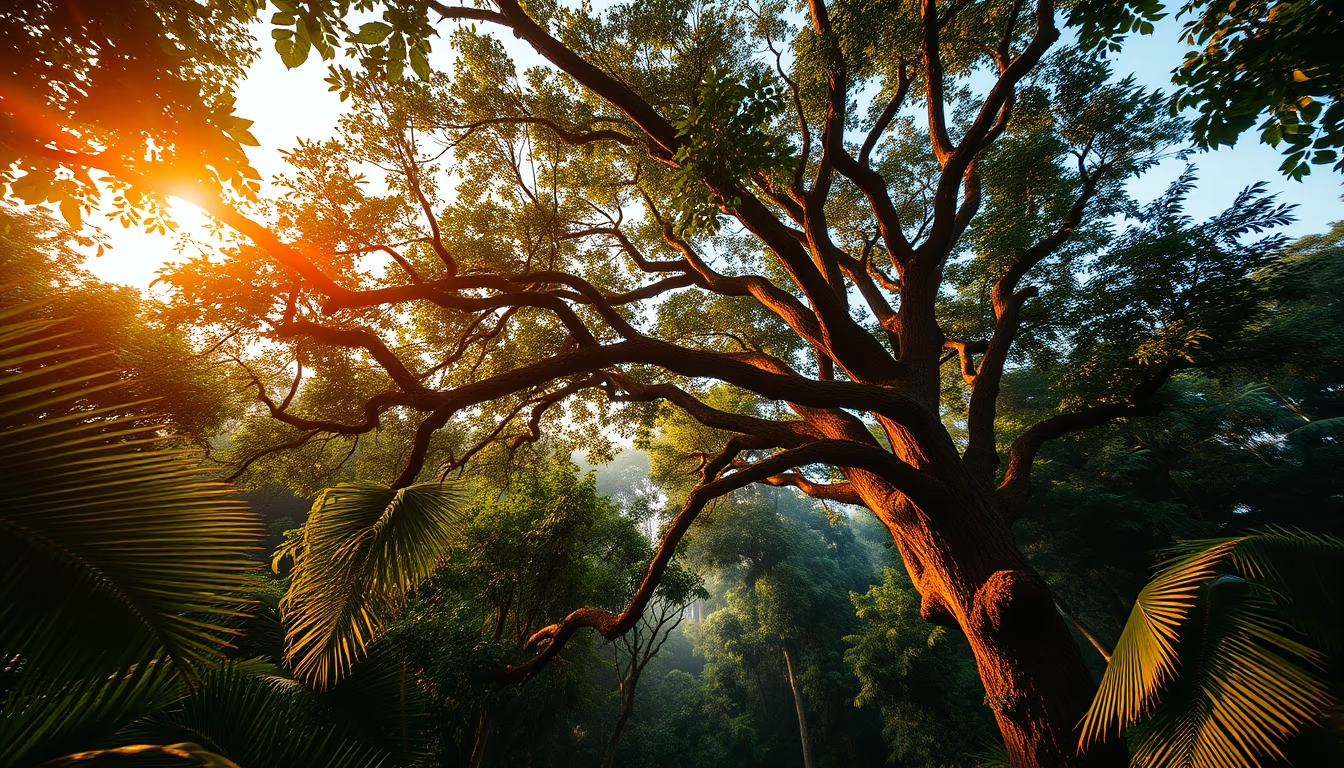
The Amazon rainforest canopy forms a unique and little-explored ecosystem, hosting thousands of species adapted to life in the heights.
About this subject
The Amazon, the world's largest tropical rainforest, covers approximately 5.5 million km² and spans nine South American countries, with about 60% of its area in Brazil. The canopy is the forest's uppermost layer, situated between 30 and 50 meters high, formed by the crowns of the tallest trees. This region receives about 80% of the sunlight that reaches the forest, creating a warm, humid microclimate with temperatures that can exceed 35 °C during the day. It is estimated that the canopy harbors 40% to 70% of all Amazonian biodiversity, including insects, birds, mammals, and epiphytes such as orchids and bromeliads.
Life in the canopy is adapted to extreme conditions: strong winds, high solar exposure, and limited soil water availability. Many plants have developed aerial roots or water storage systems, such as tank bromeliads that form small liquid reservoirs. Animals like sloths, spider monkeys, and macaws spend most of their time in this layer, rarely descending to the ground. Species interactions are intense: pollinators like bees and hummingbirds visit flowers at the top, while frugivorous birds disperse seeds over long distances.
Despite its ecological importance, the Amazon canopy remains one of the least studied environments on the planet. Access is difficult and dangerous, requiring climbing techniques or the use of observation towers and balloons. Recent research, such as that conducted by the Biological Dynamics of Forest Fragments Project (BDFFP), reveals that the canopy is more sensitive to climate change than the understory. Global warming and deforestation fragment this habitat, threatening species that depend exclusively on it. Scientific exploration of the canopy continues to uncover new species and ecological relationships, reinforcing the need for integrated forest conservation across all layers.
Frequently Asked Questions
Why is the Amazon canopy so important for biodiversity?
The canopy concentrates most of the forest's sunlight and food resources, hosting 40% to 70% of Amazonian species. Many are exclusive to this environment, such as certain orchids, bromeliads, and animals adapted to life in the heights.
How do scientists study the Amazon rainforest canopy?
Researchers use observation towers, balloons, drones, and climbing techniques to access the canopy. Projects like the BDFFP (Biological Dynamics of Forest Fragments Project) monitor biodiversity and the effects of climate change in this layer.
Which animals live exclusively in the Amazon canopy?
Examples include the spider monkey (Ateles spp.), the three-toed sloth (Bradypus tridactylus), the hyacinth macaw (Anodorhynchus hyacinthinus), and various frog and lizard species that never descend to the ground.
Direct URL
https://pub-c7d6a6ea828543ac903a74a341ccb2e1.r2.dev/imagens/amazon-rainforest-canopy-cinematic-wide-shot-v2.avifHow to credit
Include a visible link back to UtilizAí. Copy one of the snippets below:
<a href="https://xn--utiliza-eza.com/en/midia/imagens/amazon-rainforest-canopy-cinematic-wide-shot-v2">Amazon rainforest canopy</a> by <a href="https://xn--utiliza-eza.com">UtilizAí</a>, licensed under <a href="https://creativecommons.org/licenses/by/4.0/">CC BY 4.0</a>.
[Amazon rainforest canopy](https://xn--utiliza-eza.com/en/midia/imagens/amazon-rainforest-canopy-cinematic-wide-shot-v2) by [UtilizAí](https://xn--utiliza-eza.com), CC BY 4.0
License: CC-BY-4.0