AI neural network glowing nodes and connections in 3D space
1344×768 · AVIF · CC BY 4.0
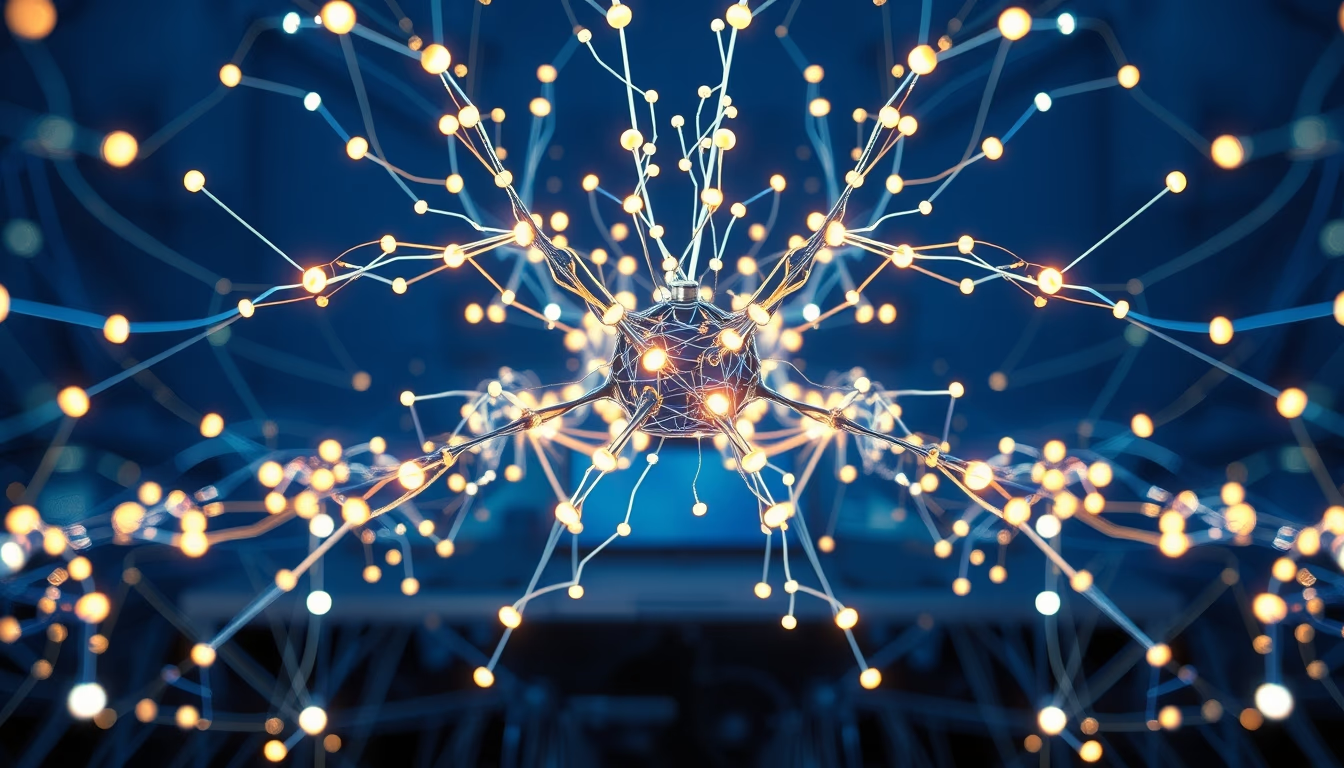
Artificial neural network is a computational model inspired by the brain, with interconnected nodes processing data in layers.
About this subject
Artificial neural networks are the backbone of deep learning, a subfield of artificial intelligence that revolutionized areas like image recognition, natural language processing, and medical diagnostics. Inspired by biological neurons, these networks consist of layers of nodes (artificial neurons) connected by weighted synapses. During training, weights are adjusted to minimize errors through a process called backpropagation.
The first neural network was the Perceptron, created by Frank Rosenblatt in 1958. For decades, progress was limited by computational power, but since the 2010s, with GPUs and large datasets, deep networks became viable. Today, models like GPT and BERT process billions of parameters, while convolutional neural networks (CNNs) are standard in computer vision.
Trivia: the term "neuron" was coined in 1891 by Heinrich Wilhelm Waldeyer, but the mathematical modeling came from McCulloch and Pitts in 1943. Neural networks are also used in finance for fraud detection and in autonomous vehicles for scene segmentation. The most common architecture is feedforward, where data flows from input to output without loops.
Frequently Asked Questions
What is an artificial neural network?
It is a computational model composed of layers of interconnected nodes that process information similarly to the human brain. Each node receives inputs, applies an activation function, and passes the result forward.
How does a neural network learn?
It learns by adjusting the weights of connections between neurons based on training examples. The backpropagation algorithm calculates the error at the output and propagates corrections backward, updating the weights.
What are practical applications of neural networks?
They are used in facial recognition, machine translation, medical imaging, autonomous vehicles, recommendation systems, and even generative art.
Direct URL
https://pub-c7d6a6ea828543ac903a74a341ccb2e1.r2.dev/imagens/ai-neural-network-glowing-nodes-and-connections-in-3d-space-symmetric-composition-twilight-blue-hour.avifHow to credit
Include a visible link back to UtilizAí. Copy one of the snippets below:
<a href="https://xn--utiliza-eza.com/en/midia/imagens/ai-neural-network-glowing-nodes-and-connections-in-3d-space-symmetric-composition-twilight-blue-hour">AI neural network glowing nodes and connections in 3D space</a> by <a href="https://xn--utiliza-eza.com">UtilizAí</a>, licensed under <a href="https://creativecommons.org/licenses/by/4.0/">CC BY 4.0</a>.
[AI neural network glowing nodes and connections in 3D space](https://xn--utiliza-eza.com/en/midia/imagens/ai-neural-network-glowing-nodes-and-connections-in-3d-space-symmetric-composition-twilight-blue-hour) by [UtilizAí](https://xn--utiliza-eza.com), CC BY 4.0
License: CC-BY-4.0