AI neural network glowing nodes and connections in 3D space
1344×768 · AVIF · CC BY 4.0
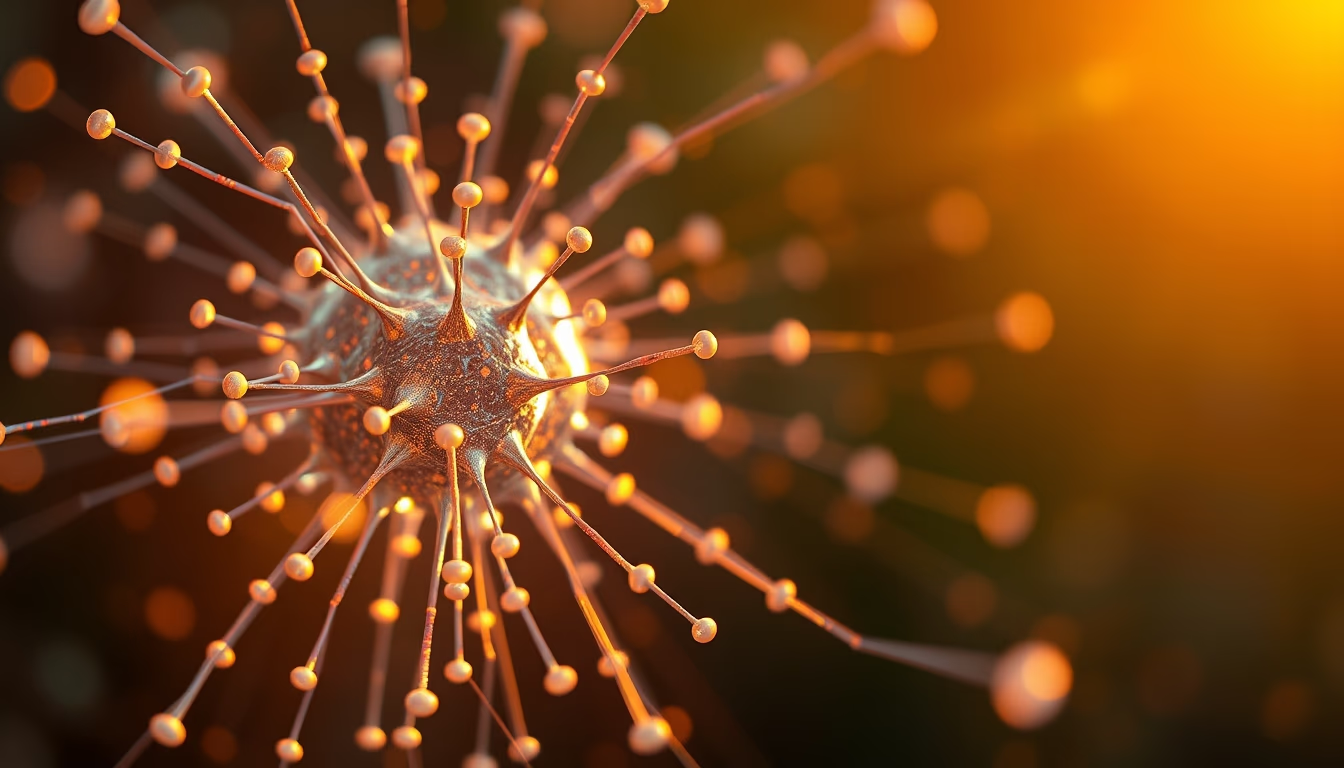
Artificial neural networks are computational models inspired by the human brain, used in machine learning and artificial intelligence.
About this subject
Artificial neural networks (ANNs) are the backbone of deep learning, a subfield of artificial intelligence that has revolutionized areas such as computer vision, natural language processing, and gaming. Inspired by the biological structure of neurons, ANNs consist of layers of interconnected nodes, where each connection has an adjustable weight during training. The concept was introduced in the 1940s with the McCulloch-Pitts model, but gained practical traction in the 2000s with increased computing power and availability of large datasets.
A typical ANN has an input layer, one or more hidden layers, and an output layer. Nodes in each layer are connected to the next via activation functions like ReLU or sigmoid, which introduce nonlinearities. Training occurs via backpropagation, adjusting weights to minimize the error between predicted and actual output. This process is analogous to reinforcement learning in biological systems.
Globally, ANNs are used in recommendation systems (Netflix, YouTube), facial recognition, autonomous cars, and medical diagnostics. In Brazil, research on neural networks is conducted at universities like USP and Unicamp, with applications in precision agriculture and socioeconomic data analysis. Despite advances, challenges such as overfitting, need for large data volumes, and energy consumption still limit adoption.
Interestingly, the term "neural network" was coined by Warren McCulloch and Walter Pitts in 1943, but the first functional perceptron was created by Frank Rosenblatt in 1958. Currently, models like GPT-4 and DALL-E, which use transformer architectures, are examples of ANNs with billions of parameters, capable of generating high-quality text and images.
Frequently Asked Questions
What is an artificial neural network?
It is a computational model inspired by the human brain, consisting of layers of interconnected nodes that learn from data.
How does a neural network learn?
Through training with examples, adjusting connection weights via backpropagation to minimize errors.
What are practical applications of neural networks?
Image recognition, natural language processing, autonomous cars, medical diagnostics, and recommendation systems.
Direct URL
https://pub-c7d6a6ea828543ac903a74a341ccb2e1.r2.dev/imagens/ai-neural-network-glowing-nodes-and-connections-in-3d-space-closeup-macro-shot-golden-hour-late-afternoon.avifHow to credit
Include a visible link back to UtilizAí. Copy one of the snippets below:
<a href="https://xn--utiliza-eza.com/en/midia/imagens/ai-neural-network-glowing-nodes-and-connections-in-3d-space-closeup-macro-shot-golden-hour-late-afternoon">AI neural network glowing nodes and connections in 3D space</a> by <a href="https://xn--utiliza-eza.com">UtilizAí</a>, licensed under <a href="https://creativecommons.org/licenses/by/4.0/">CC BY 4.0</a>.
[AI neural network glowing nodes and connections in 3D space](https://xn--utiliza-eza.com/en/midia/imagens/ai-neural-network-glowing-nodes-and-connections-in-3d-space-closeup-macro-shot-golden-hour-late-afternoon) by [UtilizAí](https://xn--utiliza-eza.com), CC BY 4.0
License: CC-BY-4.0