AI neural network glowing nodes and connections in 3D space
1344×768 · AVIF · CC BY 4.0
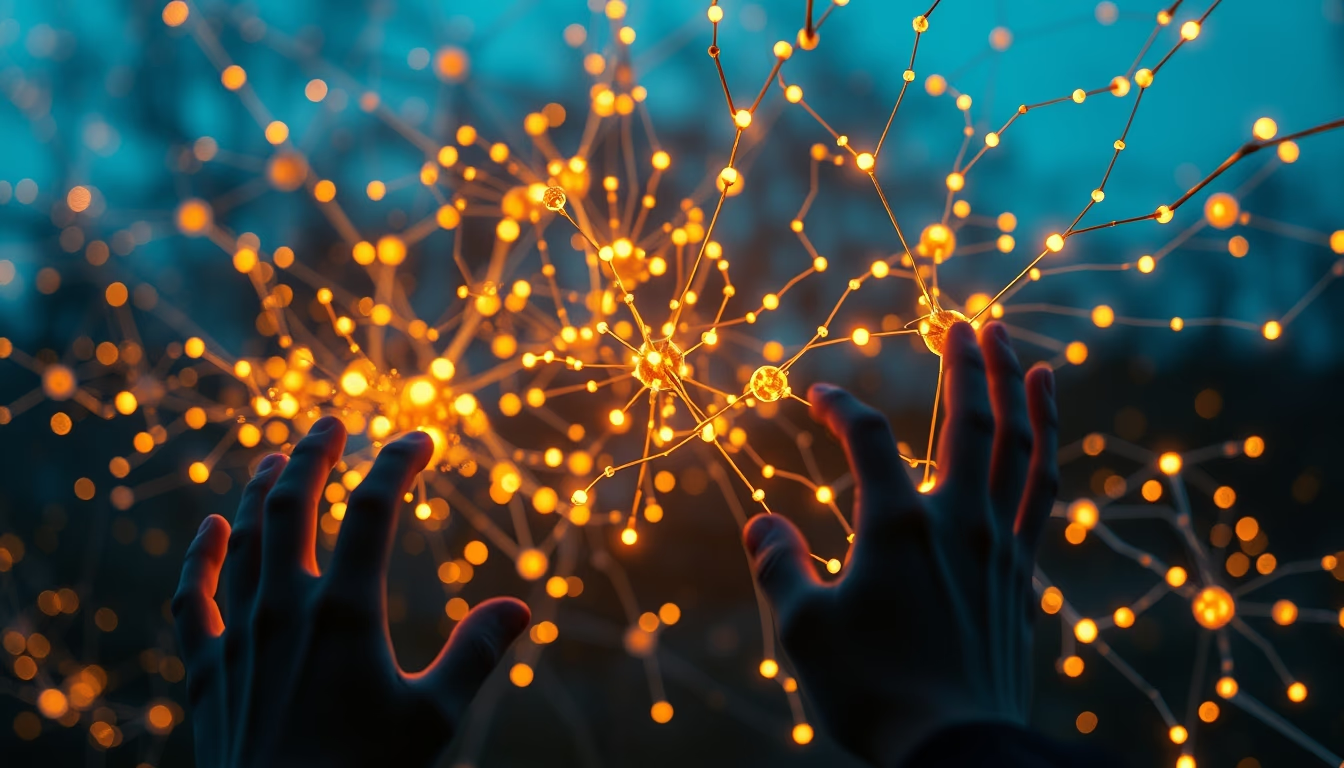
Artificial neural networks are computational systems inspired by the human brain, capable of learning complex patterns from data.
About this subject
Artificial neural networks form the basis of deep learning, a subfield of artificial intelligence that has revolutionized areas such as computer vision, natural language processing, and speech recognition. Inspired by biological neural networks, these networks consist of layers of interconnected nodes, where each connection has an adjustable weight during training. The learning process involves forward and backward propagation of signals, adjusting weights to minimize prediction errors.
Historically, the concept of neural networks dates back to the 1940s with the McCulloch-Pitts neuron model. However, it was only from the 2000s onward, with increased computational power and the availability of large datasets, that deep neural networks became feasible. Advances such as the rectified linear unit (ReLU) and the use of GPUs accelerated training, enabling architectures with dozens or hundreds of layers.
Practical applications range from recommendation systems on streaming platforms to AI-assisted medical diagnostics. Neural networks are also used in autonomous vehicles to detect pedestrians and obstacles, and in virtual assistants to understand voice commands. Despite their power, these networks are often criticized for their lack of interpretability, being called "black boxes." Research in explainable AI seeks to make their processes more transparent.
Interestingly, a typical neural network can contain millions of parameters, requiring large amounts of data and energy for training. The GPT-3 model, for example, has 175 billion parameters and was trained on hundreds of gigabytes of text. This exponential growth raises questions about sustainability and efficiency, driving the development of techniques such as network pruning and quantization.
Frequently Asked Questions
What is an artificial neural network?
It is a computational model inspired by the human brain, composed of layers of interconnected nodes that learn patterns from data by adjusting connection weights during training.
What are the main applications of neural networks?
They are used in image recognition, natural language processing, autonomous vehicles, medical diagnostics, recommendation systems, and virtual assistants, among others.
Why are neural networks considered 'black boxes'?
Because their internal complexity makes it difficult to interpret how they reach a decision, leading to efforts in explainable AI to make their processes more transparent.
Direct URL
https://pub-c7d6a6ea828543ac903a74a341ccb2e1.r2.dev/imagens/ai-neural-network-glowing-nodes-and-connections-in-3d-space-cinematic-wide-shot-twilight-blue-hour.avifHow to credit
Include a visible link back to UtilizAí. Copy one of the snippets below:
<a href="https://xn--utiliza-eza.com/en/midia/imagens/ai-neural-network-glowing-nodes-and-connections-in-3d-space-cinematic-wide-shot-twilight-blue-hour">AI neural network glowing nodes and connections in 3D space</a> by <a href="https://xn--utiliza-eza.com">UtilizAí</a>, licensed under <a href="https://creativecommons.org/licenses/by/4.0/">CC BY 4.0</a>.
[AI neural network glowing nodes and connections in 3D space](https://xn--utiliza-eza.com/en/midia/imagens/ai-neural-network-glowing-nodes-and-connections-in-3d-space-cinematic-wide-shot-twilight-blue-hour) by [UtilizAí](https://xn--utiliza-eza.com), CC BY 4.0
License: CC-BY-4.0