AI neural network glowing nodes and connections in 3D space
1344×768 · AVIF · CC BY 4.0
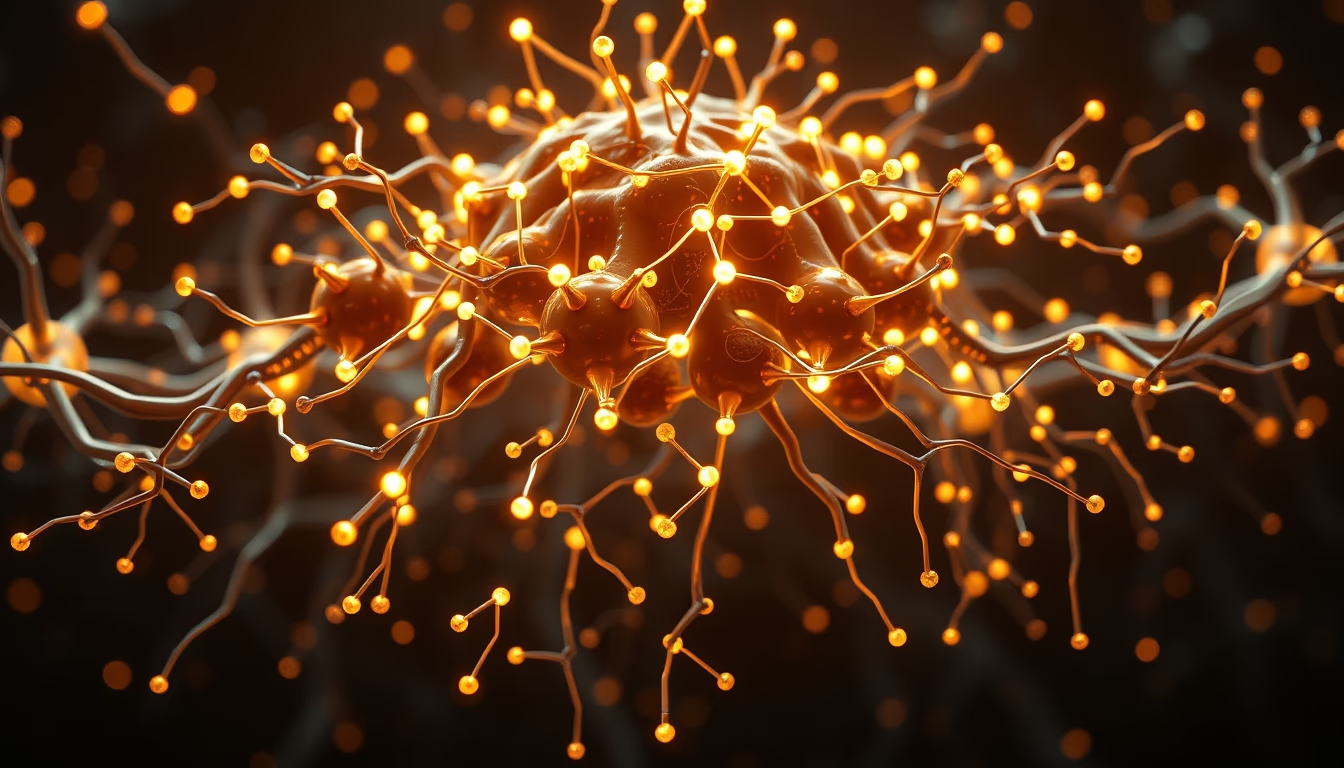
Visual representation of an artificial neural network, with glowing nodes and connections in a 3D space, symbolizing the functioning of modern artificial intelligence.
About this subject
Artificial neural networks are the backbone of deep learning, a subfield of artificial intelligence that has revolutionized fields such as computer vision, natural language processing, and pattern recognition. Inspired by the human brain, these networks consist of layers of interconnected artificial neurons. Each node represents a processing unit that receives inputs, applies weights and activation functions, and transmits signals forward. The connections between nodes have adjustable weights, which are optimized during training through algorithms like backpropagation.
The typical architecture includes an input layer, one or more hidden layers, and an output layer. Deep networks, with many hidden layers, can learn complex hierarchical representations. For example, in image recognition, early layers detect edges and textures, while later layers recognize complete shapes and objects. This process is analogous to what occurs in the human visual cortex.
Training a neural network requires large volumes of data and significant computational power, often using GPUs. During training, the network adjusts its weights to minimize a loss function, which measures the error between predicted outputs and actual values. Techniques such as regularization and dropout help prevent overfitting, ensuring the network generalizes well to new data.
Today, neural networks are applied in recommendation systems, autonomous vehicles, medical diagnostics, and even generative art. The development of architectures like transformers and generative adversarial networks (GANs) has further expanded their capabilities. Despite advances, challenges such as interpretability, algorithmic bias, and energy consumption remain active research areas.
Frequently Asked Questions
What is an artificial neural network?
It is a computational model inspired by the human brain, composed of artificial neurons organized in layers, that learns from data to perform tasks such as classification and regression.
How does a neural network learn?
Through training with labeled data, adjusting connection weights via backpropagation and optimization (e.g., gradient descent) to minimize prediction error.
What are practical applications of neural networks?
They are used in facial recognition, machine translation, medical diagnostics, autonomous vehicles, recommendation systems, and content generation, among others.
Direct URL
https://pub-c7d6a6ea828543ac903a74a341ccb2e1.r2.dev/imagens/ai-neural-network-glowing-nodes-and-connections-in-3d-space-cinematic-wide-shot-studio-professional-lighting.avifHow to credit
Include a visible link back to UtilizAí. Copy one of the snippets below:
<a href="https://xn--utiliza-eza.com/en/midia/imagens/ai-neural-network-glowing-nodes-and-connections-in-3d-space-cinematic-wide-shot-studio-professional-lighting">AI neural network glowing nodes and connections in 3D space</a> by <a href="https://xn--utiliza-eza.com">UtilizAí</a>, licensed under <a href="https://creativecommons.org/licenses/by/4.0/">CC BY 4.0</a>.
[AI neural network glowing nodes and connections in 3D space](https://xn--utiliza-eza.com/en/midia/imagens/ai-neural-network-glowing-nodes-and-connections-in-3d-space-cinematic-wide-shot-studio-professional-lighting) by [UtilizAí](https://xn--utiliza-eza.com), CC BY 4.0
License: CC-BY-4.0