AI neural network glowing nodes and connections in 3D space
1344×768 · AVIF · CC BY 4.0
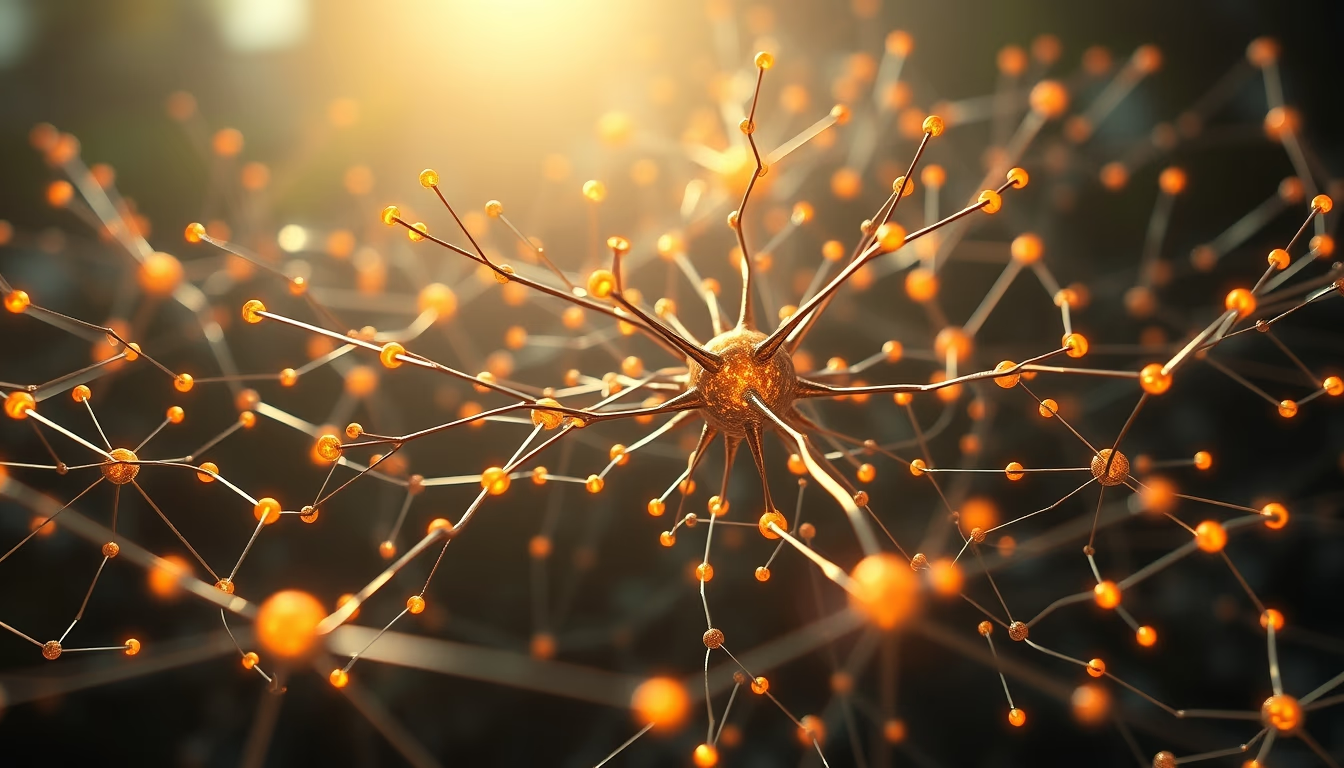
Artificial neural networks are computational models inspired by the human brain, capable of learning complex patterns from data.
About this subject
An artificial neural network is an information processing system composed of interconnected units called neurons, organized in layers. Each connection has a weight that is adjusted during training, allowing the network to learn mappings from inputs to outputs. This concept, inspired by the brain's structure, was formalized in the 1940s by Warren McCulloch and Walter Pitts, but gained practical traction with the advent of large datasets and computational power in recent decades.
Neural networks form the basis of deep learning, which powers applications such as image recognition, natural language processing, and autonomous vehicles. For instance, convolutional neural networks (CNNs) revolutionized computer vision, while recurrent neural networks (RNNs) and transformers transformed machine translation and text generation. Models like GPT and BERT use transformer architectures with millions or billions of parameters.
A key curiosity is that training neural networks requires large labeled datasets and intensive computational resources, such as specialized GPUs. The backpropagation algorithm, which adjusts weights based on error, is the core method. Despite their power, neural networks are often called 'black boxes' due to the difficulty of interpreting their decisions, motivating research in explainable AI (XAI).
Globally, neural networks are used in medical diagnosis, financial forecasting, and recommendation systems. In Brazil, institutions like USP and Unicamp conduct deep learning research applied to problems such as satellite image analysis for agriculture and Portuguese language processing. Ongoing advances promise more efficient and interpretable networks, bringing AI closer to human capabilities.
Frequently Asked Questions
What is an artificial neural network?
It is a computational model inspired by the brain, composed of artificial neurons organized in layers, which learns patterns from data by adjusting connection weights.
How does a neural network learn?
During training, the network receives input-output examples. The error between predicted and actual output is calculated and used by the backpropagation algorithm to adjust weights, minimizing error over iterations.
What are practical applications of neural networks?
They are used in facial recognition, machine translation, autonomous vehicles, medical diagnostics, recommendation systems, and many other areas involving complex pattern recognition.
Direct URL
https://pub-c7d6a6ea828543ac903a74a341ccb2e1.r2.dev/imagens/ai-neural-network-glowing-nodes-and-connections-in-3d-space-cinematic-wide-shot-morning-natural-light.avifHow to credit
Include a visible link back to UtilizAí. Copy one of the snippets below:
<a href="https://xn--utiliza-eza.com/en/midia/imagens/ai-neural-network-glowing-nodes-and-connections-in-3d-space-cinematic-wide-shot-morning-natural-light">AI neural network glowing nodes and connections in 3D space</a> by <a href="https://xn--utiliza-eza.com">UtilizAí</a>, licensed under <a href="https://creativecommons.org/licenses/by/4.0/">CC BY 4.0</a>.
[AI neural network glowing nodes and connections in 3D space](https://xn--utiliza-eza.com/en/midia/imagens/ai-neural-network-glowing-nodes-and-connections-in-3d-space-cinematic-wide-shot-morning-natural-light) by [UtilizAí](https://xn--utiliza-eza.com), CC BY 4.0
License: CC-BY-4.0