AI neural network glowing nodes and connections in 3D space
1344×768 · AVIF · CC BY 4.0
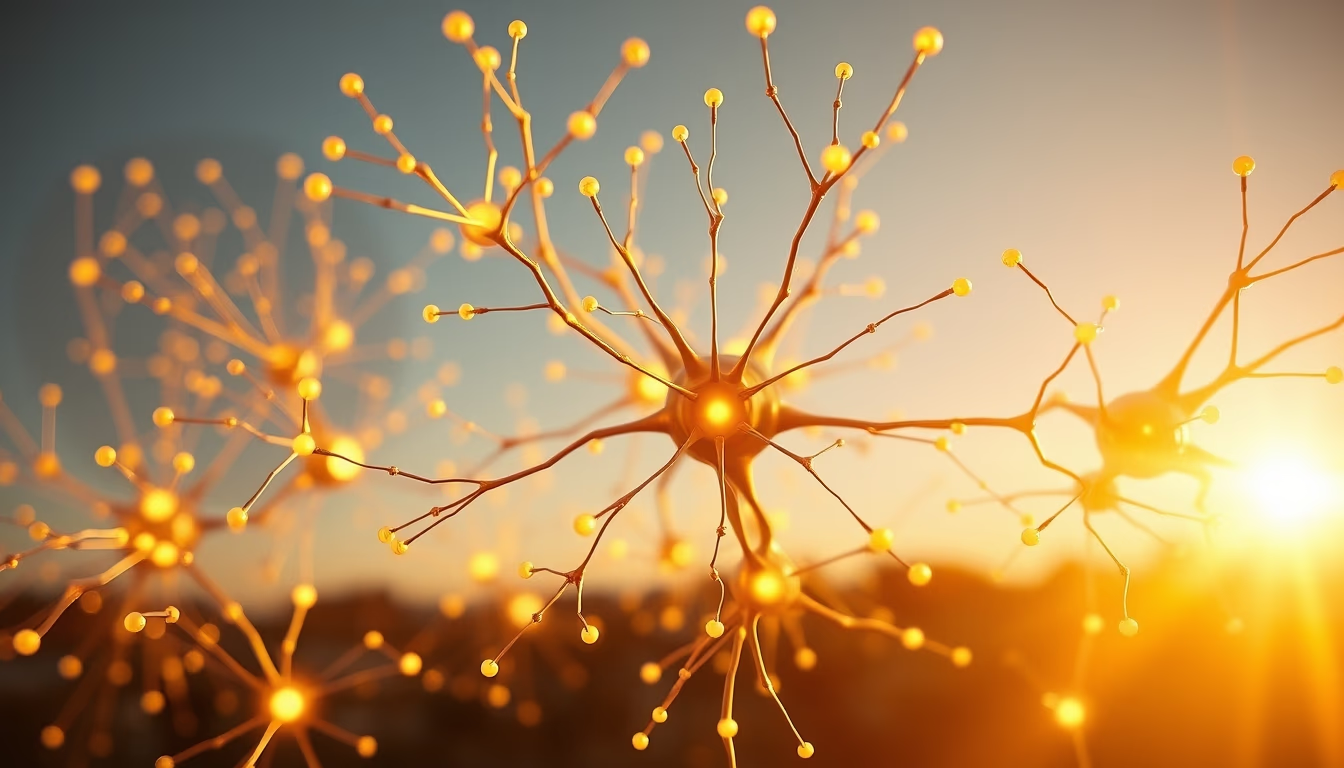
Artificial neural networks mimic the human brain with nodes and connections in 3D structures, revolutionizing computational intelligence.
About this subject
An artificial neural network is a computational model inspired by the biological nervous system. It consists of units called artificial neurons, or nodes, connected via artificial synapses. Each connection has a weight that is adjusted during training, allowing the network to learn complex patterns. In 3D representations, like in this image, nodes are glowing points and connections are luminous lines forming a dynamic web, symbolizing information flow.
Neural networks are essential for deep learning, a subfield of artificial intelligence driving advances in speech recognition, computer vision, and natural language processing. Models such as convolutional neural networks (CNNs) and recurrent neural networks (RNNs) have specific architectures for tasks like image classification and machine translation. 3D visualization of nodes and connections helps researchers understand network topology and identify potential bottlenecks or overfitting.
Historically, the concept of neural networks dates back to the 1940s with the McCulloch-Pitts model. However, it was in the 2010s, with increased computational power and large datasets, that deep neural networks became popular. Today, companies like Google, OpenAI, and Meta use networks with billions of parameters, such as GPT-4 and BERT. The 3D representation with glowing nodes is often used in media and science communication to convey the complexity and transformative potential of the technology.
Frequently Asked Questions
What does each node and connection represent in a neural network?
Each node represents an artificial neuron that processes an input and produces an output. Connections are synapses that transmit signals between neurons, with weights determining transmission strength.
How are neural networks trained?
Training uses algorithms like backpropagation, where the network adjusts connection weights to minimize the error between predicted and actual output, using large labeled datasets.
What is the difference between a shallow and a deep neural network?
Shallow networks have few hidden layers (usually one or two), while deep networks (deep learning) have many layers, enabling learning of hierarchical and more abstract representations.
Direct URL
https://pub-c7d6a6ea828543ac903a74a341ccb2e1.r2.dev/imagens/ai-neural-network-glowing-nodes-and-connections-in-3d-space-cinematic-wide-shot-bright-midday-sun.avifHow to credit
Include a visible link back to UtilizAí. Copy one of the snippets below:
<a href="https://xn--utiliza-eza.com/en/midia/imagens/ai-neural-network-glowing-nodes-and-connections-in-3d-space-cinematic-wide-shot-bright-midday-sun">AI neural network glowing nodes and connections in 3D space</a> by <a href="https://xn--utiliza-eza.com">UtilizAí</a>, licensed under <a href="https://creativecommons.org/licenses/by/4.0/">CC BY 4.0</a>.
[AI neural network glowing nodes and connections in 3D space](https://xn--utiliza-eza.com/en/midia/imagens/ai-neural-network-glowing-nodes-and-connections-in-3d-space-cinematic-wide-shot-bright-midday-sun) by [UtilizAí](https://xn--utiliza-eza.com), CC BY 4.0
License: CC-BY-4.0