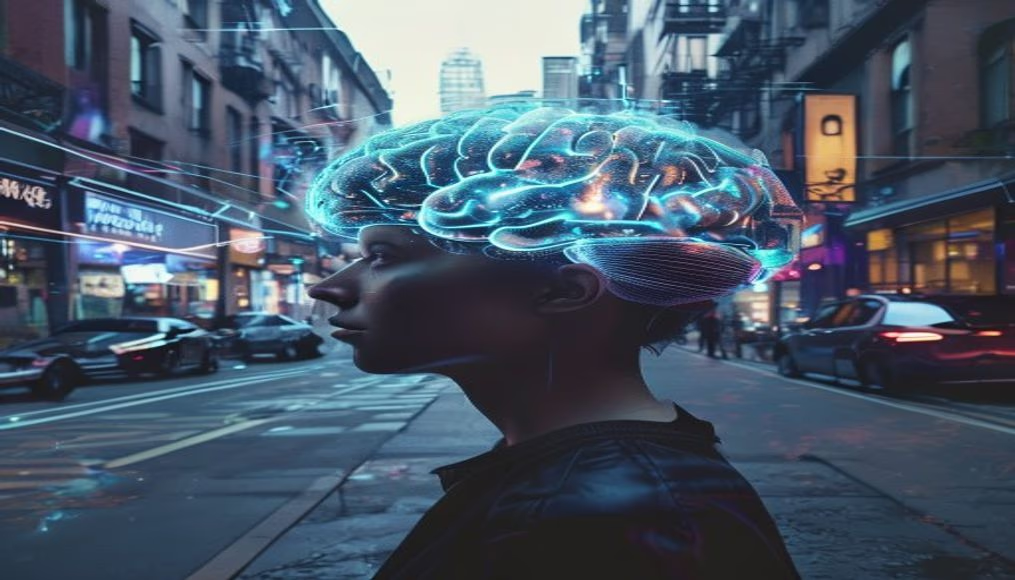
AI neural network 3D visualization
1344×768 · AVIF · CC BY 4.0

Artificial neural networks are computational systems inspired by the human brain, capable of learning complex patterns and revolutionizing fields such as image recognition and natural language processing.
About this subject
Artificial neural networks originated in the 1940s with the studies of McCulloch and Pitts, who modeled a simplified neuron. After a period of low activity, the backpropagation algorithm popularized in the 1980s boosted their application. In the 2010s, the combination of large datasets, GPUs, and deep architectures led to deep learning, making neural networks the foundation of modern artificial intelligence.
These systems consist of layers of artificial neurons, each performing simple mathematical operations. The connections between them have adjustable weights that are optimized during training to minimize errors. Convolutional neural networks (CNNs) specialize in spatial data like images, while recurrent neural networks (RNNs) handle temporal sequences. More recently, transformers revolutionized natural language processing with attention mechanisms.
In Brazil, institutions such as IMPA and USP conduct cutting-edge research on neural networks, applied from satellite image analysis to medical diagnosis. Their importance is evident in virtual assistants, autonomous cars, and recommendation systems. A fun fact is that a typical neural network can have millions of parameters, requiring computational power equivalent to hundreds of GPU hours for complete training.
Despite success, neural networks face challenges such as explainability and bias. Techniques like Grad-CAM help visualize important regions for decisions, while data privacy is ensured through methods like federated learning. The future points to more efficient models, such as spiking neural networks, which mimic the biological brain even more closely.
Frequently Asked Questions
How do neural networks learn?
They adjust the weights of connections between neurons using algorithms like backpropagation, minimizing the error between predicted and actual output.
What is the difference between deep learning and traditional neural networks?
Deep learning uses multiple hidden layers (deep networks) to extract hierarchical features, while shallow networks have few layers.
Do neural networks mimic the human brain?
Inspired by the brain, but simplified. Artificial neurons are linear mathematical models followed by activation functions.
Direct URL
https://pub-c7d6a6ea828543ac903a74a341ccb2e1.r2.dev/imagens/ai-neural-network-3d-visualization-travel-photography-v10.avifHow to credit
Include a visible link back to UtilizAí. Copy one of the snippets below:
<a href="https://xn--utiliza-eza.com/en/midia/imagens/ai-neural-network-3d-visualization-travel-photography-v10">AI neural network 3D visualization</a> by <a href="https://xn--utiliza-eza.com">UtilizAí</a>, licensed under <a href="https://creativecommons.org/licenses/by/4.0/">CC BY 4.0</a>.
[AI neural network 3D visualization](https://xn--utiliza-eza.com/en/midia/imagens/ai-neural-network-3d-visualization-travel-photography-v10) by [UtilizAí](https://xn--utiliza-eza.com), CC BY 4.0
License: CC-BY-4.0