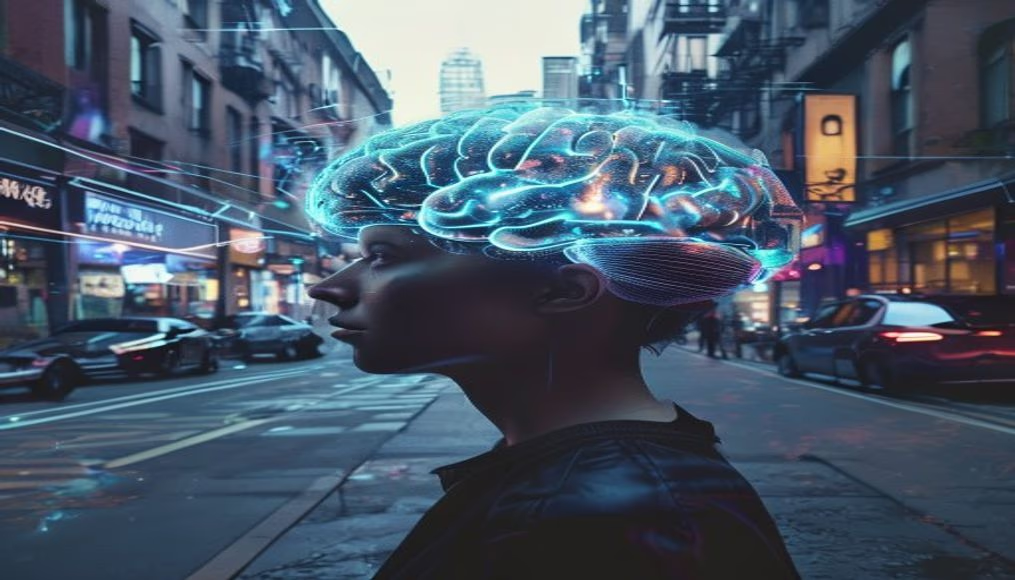
AI neural network 3D visualization
1344×768 · AVIF · CC BY 4.0

Three-dimensional visualization of an artificial neural network, highlighting the complexity and interconnection of deep learning algorithms.
About this subject
Artificial neural networks are computational models inspired by the human brain, capable of learning complex patterns from large volumes of data. A 3D visualization like this one helps to understand the typical architecture of a deep neural network, with multiple hidden layers between input and output. Each node represents an artificial neuron, and each connection a synaptic weight adjusted during training. Deep learning has revolutionized fields such as computer vision, natural language processing, and medical diagnosis, with applications ranging from autonomous cars to recommendation systems.
The three-dimensional representation is not merely aesthetic; it aids researchers and students in visualizing signal propagation and weight distribution in the network. Tools like Google's TensorBoard and Netron can generate similar visualizations from real models. Historically, the concept of neural networks dates back to the 1940s with McCulloch and Pitts, but it was from 2012, with AlexNet, that deep learning gained prominence. Today, networks with billions of parameters, such as OpenAI's GPT-3, demonstrate the scalability of these architectures.
Interestingly, the visual structure of a neural network can resemble brain connectivity maps, but the mathematical principles are distinct. Training involves backpropagation and gradient descent algorithms, which adjust weights to minimize errors. In Brazil, institutions such as the Institute of Mathematical and Computer Sciences (ICMC-USP) and the Federal University of Rio de Janeiro (UFRJ) conduct advanced research on neural networks, contributing to areas like precision agriculture and climate data analysis.
Frequently Asked Questions
What is an artificial neural network?
It is a computational model inspired by the human brain, composed of layers of artificial neurons that learn patterns from data. It uses training algorithms to adjust connections between neurons.
Why is 3D visualization of neural networks important?
3D visualization helps to understand the complexity and hierarchy of layers, as well as to diagnose issues like overfitting and vanishing gradients. It is also useful for educational and research presentations.
Where are neural networks applied today?
They are used in image and speech recognition, machine translation, autonomous vehicles, medical diagnosis, recommendation systems, games, and finance. In Brazil, notable applications include agribusiness and environmental data analysis.
Direct URL
https://pub-c7d6a6ea828543ac903a74a341ccb2e1.r2.dev/imagens/ai-neural-network-3d-visualization-studio-editorial-portrait-v3.avifHow to credit
Include a visible link back to UtilizAí. Copy one of the snippets below:
<a href="https://xn--utiliza-eza.com/en/midia/imagens/ai-neural-network-3d-visualization-studio-editorial-portrait-v3">AI neural network 3D visualization</a> by <a href="https://xn--utiliza-eza.com">UtilizAí</a>, licensed under <a href="https://creativecommons.org/licenses/by/4.0/">CC BY 4.0</a>.
[AI neural network 3D visualization](https://xn--utiliza-eza.com/en/midia/imagens/ai-neural-network-3d-visualization-studio-editorial-portrait-v3) by [UtilizAí](https://xn--utiliza-eza.com), CC BY 4.0
License: CC-BY-4.0