AI engineer training neural network on workstation
1344×768 · AVIF · CC BY 4.0
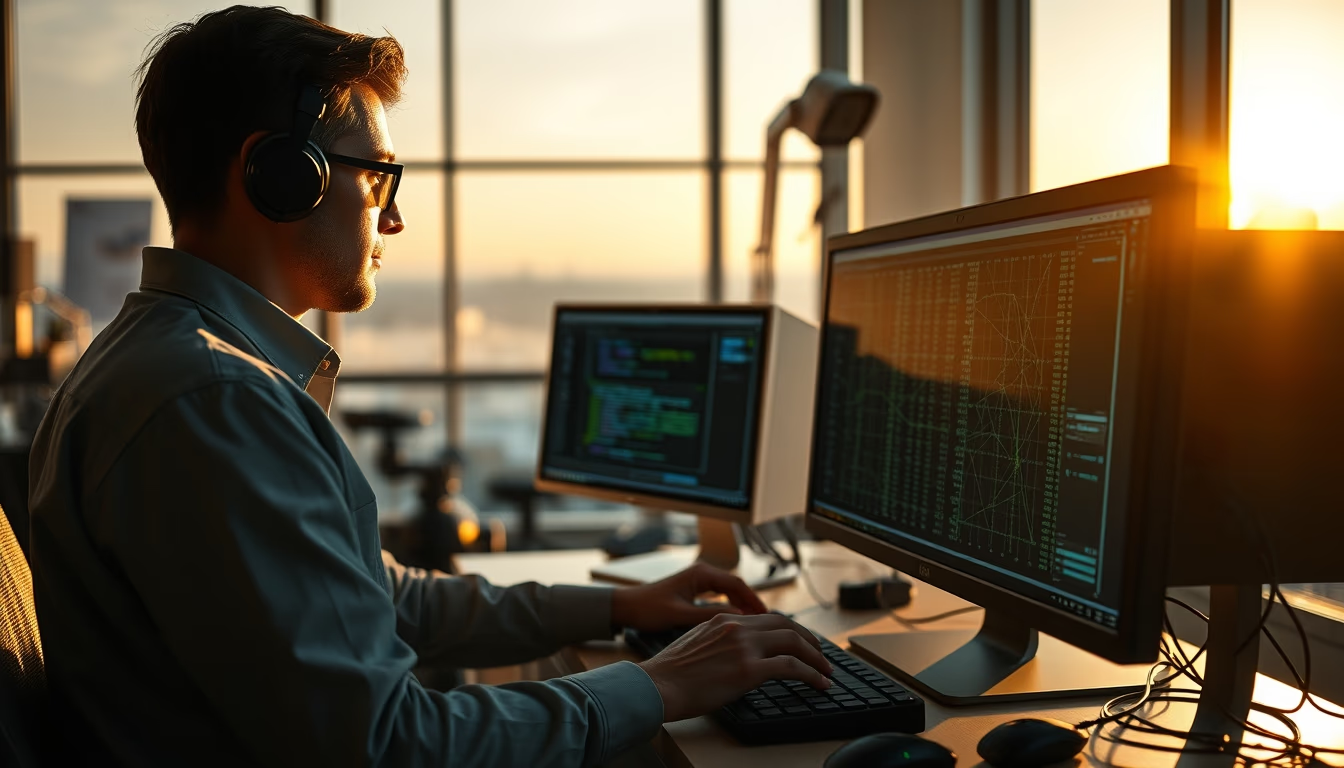
AI engineer trains a neural network on a high-performance workstation in the late afternoon.
About this subject
Training neural networks is a critical step in developing artificial intelligence systems, especially in deep learning. This process involves feeding a model with large volumes of data to adjust its weights and biases, optimizing its ability to make predictions or classifications. Workstations equipped with powerful GPUs, such as the NVIDIA RTX or A100 series, are commonly used by AI engineers to accelerate this computationally intensive task. Hardware choice directly impacts training time: a single GPU can take days to complete, while distributed clusters reduce it to hours.
In Brazil, the use of workstations for AI is growing in research centers like the Institute of Mathematical and Computer Sciences (ICMC-USP) and in tech startups in São Paulo and Belo Horizonte. AI engineers must master frameworks such as TensorFlow, PyTorch, and Keras, along with techniques like regularization and hyperparameter tuning to avoid overfitting. Late afternoon lighting, with indirect natural light, is often cited in ergonomics studies as beneficial for concentration during prolonged analytical tasks.
Interestingly, the term “training” in AI is a biological metaphor: just as a human brain learns from examples, the neural network adjusts its artificial synaptic connections. The energy consumption of a workstation training a large model can reach 500W, equivalent to a microwave oven running continuously. Companies like Google and OpenAI use dedicated server farms, but individual engineers or small teams prefer workstations for rapid prototyping before scaling to the cloud.
Frequently Asked Questions
What is the difference between training a neural network on a workstation and in the cloud?
Workstations offer full hardware control and low latency, ideal for prototyping. The cloud provides elastic scalability with on-demand GPUs, but costs can be high for long training runs. The choice depends on budget and the need for remote collaboration.
How long does it take to train a complex neural network?
It can range from minutes to weeks. Models like GPT-3 took months on thousands of GPUs. On a single-GPU workstation, tasks like image classification with ResNet-50 can take 10 to 20 hours, depending on the dataset.
What skills does an AI engineer need?
Essential skills include programming (Python), mathematics (linear algebra, calculus, probability), deep learning frameworks (TensorFlow, PyTorch), and understanding neural network architectures (CNNs, RNNs, transformers). Experience with hyperparameter optimization and model debugging is also crucial.
Direct URL
https://pub-c7d6a6ea828543ac903a74a341ccb2e1.r2.dev/imagens/ai-engineer-training-neural-network-on-workstation-wide-late-afternoon-6.avifHow to credit
Include a visible link back to UtilizAí. Copy one of the snippets below:
<a href="https://xn--utiliza-eza.com/en/midia/imagens/ai-engineer-training-neural-network-on-workstation-wide-late-afternoon-6">AI engineer training neural network on workstation</a> by <a href="https://xn--utiliza-eza.com">UtilizAí</a>, licensed under <a href="https://creativecommons.org/licenses/by/4.0/">CC BY 4.0</a>.
[AI engineer training neural network on workstation](https://xn--utiliza-eza.com/en/midia/imagens/ai-engineer-training-neural-network-on-workstation-wide-late-afternoon-6) by [UtilizAí](https://xn--utiliza-eza.com), CC BY 4.0
License: CC-BY-4.0