5G antenna tower silhouette against deep blue twilight sky
1344×768 · AVIF · CC BY 4.0
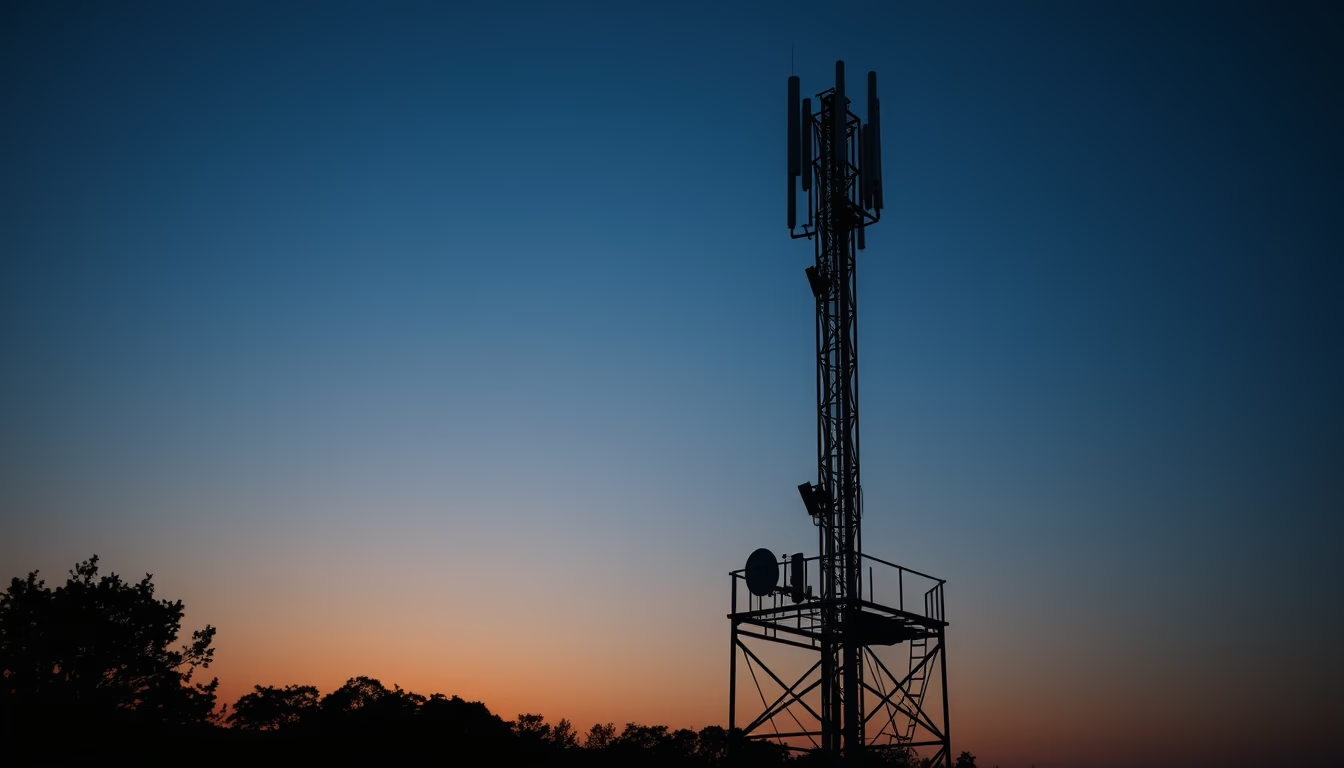
5G antenna tower silhouette against a deep blue twilight sky, symbolizing the new era of mobile connectivity.
About this subject
5G antenna towers form the backbone of the fifth generation of mobile networks, promising download speeds up to 100 times faster than 4G, latency under 1 millisecond, and massive IoT device connectivity. In Brazil, 5G deployment began officially in July 2022 after Anatel's auction, and now covers all state capitals. The tower silhouette against the twilight sky evokes the transition from day to night, paralleling the technological shift that 5G represents.
5G antennas operate in three frequency bands: low (700 MHz), mid (2.3 GHz and 3.5 GHz), and high (26 GHz, known as mmWave). Each has distinct range and penetration characteristics. The most common towers in Brazilian cities use the 3.5 GHz band, balancing coverage and capacity. Unlike 4G antennas, 5G uses beamforming technology, which directs signals to specific devices, increasing efficiency.
Installing these towers faces urban challenges, such as the need for network densification, higher frequencies have shorter range, requiring more antennas. In dense areas, towers are supplemented by small cells on poles and building facades. The deep blue sky in the background corresponds to civil twilight (sun between 0° and 6° below the horizon), a peak time for mobile data usage in Brazil, according to the National Telecommunications Agency.
Technical curiosity: 5G antennas use massive MIMO (Multiple Input Multiple Output), with dozens of antenna elements in a single panel, enabling simultaneous connections to multiple users on the same frequency. This is crucial for supporting events like concerts and games, where thousands of people share the network.
Frequently Asked Questions
What is a 5G antenna and how does it differ from 4G antennas?
A 5G antenna is a device that transmits and receives fifth-generation signals. It differs from 4G antennas by using higher frequencies (such as 3.5 GHz and 26 GHz), beamforming technology, and massive MIMO, enabling higher speeds, lower latency, and the ability to connect more devices simultaneously.
How many 5G antennas are there in Brazil currently?
According to Anatel, as of early 2025, Brazil has over 30,000 licensed 5G stations, concentrated in capitals and metropolitan areas. The goal is to cover all municipalities with more than 30,000 inhabitants by 2029.
Does 5G pose health risks?
According to the World Health Organization and Anatel, 5G frequencies are within internationally established safety limits. There is no scientific evidence proving health damage from exposure to radiofrequency electromagnetic fields within these limits.
Direct URL
https://pub-c7d6a6ea828543ac903a74a341ccb2e1.r2.dev/imagens/5g-antenna-tower-silhouette-against-deep-blue-twilight-sky-wide-late-afternoon-2.avifHow to credit
Include a visible link back to UtilizAí. Copy one of the snippets below:
<a href="https://xn--utiliza-eza.com/en/midia/imagens/5g-antenna-tower-silhouette-against-deep-blue-twilight-sky-wide-late-afternoon-2">5G antenna tower silhouette against deep blue twilight sky</a> by <a href="https://xn--utiliza-eza.com">UtilizAí</a>, licensed under <a href="https://creativecommons.org/licenses/by/4.0/">CC BY 4.0</a>.
[5G antenna tower silhouette against deep blue twilight sky](https://xn--utiliza-eza.com/en/midia/imagens/5g-antenna-tower-silhouette-against-deep-blue-twilight-sky-wide-late-afternoon-2) by [UtilizAí](https://xn--utiliza-eza.com), CC BY 4.0
License: CC-BY-4.0