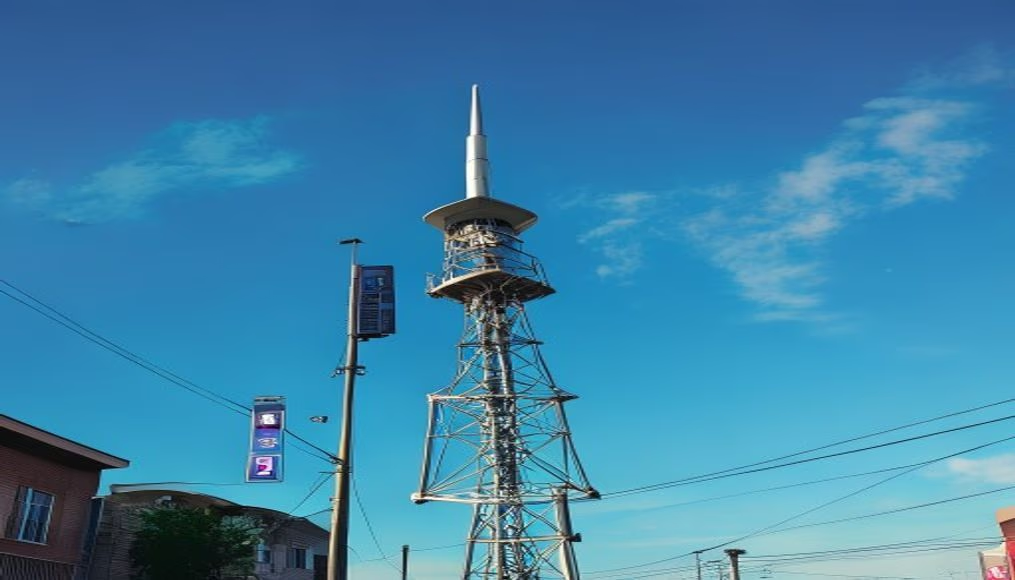
5G antenna tower silhouette against deep blue twilight sky
1344×768 · AVIF · CC BY 4.0

5G antenna tower silhouetted against a deep blue twilight sky, symbolizing the new era of mobile connectivity in Brazil.
About this subject
The silhouette of a 5G antenna tower against a deep blue twilight sky represents the arrival of the fifth generation of mobile networks in Brazil. 5G, which began commercial implementation in the country in 2022 after the National Telecommunications Agency (Anatel) auction, promises download speeds up to 20 times faster than 4G, latency reduced to less than 1 millisecond, and the ability to connect up to 1 million devices per square kilometer. This technology not only enhances user experience in streaming and online gaming but also enables critical applications such as remote surgery, autonomous vehicles, and smart cities.
In Brazil, 5G expansion faces logistical and regulatory challenges. Antenna installation requires careful urban planning, as millimeter-wave signals have shorter range and suffer more interference from physical obstacles, demanding a higher density of towers compared to previous generations. Cities like São Paulo, Rio de Janeiro, and Brasília were the first to receive coverage, but Anatel's goal is to bring 5G to all Brazilian municipalities with over 30,000 inhabitants by 2029. The tower in the image, likely located in an urban area, illustrates the infrastructure needed for this transition.
Interestingly, 5G uses frequency bands previously allocated to satellite TV and radio broadcasts, requiring service migration to free up spectrum. Additionally, the technology relies on fiber optics for backhaul, connecting antennas to data centers. Brazil, with its vast territory, needs significant fiber investments to ensure coverage in remote regions. The tower's silhouette at dusk evokes both technological progress and the promise of digital inclusion, a key objective of the National Internet of Things Plan.
Frequently Asked Questions
What is 5G and how does it differ from 4G?
5G is the fifth generation of mobile networks, offering speeds up to 20 times faster than 4G, latency under 1 ms, and the ability to connect many more devices simultaneously, enabling applications like IoT and remote surgery.
When did 5G start operating in Brazil?
5G was commercially launched in July 2022, after Anatel's auction. Brasília was the first capital to receive the signal, followed by other capitals and gradually inland cities.
What are the challenges for 5G expansion in Brazil?
Main challenges include the need to install more antennas due to shorter signal range, investments in fiber optics for backhaul, and freeing up frequency bands previously used by other services.
Direct URL
https://pub-c7d6a6ea828543ac903a74a341ccb2e1.r2.dev/imagens/5g-antenna-tower-silhouette-against-deep-blue-twilight-sky-documentary-morning-5.avifHow to credit
Include a visible link back to UtilizAí. Copy one of the snippets below:
<a href="https://xn--utiliza-eza.com/en/midia/imagens/5g-antenna-tower-silhouette-against-deep-blue-twilight-sky-documentary-morning-5">5G antenna tower silhouette against deep blue twilight sky</a> by <a href="https://xn--utiliza-eza.com">UtilizAí</a>, licensed under <a href="https://creativecommons.org/licenses/by/4.0/">CC BY 4.0</a>.
[5G antenna tower silhouette against deep blue twilight sky](https://xn--utiliza-eza.com/en/midia/imagens/5g-antenna-tower-silhouette-against-deep-blue-twilight-sky-documentary-morning-5) by [UtilizAí](https://xn--utiliza-eza.com), CC BY 4.0
License: CC-BY-4.0