5G antenna tower silhouette against deep blue twilight sky
1344×768 · AVIF · CC BY 4.0
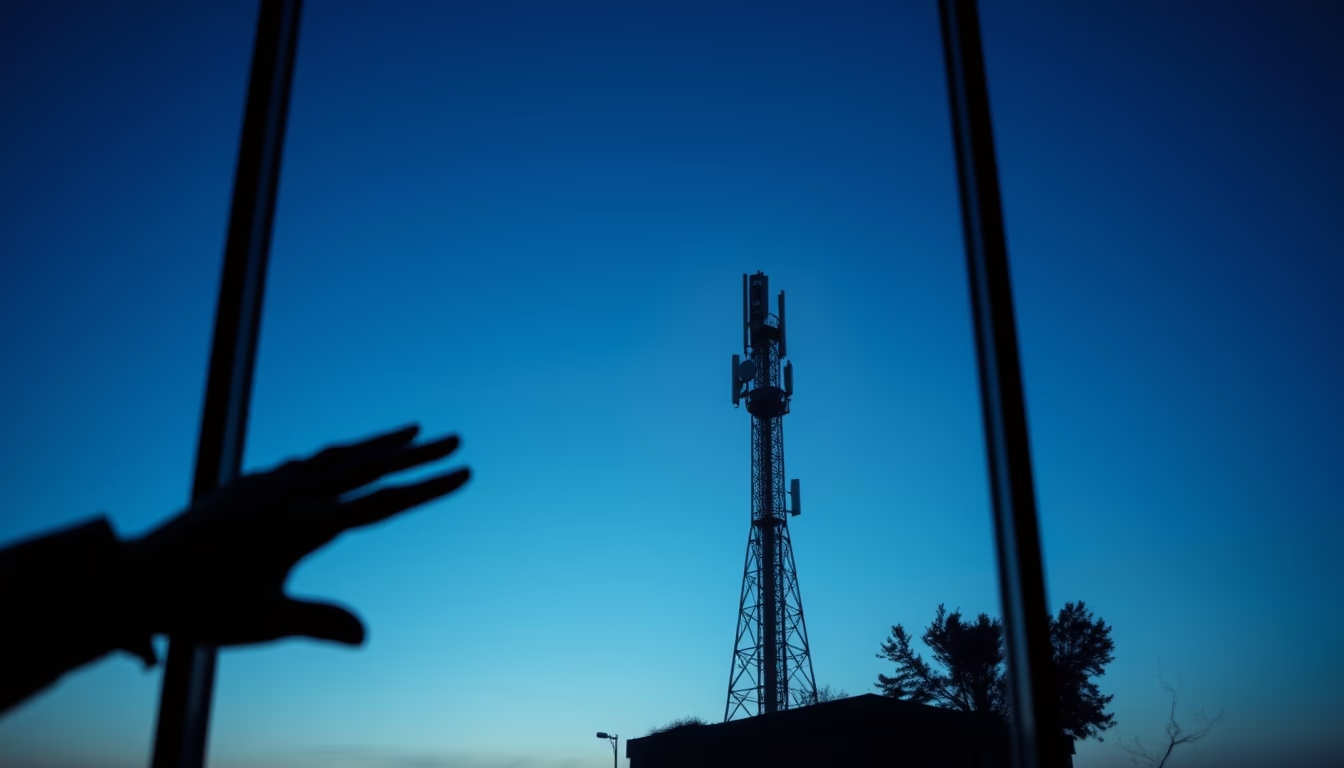
5G antenna tower silhouette against a deep blue twilight sky, symbolizing the new era of connectivity.
About this subject
5G antenna towers form the backbone of fifth-generation mobile networks, offering download speeds up to 100 times faster than 4G and latency under 1 millisecond. Unlike traditional antennas, 5G stations use millimeter waves (mmWave) that require a higher density of towers due to shorter range and lower penetration through obstacles. Thus, they are commonly seen on lampposts, building facades, and dedicated towers in urban areas.
Commercial 5G deployment began in 2019, with South Korea, the United States, and China leading the rollout. In Brazil, the technology was activated in 2022 after an Anatel auction and now covers all state capitals. The deep blue twilight sky in the background contrasts with the tower's silhouette, highlighting its sleek and discreet design, often camouflaged to minimize visual impact.
Fun fact: 5G antennas consume up to 40% less energy per bit transmitted than 4G, contributing to network energy efficiency. Moreover, the network supports up to 1 million devices per km², enabling the Internet of Things (IoT) on a large scale, from autonomous vehicles to smart cities. The silhouette at dusk evokes the transition to a hyperconnected future.
Frequently Asked Questions
What is the difference between 5G and 4G antennas?
5G antennas operate at higher frequencies (millimeter waves), enabling higher speeds and lower latency, but with shorter range. Therefore, they require more towers placed closer together, unlike 4G antennas that cover larger areas with fewer units.
Is 5G harmful to health?
There is no scientific evidence that 5G causes health harm. The waves used are non-ionizing and follow exposure limits set by organizations such as WHO and national regulators, well below dangerous levels.
Why are so many 5G towers being installed?
Due to the use of millimeter waves, the 5G signal has a shorter range and suffers more interference from obstacles. To ensure continuous coverage, operators need to install a larger number of antennas in strategic locations, such as lampposts and building tops.
Direct URL
https://pub-c7d6a6ea828543ac903a74a341ccb2e1.r2.dev/imagens/5g-antenna-tower-silhouette-against-deep-blue-twilight-sky-documentary-morning-2.avifHow to credit
Include a visible link back to UtilizAí. Copy one of the snippets below:
<a href="https://xn--utiliza-eza.com/en/midia/imagens/5g-antenna-tower-silhouette-against-deep-blue-twilight-sky-documentary-morning-2">5G antenna tower silhouette against deep blue twilight sky</a> by <a href="https://xn--utiliza-eza.com">UtilizAí</a>, licensed under <a href="https://creativecommons.org/licenses/by/4.0/">CC BY 4.0</a>.
[5G antenna tower silhouette against deep blue twilight sky](https://xn--utiliza-eza.com/en/midia/imagens/5g-antenna-tower-silhouette-against-deep-blue-twilight-sky-documentary-morning-2) by [UtilizAí](https://xn--utiliza-eza.com), CC BY 4.0
License: CC-BY-4.0