5G antenna tower silhouette against deep blue twilight sky
1344×768 · AVIF · CC BY 4.0
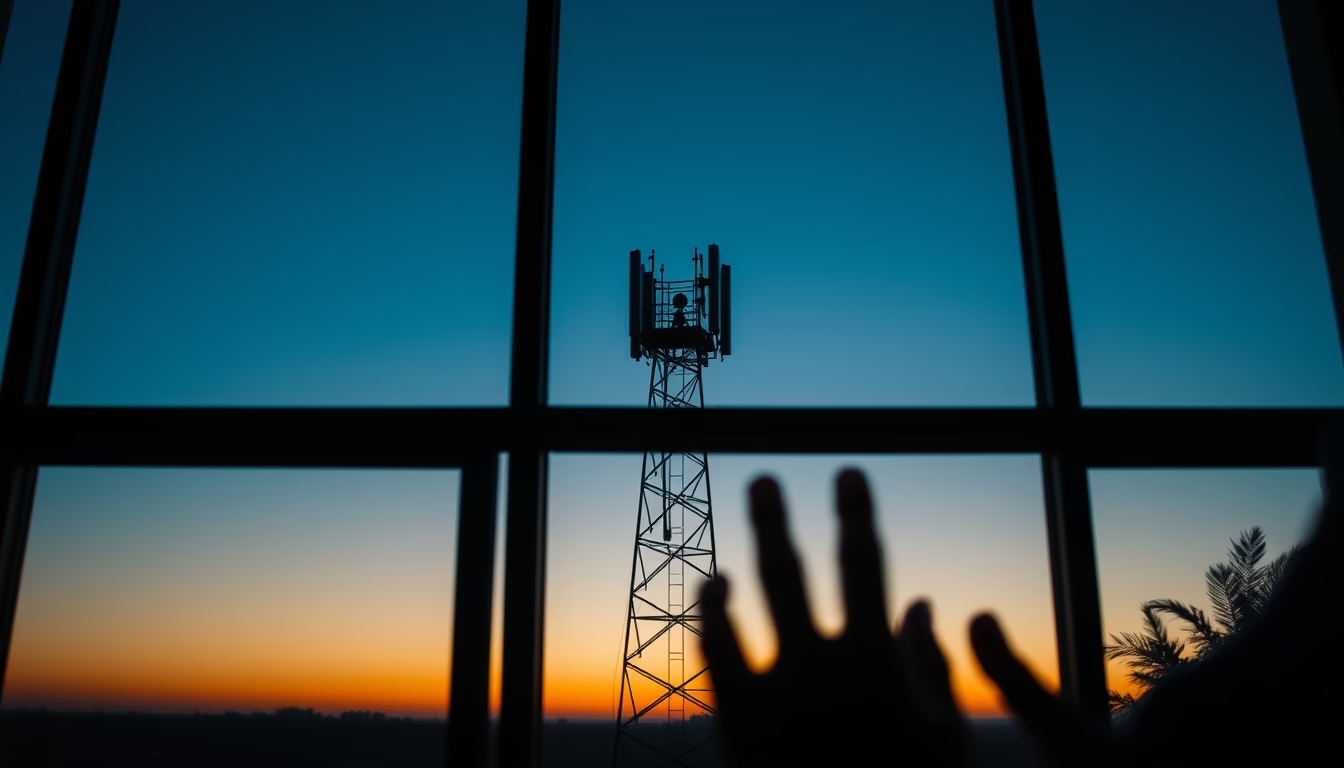
A 5G antenna tower silhouetted against a deep blue twilight sky, symbolizing the new era of mobile connectivity in Brazil and worldwide.
About this subject
5G technology represents the fifth generation of mobile networks, offering download speeds up to 20 Gbps, latency under 1 millisecond, and the capacity to connect up to 1 million devices per square kilometer. In Brazil, the frequency band auction for 5G took place in November 2021, and commercial activation began in July 2022, initially in capitals such as Brasília, São Paulo, and Belo Horizonte. The infrastructure requires the installation of thousands of new antennas, known as small cells, which complement traditional towers to ensure coverage in dense areas.
The silhouette of a 5G antenna tower against the night sky evokes the transition to a hyperconnected society, where the Internet of Things (IoT), autonomous vehicles, and remote surgeries become reality. Unlike previous generations, 5G uses millimeter waves (mmWave) and beamforming, directing the signal to specific devices, which requires line-of-sight and a higher density of antennas. Therefore, it is common to see towers installed on lampposts, building facades, and traffic lights.
Interestingly, the first commercial 5G networks were launched in South Korea and the United States in 2019. In Brazil, Anatel established coverage targets requiring operators to install antennas in all cities with more than 30,000 inhabitants by 2029. Despite advances, challenges such as the need for fiber optic backhaul and resistance from some municipalities to tower installation persist. The image of a tower at dusk symbolizes both technological progress and controversies over public health and visual impact, recurring themes in public hearings.
Frequently Asked Questions
What is needed for 5G to work in a region?
Specific 5G antennas connected by fiber optic backhaul are required, along with frequency band allocation by the regulator (Anatel in Brazil). Operators also need municipal permits to install the towers.
Will 5G completely replace 4G?
No. 5G complements 4G, which will continue to operate for many years. 4G devices will still work normally but will not access 5G speeds and features.
Do 5G antennas pose health risks?
According to the World Health Organization and Anatel, 5G antennas operate within safe limits of electromagnetic field exposure. Studies continue, but so far there is no evidence of health risks.
Direct URL
https://pub-c7d6a6ea828543ac903a74a341ccb2e1.r2.dev/imagens/5g-antenna-tower-silhouette-against-deep-blue-twilight-sky-documentary-morning.avifHow to credit
Include a visible link back to UtilizAí. Copy one of the snippets below:
<a href="https://xn--utiliza-eza.com/en/midia/imagens/5g-antenna-tower-silhouette-against-deep-blue-twilight-sky-documentary-morning">5G antenna tower silhouette against deep blue twilight sky</a> by <a href="https://xn--utiliza-eza.com">UtilizAí</a>, licensed under <a href="https://creativecommons.org/licenses/by/4.0/">CC BY 4.0</a>.
[5G antenna tower silhouette against deep blue twilight sky](https://xn--utiliza-eza.com/en/midia/imagens/5g-antenna-tower-silhouette-against-deep-blue-twilight-sky-documentary-morning) by [UtilizAí](https://xn--utiliza-eza.com), CC BY 4.0
License: CC-BY-4.0