5G antenna tower silhouette against deep blue twilight sky
1344×768 · AVIF · CC BY 4.0
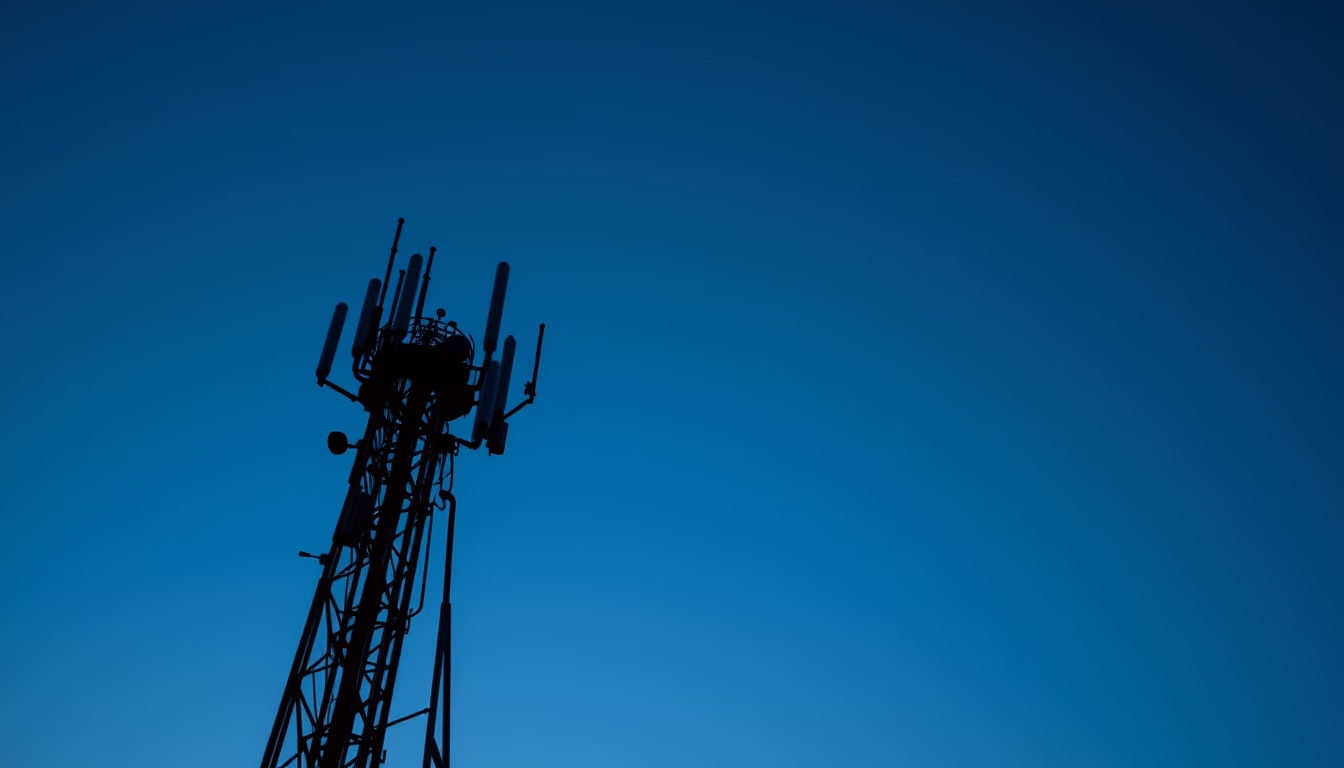
5G antenna tower silhouette against deep blue twilight sky, symbolizing the expansion of high-speed mobile connectivity in Brazil.
About this subject
5G technology represents the fifth generation of mobile networks, offering download speeds up to 20 Gbps and latency below 1 millisecond. This evolution enables advances in areas such as the Internet of Things (IoT), autonomous vehicles, and telemedicine. In Brazil, 5G implementation officially began in July 2022, following the frequency band auction by Anatel in 2021. The 3.5 GHz band, ideal for balancing coverage and capacity, was the main one allocated for standalone 5G. Major urban centers like São Paulo, Rio de Janeiro, and Brasília were the first to receive the technology, with plans to expand to all state capitals by 2029. The 5G antenna tower, seen in silhouette at dusk, is a common element in the modern urban landscape, representing the infrastructure needed to support growing data traffic. Unlike 4G antennas, 5G base stations use beamforming and massive MIMO to direct signals more efficiently. The deep blue twilight sky in the background is not merely aesthetic; the sky color indicates stable weather conditions, ideal for the propagation of millimeter waves used by 5G, which are more susceptible to obstacles like rain and fog. Studies show that the density of 5G antennas per square kilometer can be up to 10 times higher than 4G, due to the shorter range of higher frequencies. This explains why we see more towers in urban areas. Additionally, 5G promises to reduce energy consumption per transmitted bit by up to 90%, contributing to the sustainability of telecommunications networks.
Frequently Asked Questions
What differentiates 5G from 4G in terms of speed?
5G offers theoretical download speeds of up to 20 Gbps, while 4G reaches a maximum of 1 Gbps. In practice, 5G can be 10 to 100 times faster than 4G, depending on implementation.
How many 5G antennas are there in Brazil?
As of 2023, Brazil had over 10,000 licensed 5G antennas, mainly concentrated in capital cities. The goal is to reach 50,000 antennas by 2025, according to the Brazilian Association of Telecommunications Infrastructure (Abrint).
Does 5G work in rural areas?
Yes, but with limitations. Higher frequencies (e.g., 26 GHz) have short range, ideal for dense areas. For rural zones, 5G can use lower bands (e.g., 700 MHz) for wider coverage, though with reduced speeds.
Direct URL
https://pub-c7d6a6ea828543ac903a74a341ccb2e1.r2.dev/imagens/5g-antenna-tower-silhouette-against-deep-blue-twilight-sky-closeup-twilight.avifHow to credit
Include a visible link back to UtilizAí. Copy one of the snippets below:
<a href="https://xn--utiliza-eza.com/en/midia/imagens/5g-antenna-tower-silhouette-against-deep-blue-twilight-sky-closeup-twilight">5G antenna tower silhouette against deep blue twilight sky</a> by <a href="https://xn--utiliza-eza.com">UtilizAí</a>, licensed under <a href="https://creativecommons.org/licenses/by/4.0/">CC BY 4.0</a>.
[5G antenna tower silhouette against deep blue twilight sky](https://xn--utiliza-eza.com/en/midia/imagens/5g-antenna-tower-silhouette-against-deep-blue-twilight-sky-closeup-twilight) by [UtilizAí](https://xn--utiliza-eza.com), CC BY 4.0
License: CC-BY-4.0