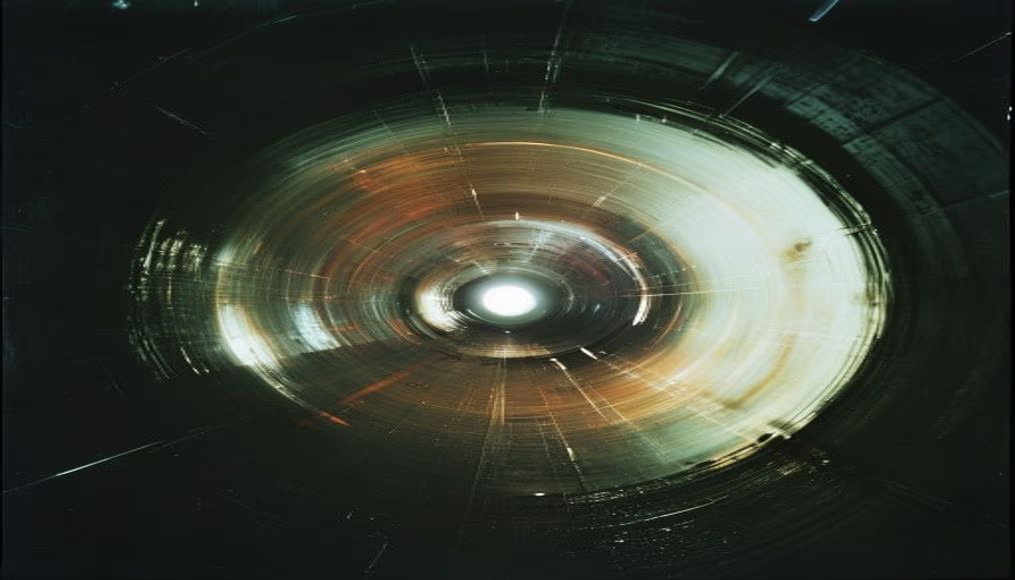
White dwarf star fading
1344×768 · AVIF · CC BY 4.0

White dwarfs are the collapsed cores of Sun-like stars, gradually cooling and fading over billions of years.
About this subject
A white dwarf is the remnant of a moderate-mass star like the Sun after it exhausts its nuclear fuel. In its final phase, the star expels its outer layers, forming a planetary nebula, while the core collapses under gravity into an extremely dense object. A teaspoon of white dwarf matter would weigh several tons. These stars are supported by electron degeneracy pressure, a quantum effect that prevents further collapse.
White dwarfs are initially very hot, with surface temperatures exceeding 100,000 K, but they have no internal energy source, so they gradually cool by radiating heat into space. This cooling process can take billions of years. Eventually, a white dwarf becomes a black dwarf, a cold, dark object, but the universe is thought not yet old enough for any white dwarf to have reached that stage. The oldest known white dwarf is about 11 billion years old and is still relatively hot.
The most famous white dwarf is Sirius B, the companion of Sirius, the brightest star in the night sky. Discovered in 1862, Sirius B was one of the first white dwarfs identified and helped confirm theories about these objects. Another notable white dwarf is Van Maanen's Star, about 14 light-years away. It is estimated that 97% of stars in the Milky Way, including the Sun, will end their lives as white dwarfs. Studying these objects is fundamental to understanding stellar evolution and physics under extreme conditions.
Frequently Asked Questions
How does a white dwarf form?
A white dwarf forms when a moderate-mass star (up to about 8 solar masses) exhausts its nuclear fuel. The core collapses under gravity while the outer layers are ejected, forming a planetary nebula. What remains is a dense, hot core: the white dwarf.
How long does it take for a white dwarf to cool?
The cooling of a white dwarf is extremely slow, taking billions of years. They transition from white (hot) to redder hues and eventually become black dwarfs, but the universe is not old enough for any to have formed yet.
What happens when a white dwarf cools down?
When a white dwarf completely cools, it becomes a black dwarf, a dark, cold object that emits no significant light or heat. However, since this process takes longer than the current age of the universe, no black dwarfs exist yet.
Direct URL
https://pub-c7d6a6ea828543ac903a74a341ccb2e1.r2.dev/imagens/white-dwarf-star-fading-studio-editorial-portrait-p5.avifHow to credit
Include a visible link back to UtilizAí. Copy one of the snippets below:
<a href="https://xn--utiliza-eza.com/en/midia/imagens/white-dwarf-star-fading-studio-editorial-portrait-p5">White dwarf star fading</a> by <a href="https://xn--utiliza-eza.com">UtilizAí</a>, licensed under <a href="https://creativecommons.org/licenses/by/4.0/">CC BY 4.0</a>.
[White dwarf star fading](https://xn--utiliza-eza.com/en/midia/imagens/white-dwarf-star-fading-studio-editorial-portrait-p5) by [UtilizAí](https://xn--utiliza-eza.com), CC BY 4.0
License: CC-BY-4.0