Watercolor wet pigment
1344×768 · AVIF · CC BY 4.0
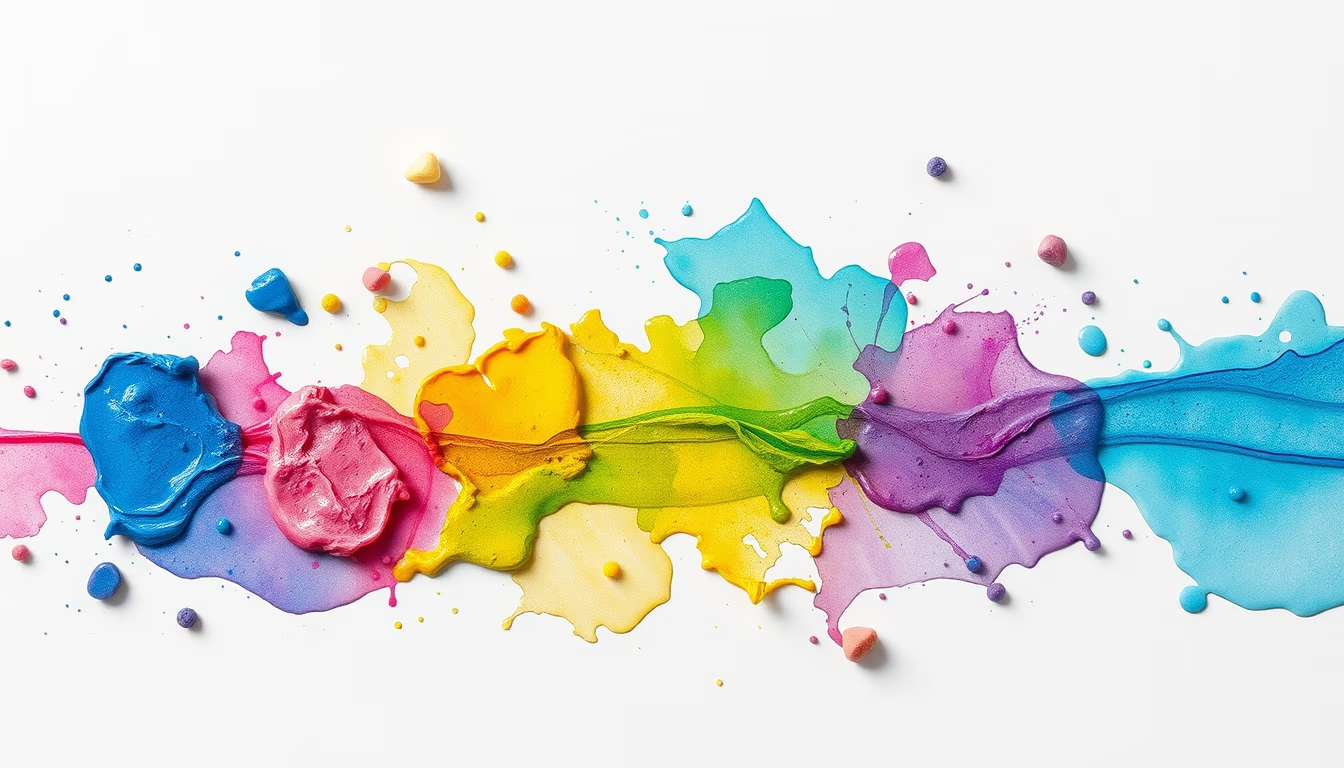
How watercolor pigment behaves while still wet, revealing color nuances and texture.
About this subject
Watercolor technique heavily relies on the behavior of wet pigment on paper. When the paint is moist, pigment particles disperse in water, creating smooth gradients and unpredictable blends. This fluid state allows the artist to control saturation and transparency, unique features of watercolor. Wet pigment also reacts to the angle of the paper, forming puddles and veins that can be intentionally manipulated for organic effects.
Historically, watercolor gained prominence in the 18th century with English artists like J.M.W. Turner, who exploited the luminosity obtained by layering thin, wet washes. In Brazil, the technique was adopted by 19th-century naturalist travelers, such as the German Johann Moritz Rugendas, to record tropical flora and fauna. The local humid climate even influences drying time and how pigments set.
Chemically, watercolor pigments are suspended in a water-soluble binder, usually gum arabic. When wet, water molecules separate pigment particles, increasing light reflection and creating a sense of transparency. As water evaporates, pigment fixes into paper fibers, retaining final color. Professional artists often use high-granulation pigments to create textures that only appear when wet.
A practical curiosity: the wet-on-wet technique involves applying pigment onto an already damp surface, producing soft, diffused edges. The wet-on-dry technique allows more control and defined contours. Working time with wet pigment varies according to paper weight, ambient humidity, and water amount. Cold-pressed papers absorb water more slowly, extending the manipulation window.
Frequently Asked Questions
How long does it take for watercolor to dry completely?
Drying time ranges from minutes to hours, depending on air humidity, paper weight, and water amount. In dry climates, it may dry in 5-10 minutes; in humid conditions, over 30 minutes.
Why do some watercolors appear grainy when dry?
Graining occurs when heavier pigment particles settle into paper fibers as water evaporates. This is common in colors like ultramarine and ochre, and is intentional for texture.
Can watercolor paint be reactivated after drying?
Yes, watercolor is rewettable with water even after drying. This allows layering or corrections, but excessive reactivation can damage the paper.
Direct URL
https://pub-c7d6a6ea828543ac903a74a341ccb2e1.r2.dev/imagens/watercolor-wet-pigment-minimalist-composition-p0.avifHow to credit
Include a visible link back to UtilizAí. Copy one of the snippets below:
<a href="https://xn--utiliza-eza.com/en/midia/imagens/watercolor-wet-pigment-minimalist-composition-p0">Watercolor wet pigment</a> by <a href="https://xn--utiliza-eza.com">UtilizAí</a>, licensed under <a href="https://creativecommons.org/licenses/by/4.0/">CC BY 4.0</a>.
[Watercolor wet pigment](https://xn--utiliza-eza.com/en/midia/imagens/watercolor-wet-pigment-minimalist-composition-p0) by [UtilizAí](https://xn--utiliza-eza.com), CC BY 4.0
License: CC-BY-4.0