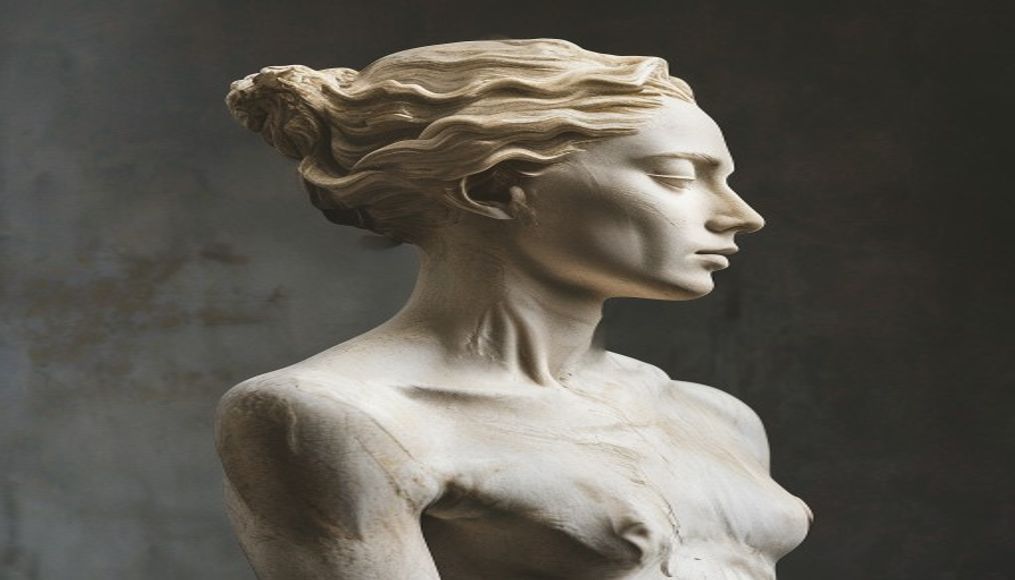
Venus de milo
1344×768 · AVIF · CC BY 4.0

The Venus de Milo is one of the most iconic statues of ancient Greece, representing the goddess Aphrodite with elegance and mystery.
About this subject
The Venus de Milo, also known as Aphrodite of Melos, is a Hellenistic marble sculpture created between 130 and 100 BC. Discovered in 1820 on the Greek island of Melos by a local farmer, the statue stands 2.02 meters tall and depicts the goddess of love and beauty, Aphrodite, in a classical contrapposto pose. The missing arms, which have become her most famous feature, remain a mystery, they were likely lost during discovery or subsequent transport attempts.
The statue is attributed to Alexandros of Antioch, based on an inscription found on its original pedestal. During the Hellenistic period, Greek art evolved toward greater realism and emotion, evident in the intricate folds of the drapery and the texture of the marble skin. Venus de Milo was brought to France and displayed at the Louvre Museum in 1821, quickly becoming a centerpiece. French propaganda later promoted it as an ideal of beauty, cementing its global fame.
Interestingly, the statue was originally painted in vivid colors, as was common in Greek sculpture, but these pigments have faded over time. Modern X-ray studies suggest the missing arms may have held an apple (symbol of the Judgment of Paris) and a mirror or shield. Venus de Milo has influenced artists like Salvador Dalí and remains a subject of archaeological research, bridging classical art and contemporary imagination.
Frequently Asked Questions
Why is the Venus de Milo missing her arms?
The arms were lost, likely during the statue's discovery in 1820 or transport. Their exact fate is unknown, but studies suggest one arm held an apple and the other possibly a mirror or shield.
Where is the Venus de Milo currently located?
The Venus de Milo is displayed at the Louvre Museum in Paris, France, since 1821. It remains one of the museum's most visited exhibits.
Who sculpted the Venus de Milo?
The statue is attributed to Alexandros of Antioch, based on an inscription on its original pedestal. He was a sculptor of the Hellenistic school.
Direct URL
https://pub-c7d6a6ea828543ac903a74a341ccb2e1.r2.dev/imagens/venus-de-milo-cinematic-wide-shot-p2.avifHow to credit
Include a visible link back to UtilizAí. Copy one of the snippets below:
<a href="https://xn--utiliza-eza.com/en/midia/imagens/venus-de-milo-cinematic-wide-shot-p2">Venus de milo</a> by <a href="https://xn--utiliza-eza.com">UtilizAí</a>, licensed under <a href="https://creativecommons.org/licenses/by/4.0/">CC BY 4.0</a>.
[Venus de milo](https://xn--utiliza-eza.com/en/midia/imagens/venus-de-milo-cinematic-wide-shot-p2) by [UtilizAí](https://xn--utiliza-eza.com), CC BY 4.0
License: CC-BY-4.0