Uranus blue tilted
1344×768 · AVIF · CC BY 4.0
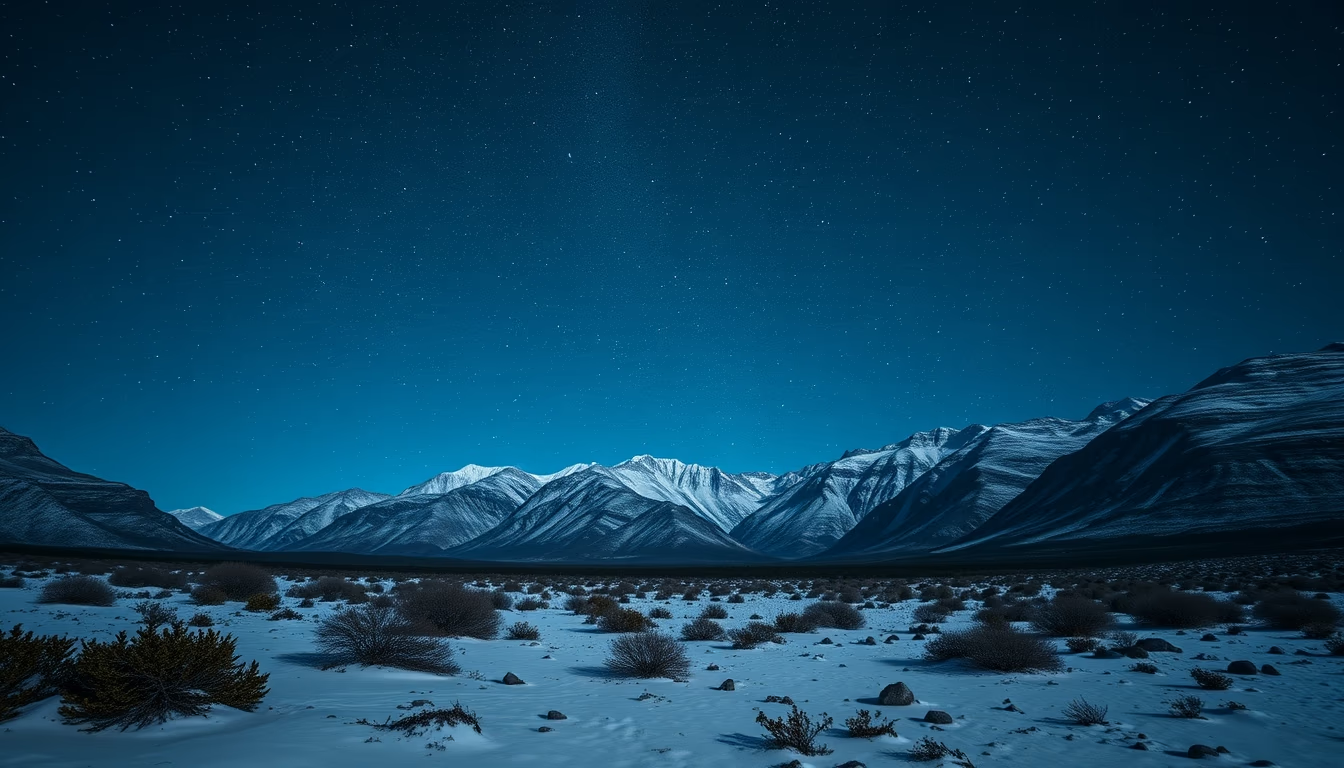
Uranus is the seventh planet from the Sun, famous for its blue color and extreme axial tilt of about 98 degrees.
About this subject
Uranus is an ice giant located about 2.9 billion kilometers from the Sun. Its atmosphere consists mainly of hydrogen and helium, with methane absorbing red light and reflecting blue, giving the planet its distinctive color. Unlike other planets, Uranus rotates on its side, with its axis nearly parallel to its orbital plane. This unique tilt causes extreme seasons, with each pole experiencing 42 years of continuous sunlight followed by 42 years of darkness.
Discovered by William Herschel in 1781, Uranus was the first planet found using a telescope. The Voyager 2 spacecraft remains the only probe to have visited it, passing by in 1986 and revealing a system of thin, dark rings and 27 known moons, many named after characters from Shakespeare and Alexander Pope's works. The major moons are Miranda, Ariel, Umbriel, Titania, and Oberon. The planet's magnetosphere is tilted and offset due to its sideways rotation.
Despite its distance, Uranus can be seen with the naked eye under dark skies but is often mistaken for a star. Its name derives from the Greek god of the sky, Uranus, father of Cronus. Recent studies suggest the extreme tilt may have resulted from a collision with a massive object early in the Solar System's formation. The planet also has a complex ring system, with 13 known rings discovered in 1977 during a stellar occultation.
Frequently Asked Questions
Why is Uranus blue?
Uranus appears blue because methane in its atmosphere absorbs red light and reflects blue light. This process is similar to Neptune, but Uranus has less haze, giving it a lighter blue color.
What is Uranus's axial tilt?
Uranus has an axial tilt of about 98 degrees, meaning it rotates nearly on its side. This extreme tilt is thought to have been caused by a giant collision early in the Solar System's formation.
How many moons does Uranus have and what are the main ones?
Uranus has 27 known moons. The five largest are Miranda, Ariel, Umbriel, Titania, and Oberon. All are named after characters from the works of William Shakespeare and Alexander Pope.
Direct URL
https://pub-c7d6a6ea828543ac903a74a341ccb2e1.r2.dev/imagens/uranus-blue-tilted-national-geographic-style-p10.avifHow to credit
Include a visible link back to UtilizAí. Copy one of the snippets below:
<a href="https://xn--utiliza-eza.com/en/midia/imagens/uranus-blue-tilted-national-geographic-style-p10">Uranus blue tilted</a> by <a href="https://xn--utiliza-eza.com">UtilizAí</a>, licensed under <a href="https://creativecommons.org/licenses/by/4.0/">CC BY 4.0</a>.
[Uranus blue tilted](https://xn--utiliza-eza.com/en/midia/imagens/uranus-blue-tilted-national-geographic-style-p10) by [UtilizAí](https://xn--utiliza-eza.com), CC BY 4.0
License: CC-BY-4.0