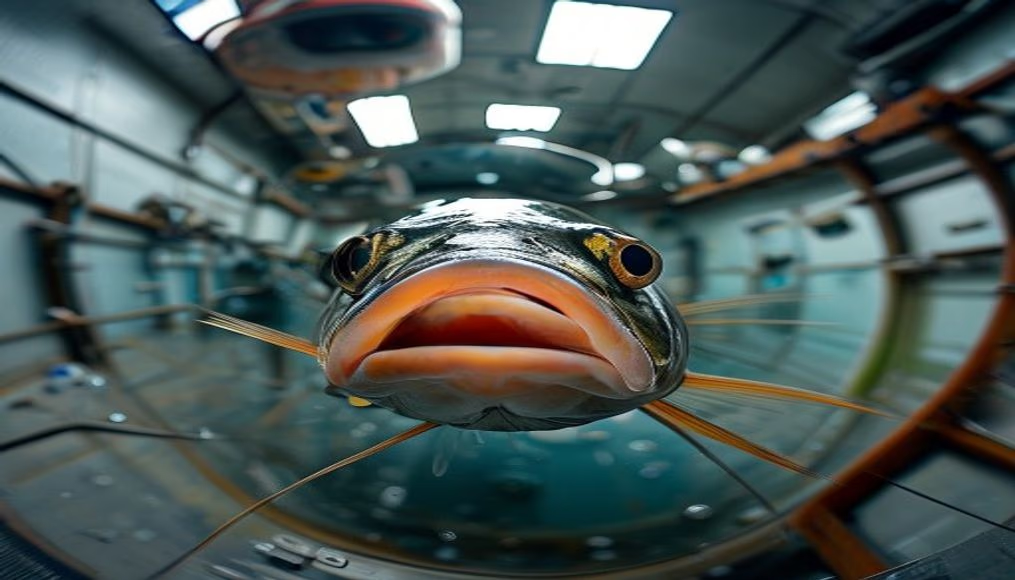
Supercomputer hall
1344×768 · AVIF · CC BY 4.0

Supercomputers are high-performance machines designed to process trillions of operations per second, housed in cooled halls with specialized infrastructure.
About this subject
Supercomputers represent the pinnacle of computational capacity, used for tasks requiring massive processing power such as climate simulations, molecular modeling, and artificial intelligence training. These machines occupy large rooms called halls, where the infrastructure is designed to ensure efficient cooling and power stability. Brazil hosts the Santos Dumont supercomputer at the National Laboratory for Scientific Computing (LNCC) in Petrópolis, one of the most powerful in the world.
Cooling is one of the biggest challenges: precision air conditioning systems or liquid cooling dissipate the heat generated by thousands of processors. Energy consumption can match that of a small town. Racks are arranged in rows, with cables and air ducts strategically placed. The TOP500 list updates the ranking of the fastest supercomputers every six months, highlighting Fugaku (Japan) and Frontier (USA), which exceed exaflop performance.
Long-exposure photography in supercomputer halls captures the movement of LED lights, fans, and cables, creating images that suggest constant activity and data flow. This technique highlights the dynamic and technological atmosphere of the environment, revealing details invisible to the naked eye. Such images are popular in science communication and technology archives, conveying the scale and complexity of these machines.
Beyond academic research, supercomputers are essential for weather forecasting, drug development, and simulation of nuclear explosions (without actual tests). High-performance computing drives advances in aerospace, energy, and finance. The future points toward quantum and neuromorphic systems, which could further revolutionize scientific computing.
Frequently Asked Questions
How does supercomputer cooling work?
Cooling can be achieved through precision air conditioning or by circulating liquid coolant through cold plates (water cooling). Modern systems use immersion in dielectric fluid to increase efficiency and reduce energy consumption.
Which is the fastest supercomputer in the world currently?
As of 2025, Frontier at Oak Ridge National Laboratory (USA) leads the TOP500 ranking with performance exceeding 1.2 exaflops, followed by Fugaku (Japan) and LUMI (Finland).
Why are supercomputer halls photographed with long exposure?
Long exposure captures the movement of lights and fans, creating a visual effect that suggests data flow and constant activity. This helps convey the scale and dynamics of the technological environment.
Direct URL
https://pub-c7d6a6ea828543ac903a74a341ccb2e1.r2.dev/imagens/supercomputer-hall-long-exposure-p1.avifHow to credit
Include a visible link back to UtilizAí. Copy one of the snippets below:
<a href="https://xn--utiliza-eza.com/en/midia/imagens/supercomputer-hall-long-exposure-p1">Supercomputer hall</a> by <a href="https://xn--utiliza-eza.com">UtilizAí</a>, licensed under <a href="https://creativecommons.org/licenses/by/4.0/">CC BY 4.0</a>.
[Supercomputer hall](https://xn--utiliza-eza.com/en/midia/imagens/supercomputer-hall-long-exposure-p1) by [UtilizAí](https://xn--utiliza-eza.com), CC BY 4.0
License: CC-BY-4.0