Supercomputer hall
1344×768 · AVIF · CC BY 4.0
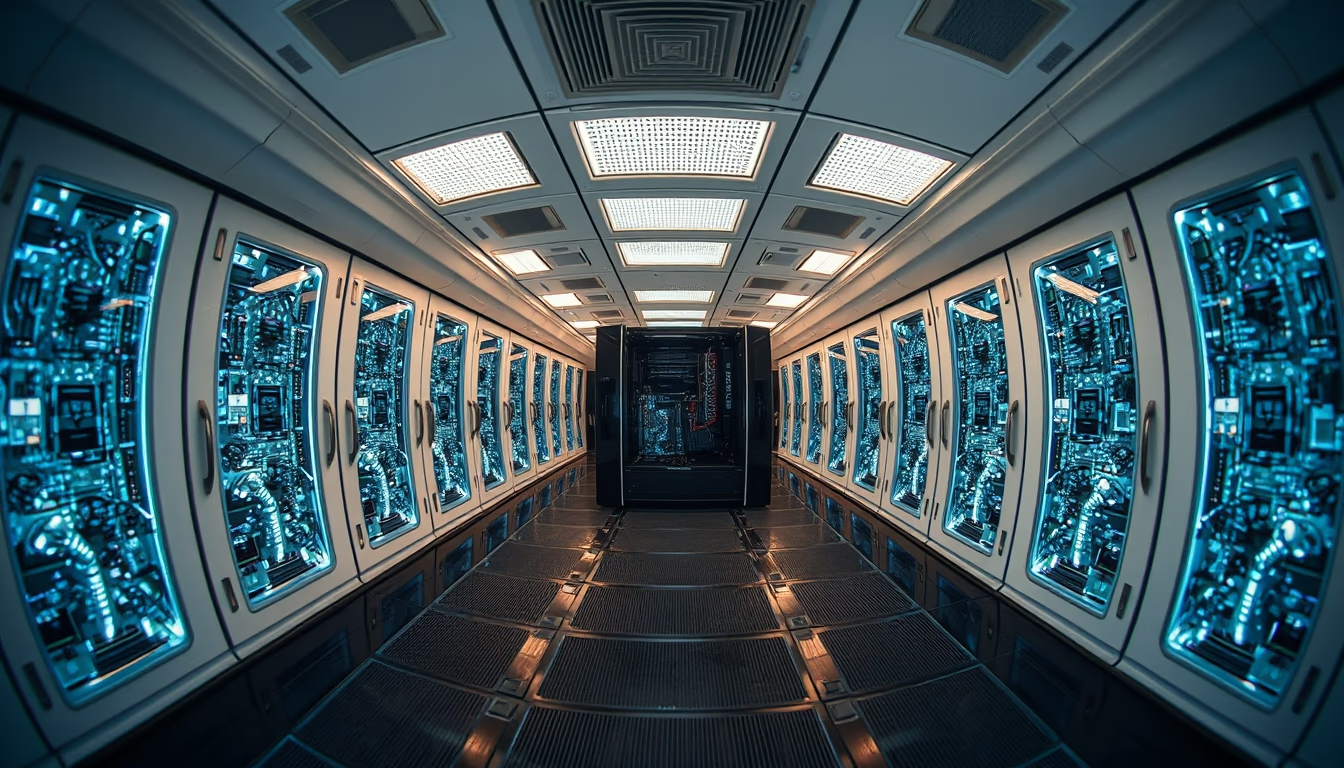
Supercomputer hallway: liquid-cooled facilities housing thousands of parallel processors for high-performance computing.
About this subject
A supercomputer hall is a purpose-built environment housing racks of high-performance computing systems. These facilities rely on liquid cooling, such as direct-to-chip water cooling or dielectric immersion, to manage heat output from thousands of parallel processors. The typical layout uses hot aisle/cold aisle containment to separate exhaust and intake air, maximizing thermal efficiency.
Electrical infrastructure is equally demanding: each rack consumes tens of kilowatts, requiring redundant power feeds and uninterruptible power supplies. Supercomputers like Fugaku (Japan), Summit (USA), and LUMI (Finland) occupy halls covering hundreds of square meters with total power draw in the megawatt range. Interconnection between nodes uses high-speed networks like InfiniBand or proprietary Ethernet, forming topologies such as 3D torus or hypercube.
Beyond compute nodes, halls house parallel storage systems (NVMe or high-performance HDD) and backup/archive units. Physical security includes biometric access and environmental sensors. Due to exorbitant costs (billions of dollars in some cases), conditions are tightly controlled: temperature 20, 25°C, humidity 40, 60% RH to avoid condensation and ESD.
Modern supercomputer halls are designed for scalability: they allow hot-swappable modules without downtime, with raised floors for cable and coolant routing. Recent trends include adiabatic cooling and waste heat reuse for district heating, exemplified by Finland's LUMI supercomputer.
Frequently Asked Questions
What is a supercomputer hall?
It is a specially designed room or building that houses supercomputers, featuring liquid cooling, redundant power supplies, and strict environmental controls to ensure continuous operation.
How is a supercomputer hall cooled?
Cooling relies on liquid systems such as cold plates on chips or dielectric immersion, combined with hot aisle/cold aisle containment. Some halls use adiabatic cooling or waste heat recovery for district heating.
What are the largest supercomputer halls in the world?
Prominent examples include Fugaku's hall at Riken (Japan), Summit at Oak Ridge (USA), LUMI at CSC (Finland), and Frontier (USA). They occupy hundreds of square meters and consume megawatts of power.
Direct URL
https://pub-c7d6a6ea828543ac903a74a341ccb2e1.r2.dev/imagens/supercomputer-hall-fish-eye-wide-angle-p3.avifHow to credit
Include a visible link back to UtilizAí. Copy one of the snippets below:
<a href="https://xn--utiliza-eza.com/en/midia/imagens/supercomputer-hall-fish-eye-wide-angle-p3">Supercomputer hall</a> by <a href="https://xn--utiliza-eza.com">UtilizAí</a>, licensed under <a href="https://creativecommons.org/licenses/by/4.0/">CC BY 4.0</a>.
[Supercomputer hall](https://xn--utiliza-eza.com/en/midia/imagens/supercomputer-hall-fish-eye-wide-angle-p3) by [UtilizAí](https://xn--utiliza-eza.com), CC BY 4.0
License: CC-BY-4.0