Submarine deep ocean
1344×768 · AVIF · CC BY 4.0
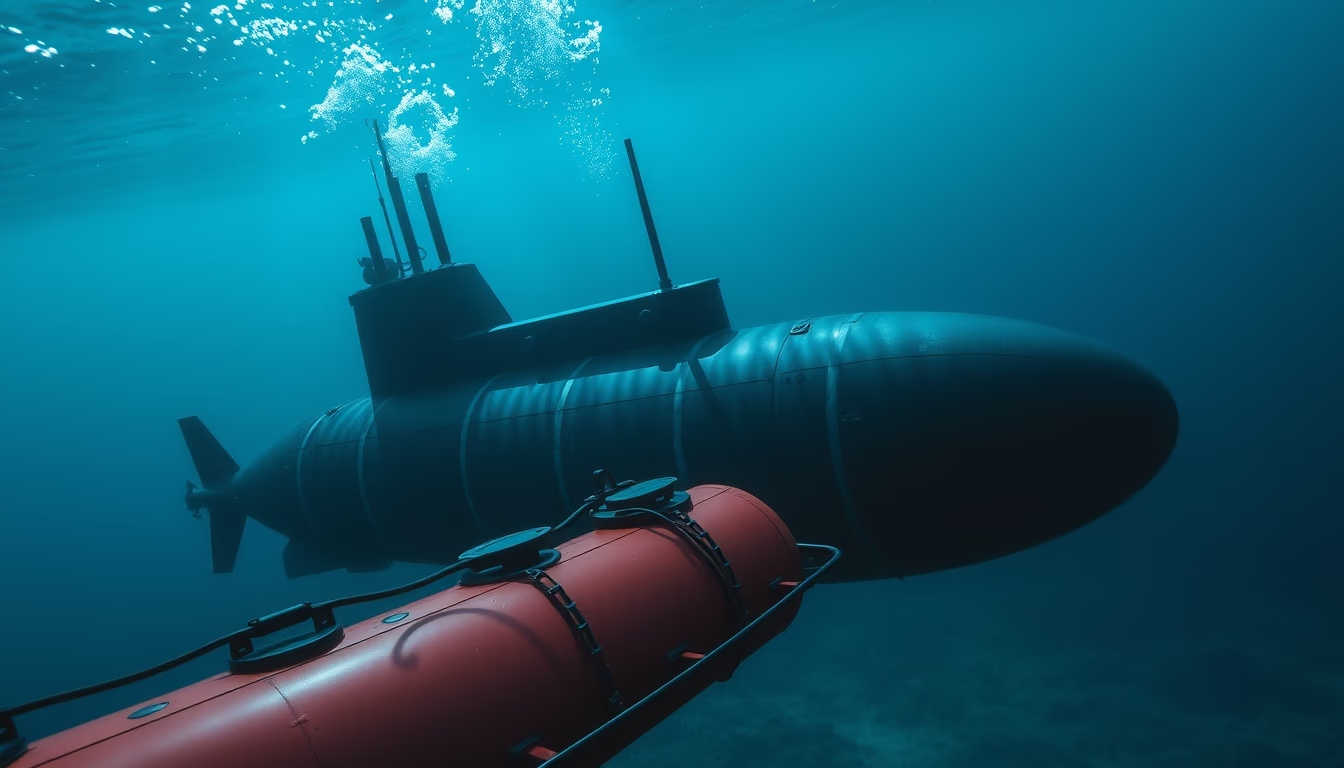
Modern submarines explore the deep ocean, unveiling little-known ecosystems and pushing the limits of human engineering.
About this subject
Submarines are underwater vehicles capable of operating at great depths, essential for oceanographic research, resource exploration, and national defense. The first viable submarines appeared in the 19th century, such as Narcís Monturiol's Ictíneo (1859), but it was in the 20th century that they evolved into sophisticated machines. The American nuclear submarine Nautilus, launched in 1954, was the first to use nuclear propulsion, allowing long submerged autonomy. Currently, submarines like the Trieste II or China's Jiaolong reach depths of over 7,000 meters, in the hadal abyss.
Deep ocean exploration is compared to space exploration: less than 20% of the ocean floor has been mapped with details equivalent to those of Mars or the Moon. Manned submarines and ROVs (remotely operated vehicles) have discovered hydrothermal vents, bioluminescent creatures, and ecosystems that survive without sunlight. The Mariana Trench, the deepest point, has been visited only a few times by humans, such as James Cameron's expedition in the Deepsea Challenger in 2012.
Beyond science, submarines play a strategic role in military and commercial sectors. The maintenance of submarine internet cables, which carry 99% of global data traffic, depends on underwater vehicles. Submarine design must balance internal pressure, air autonomy, and hull strength. Lithium-ion battery technology, combined with fuel cells, is enabling non-nuclear submarines to be quieter and more environmentally friendly.
Frequently Asked Questions
What are the main differences between manned and unmanned submarines?
Manned submarines allow human presence for real-time observation and decision-making, but have limitations in time and safety. Unmanned ones (ROVs and AUVs) can operate longer, reach greater depths, and avoid human risks, being controlled remotely or by artificial intelligence.
How do submarines withstand the extreme pressure of the deep ocean?
The hull is built with strong materials like high-strength steel or titanium, and has a spherical or cylindrical shape to distribute pressure evenly. The hull thickness is calculated to withstand the pressure at the operating depth, with safety margins.
What were the most remarkable discoveries made by submarines on the ocean floor?
Highlights include the discovery of hydrothermal vents and associated ecosystems in the 1970s, the location of the Titanic wreck in 1985, and the observation of life adapted to extremely high pressures in the Mariana Trench, such as the Mariana snailfish.
Direct URL
https://pub-c7d6a6ea828543ac903a74a341ccb2e1.r2.dev/imagens/submarine-deep-ocean-magazine-editorial-p4.avifHow to credit
Include a visible link back to UtilizAí. Copy one of the snippets below:
<a href="https://xn--utiliza-eza.com/en/midia/imagens/submarine-deep-ocean-magazine-editorial-p4">Submarine deep ocean</a> by <a href="https://xn--utiliza-eza.com">UtilizAí</a>, licensed under <a href="https://creativecommons.org/licenses/by/4.0/">CC BY 4.0</a>.
[Submarine deep ocean](https://xn--utiliza-eza.com/en/midia/imagens/submarine-deep-ocean-magazine-editorial-p4) by [UtilizAí](https://xn--utiliza-eza.com), CC BY 4.0
License: CC-BY-4.0