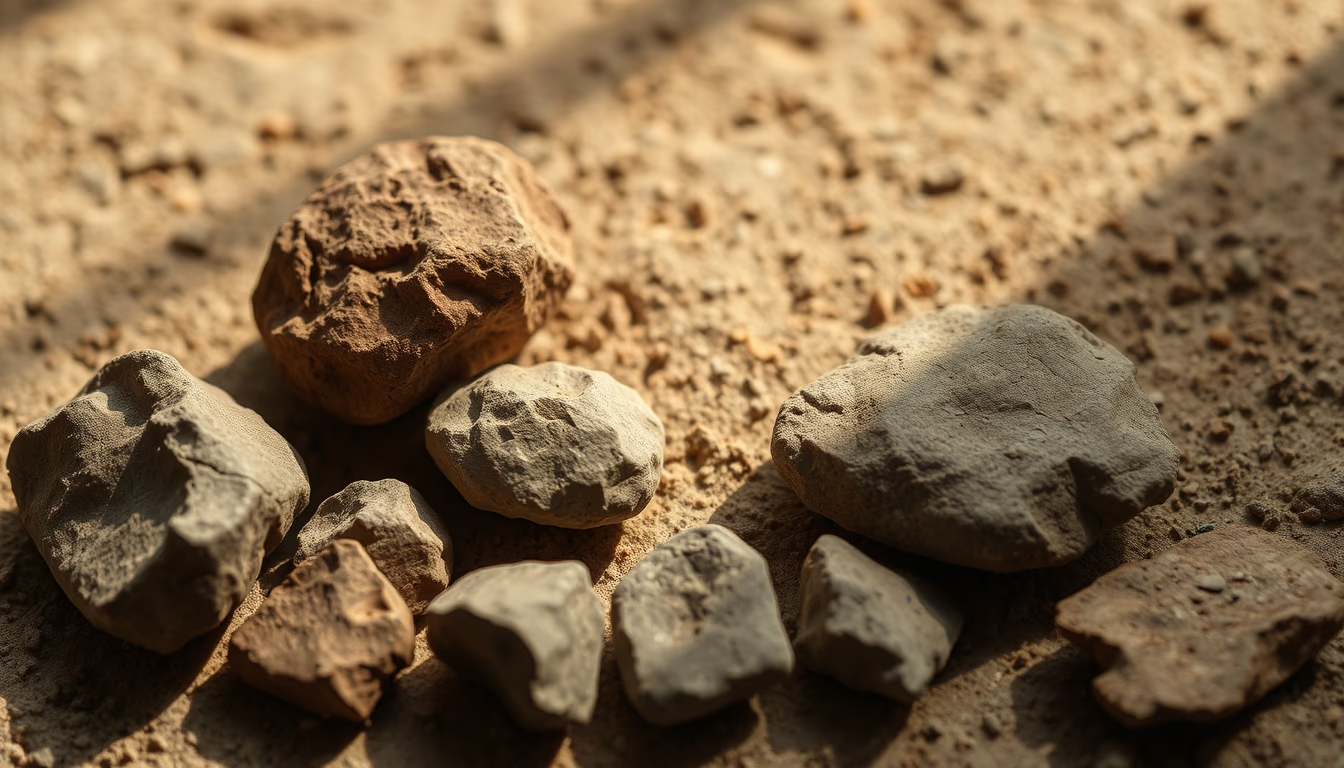
Stone tools paleolithic
1344×768 · AVIF · CC BY 4.0

Paleolithic stone tools represent the earliest human technologies, dating back 2.6 million years, crucial for survival and cultural evolution.
About this subject
Paleolithic stone tools, or chipped stone tools, represent the earliest record of human technological innovation. Emerging around 2.6 million years ago in East Africa, these tools were crafted by hominins such as Homo habilis and later Homo erectus. They mark the beginning of a long trajectory of adaptation and mastery over the natural environment.
Among the most well-known types are the Oldowan industry, consisting of pebbles chipped to create cutting edges, and the more elaborate bifaces of the Acheulean culture. The Acheulean handaxes, for instance, show a notable technical advance with standardized shapes that suggest planning ability and knowledge transmission.
The manufacturing process, known as knapping, involved striking one stone against another (hammerstone) to detach flakes. Material selection was critical: flint, quartz, and obsidian were preferred for their conchoidal fracture. Over time, techniques like the Levallois method allowed greater control over flake shape and size.
These tools were multifunctional: cutting meat, scraping hides, breaking bones, working wood, and even as weapons. Their production required fine motor coordination and abstract reasoning, factors that drove human cognitive development. Moreover, the need to share manufacturing techniques may have fostered communication and social cooperation, key elements for the formation of early communities.
Frequently Asked Questions
What are the main types of Paleolithic stone tools?
The main types include the chipped pebbles of the Oldowan industry (choppers and simple flakes) and the Acheulean bifaces (handaxes). Later, flake tools such as scrapers and points emerged, associated with the Levallois method.
How do archaeologists date Paleolithic stone tools?
Dating is done primarily through indirect methods such as stratigraphy (position in sedimentary layers) and radiometric dating of associated minerals (e.g., potassium-argon on volcanic ash). The typology of tools also helps establish relative chronologies.
Where were the oldest Paleolithic stone tools found?
The oldest were discovered at the Ledi-Geraru site in Ethiopia, dated to 2.6 million years ago. Other important sites include Olduvai Gorge in Tanzania and Koobi Fora in Kenya.
Direct URL
https://pub-c7d6a6ea828543ac903a74a341ccb2e1.r2.dev/imagens/stone-tools-paleolithic-cinematic-wide-shot-p5.avifHow to credit
Include a visible link back to UtilizAí. Copy one of the snippets below:
<a href="https://xn--utiliza-eza.com/en/midia/imagens/stone-tools-paleolithic-cinematic-wide-shot-p5">Stone tools paleolithic</a> by <a href="https://xn--utiliza-eza.com">UtilizAí</a>, licensed under <a href="https://creativecommons.org/licenses/by/4.0/">CC BY 4.0</a>.
[Stone tools paleolithic](https://xn--utiliza-eza.com/en/midia/imagens/stone-tools-paleolithic-cinematic-wide-shot-p5) by [UtilizAí](https://xn--utiliza-eza.com), CC BY 4.0
License: CC-BY-4.0