Space telescope hubble photograph
1344×768 · AVIF · CC BY 4.0
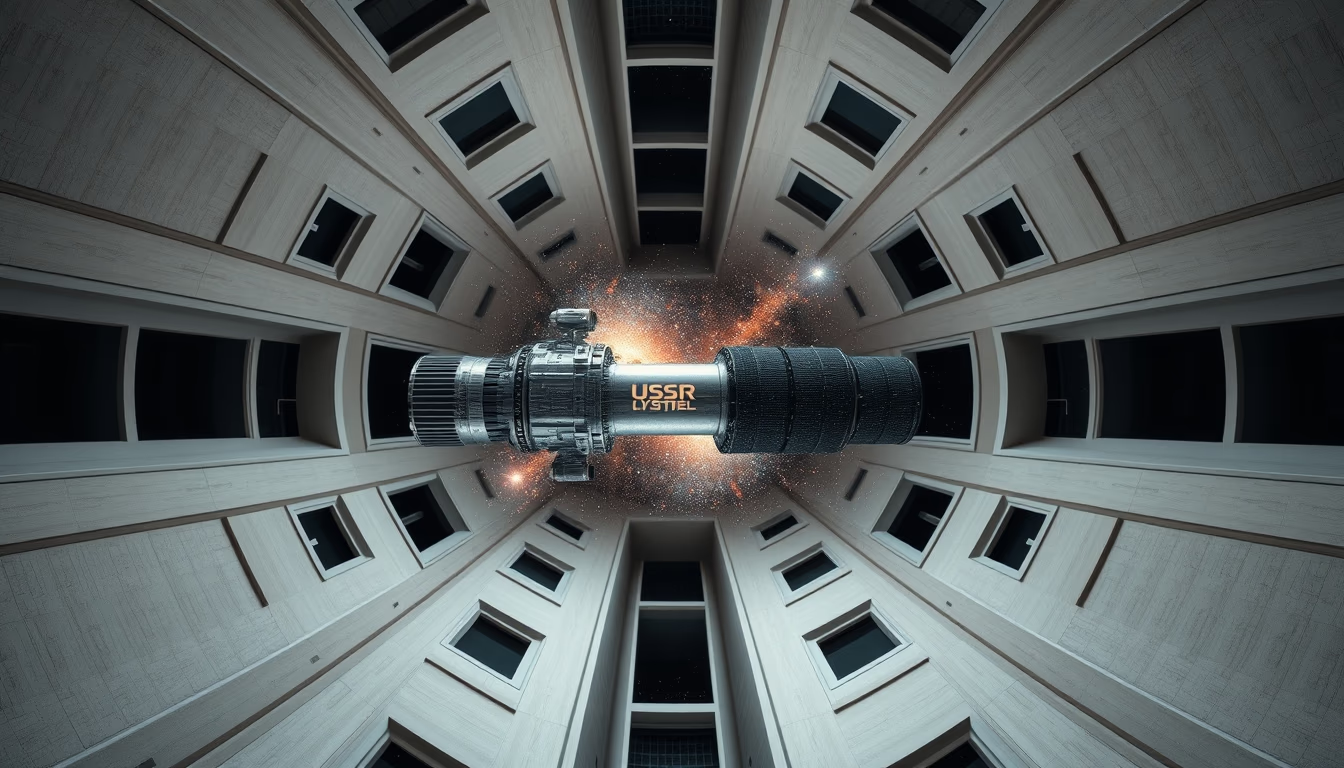
The Hubble Space Telescope revolutionized astronomy by capturing images of the universe with unprecedented clarity from its Earth orbit.
About this subject
Launched on April 24, 1990, aboard the Space Shuttle Discovery, the Hubble Space Telescope is one of the most important scientific instruments ever built. Orbiting Earth at an altitude of about 547 kilometers, it travels at roughly 28,000 km/h, completing a lap every 97 minutes. Unlike ground-based telescopes, Hubble avoids atmospheric distortion, enabling sharp observations in visible, ultraviolet, and near-infrared light.
The telescope has a 2.4-meter primary mirror and carries instruments such as the Advanced Camera for Surveys (ACS) and Wide Field Camera 3 (WFC3). Over three decades, Hubble has conducted over 1.4 million observations, contributing to discoveries like the age of the universe (13.8 billion years), the existence of supermassive black holes at galaxy centers, and the accelerated expansion of the cosmos leading to dark energy.
A landmark was the Hubble Deep Field image, exposed for 10 consecutive days in 1995, revealing thousands of distant galaxies billions of light-years away. The telescope also recorded events such as the impact of Comet Shoemaker-Levy 9 on Jupiter in 1994 and the evolution of planetary nebulae. Although designed for a 15-year lifespan, Hubble remains operational thanks to five space shuttle servicing missions, the last in 2009. Its successor, NASA's James Webb Space Telescope, operates in infrared and launched in 2021.
Culturally, Hubble transformed public perception of the cosmos with iconic images like the Pillars of Creation in the Eagle Nebula. These photographs not only advanced science but also inspired generations, appearing in books, documentaries, and art. The telescope symbolizes international collaboration between NASA and ESA, and its data is publicly available, fostering global research.
Frequently Asked Questions
What is the main difference between Hubble and the James Webb telescope?
Hubble mainly observes in visible and ultraviolet light, while James Webb is optimized for infrared, allowing it to see more distant and cooler objects, such as the earliest galaxies. Additionally, Webb orbits the Sun at the L2 point, 1.5 million km from Earth.
How many times has Hubble been repaired in space?
Hubble received five crewed servicing missions between 1993 and 2009, conducted by the space shuttle. These missions corrected flaws, replaced instruments, and upgraded systems, extending its operational life for decades.
Is Hubble still operational in 2025?
Yes, Hubble is still operational in 2025, although no repair missions have occurred since 2009. It is expected to function until the late 2020s or early 2030s, when its orbit will naturally decay.
Direct URL
https://pub-c7d6a6ea828543ac903a74a341ccb2e1.r2.dev/imagens/space-telescope-hubble-photograph-architectural-photography-p2.avifHow to credit
Include a visible link back to UtilizAí. Copy one of the snippets below:
<a href="https://xn--utiliza-eza.com/en/midia/imagens/space-telescope-hubble-photograph-architectural-photography-p2">Space telescope hubble photograph</a> by <a href="https://xn--utiliza-eza.com">UtilizAí</a>, licensed under <a href="https://creativecommons.org/licenses/by/4.0/">CC BY 4.0</a>.
[Space telescope hubble photograph](https://xn--utiliza-eza.com/en/midia/imagens/space-telescope-hubble-photograph-architectural-photography-p2) by [UtilizAí](https://xn--utiliza-eza.com), CC BY 4.0
License: CC-BY-4.0





