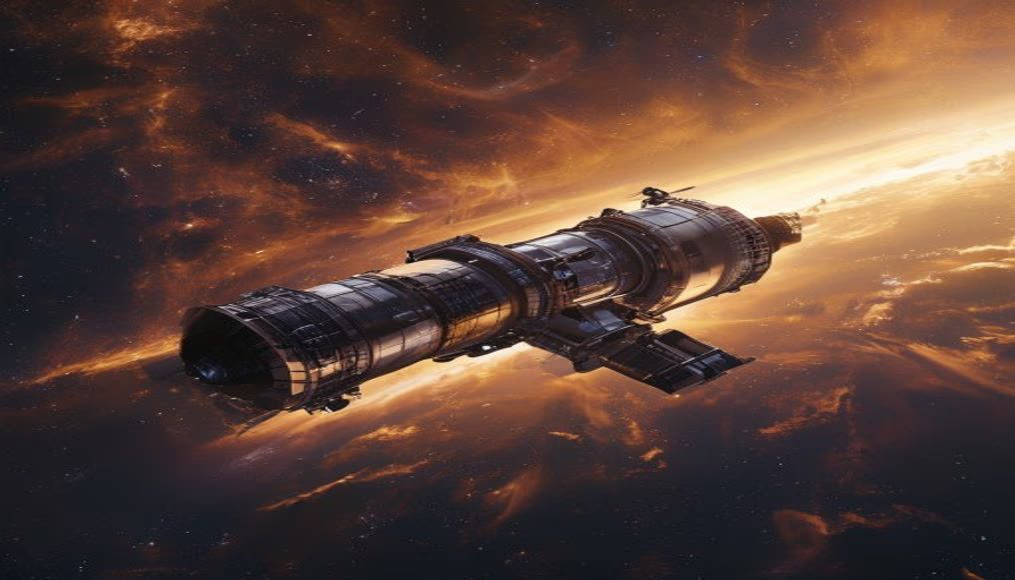
Space telescope hubble
1344×768 · AVIF · CC BY 4.0
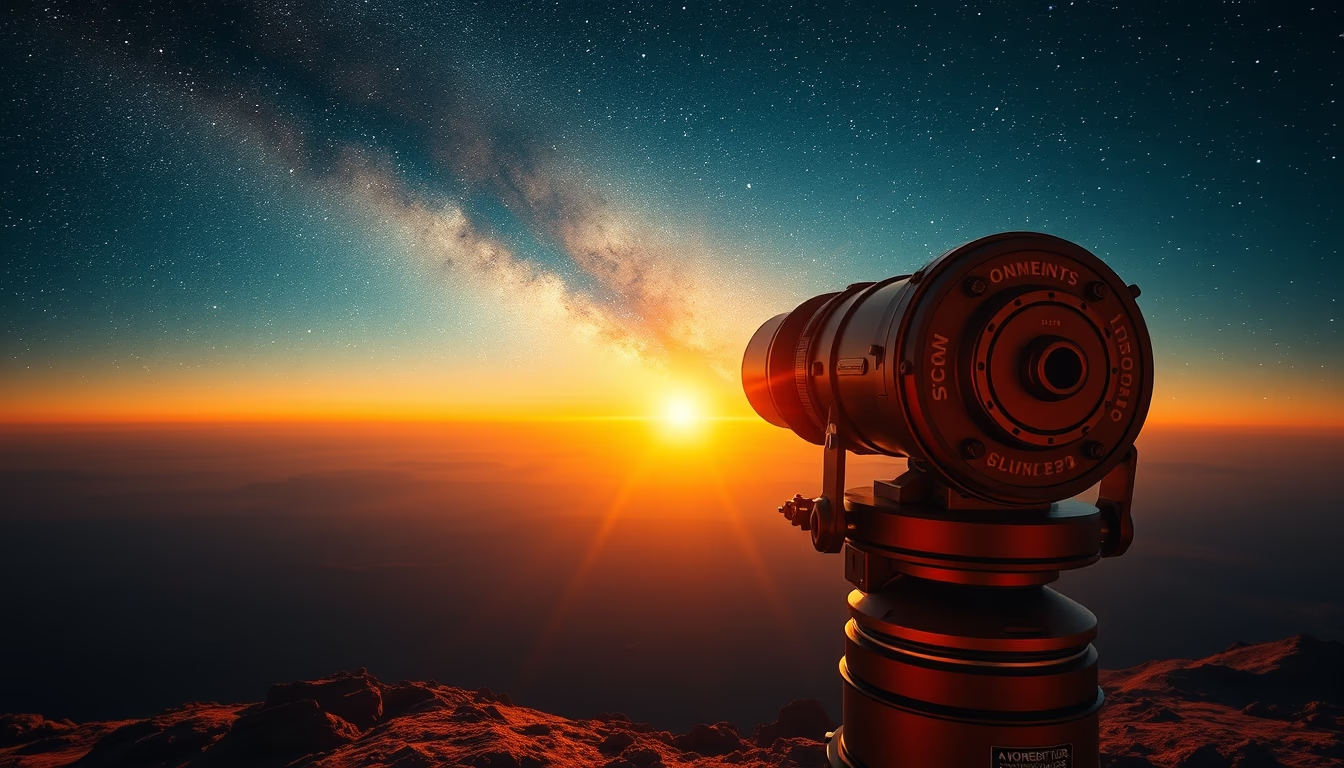
The Hubble Space Telescope has revolutionized astronomy since 1990, orbiting Earth and capturing unprecedented details of the cosmos.
About this subject
The Hubble Space Telescope, launched on April 24, 1990, aboard the Space Shuttle Discovery, is one of the most important scientific instruments in history. Operating in low Earth orbit at an altitude of about 540 km, Hubble avoids atmospheric distortion that affects ground-based telescopes, enabling sharp observations in visible, ultraviolet, and near-infrared light. Its primary mirror, 2.4 meters in diameter, collects light from distant objects, revealing galaxies billions of light-years away.
Hubble was designed to be serviced and upgraded by Space Shuttle missions, a unique feature among major observatories. Five servicing missions between 1993 and 2009 corrected a mirror defect (spherical aberration), installed new instruments like the Advanced Camera for Surveys (ACS) and Wide Field Camera 3, and replaced gyroscopes and batteries. These upgrades kept the telescope at the forefront of science for over three decades.
Among Hubble's scientific contributions are precisely determining the universe's expansion rate (Hubble constant), discovering that expansion is accelerating (2011 Nobel Prize in Physics), confirming supermassive black holes at galaxy centers, and iconic images like the Pillars of Creation in the Eagle Nebula. Hubble also helped date the universe's age at about 13.8 billion years.
The telescope remains operational, but its successor, the James Webb Space Telescope (launched in 2021), observes in infrared with greater sensitivity. Nevertheless, Hubble continues making important discoveries, such as studying exoplanet atmospheres and observing transient events. Its longevity makes it a symbol of NASA-ESA collaboration, with over 1.5 million observations performed to date.
Frequently Asked Questions
What was Hubble's main flaw after launch?
Hubble's primary mirror was incorrectly polished, causing spherical aberration that blurred images. This was corrected during the first servicing mission in 1993 with the installation of COSTAR.
Is Hubble still operational?
Yes, Hubble remains operational and conducts regular scientific observations. It is expected to function until the mid-2030s.
How many images has Hubble captured?
As of 2023, Hubble has performed over 1.5 million observations and generated more than 150 terabytes of data.
Direct URL
https://pub-c7d6a6ea828543ac903a74a341ccb2e1.r2.dev/imagens/space-telescope-hubble-cinematic-wide-shot-v2.avifHow to credit
Include a visible link back to UtilizAí. Copy one of the snippets below:
<a href="https://xn--utiliza-eza.com/en/midia/imagens/space-telescope-hubble-cinematic-wide-shot-v2">Space telescope hubble</a> by <a href="https://xn--utiliza-eza.com">UtilizAí</a>, licensed under <a href="https://creativecommons.org/licenses/by/4.0/">CC BY 4.0</a>.
[Space telescope hubble](https://xn--utiliza-eza.com/en/midia/imagens/space-telescope-hubble-cinematic-wide-shot-v2) by [UtilizAí](https://xn--utiliza-eza.com), CC BY 4.0
License: CC-BY-4.0