Space station orbit earth
1344×768 · AVIF · CC BY 4.0
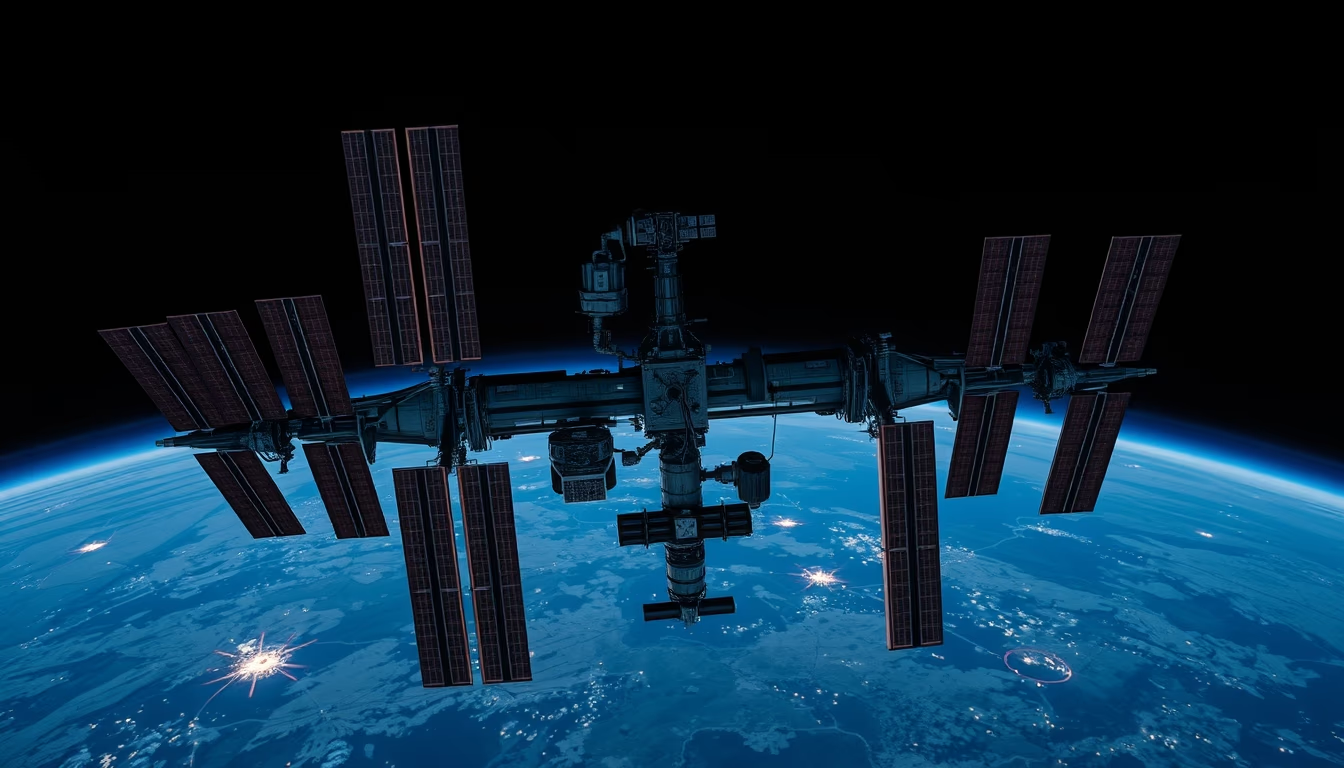
International Space Station in low Earth orbit, a microgravity research laboratory with continuous human presence since 2000.
About this subject
The International Space Station (ISS) is the largest artificial object in low Earth orbit, flying at an altitude of approximately 400 km. Its construction began in 1998 through a collaboration of five space agencies: NASA, Roscosmos, JAXA, ESA, and CSA. The ISS orbits Earth at an average speed of 28,000 km/h, completing one revolution every 90 minutes. Crew members experience 16 sunrises and sunsets each day.
The station serves as a unique laboratory for microgravity research, studying phenomena that cannot be replicated on Earth. Experiments include crystal growth, cell biology, fluid physics, and materials testing. The ISS is also critical for understanding the effects of long-term space exposure on the human body, paving the way for future missions to the Moon and Mars.
Life aboard is tightly scheduled. Astronauts work about 10 hours daily, including exercise to counteract muscle atrophy and bone density loss. Food consists of freeze-dried and canned meals, with flavor adjustments due to altered taste perception in microgravity. Water is recycled from urine and air humidity, an essential sustainability system.
Future space stations include commercial projects like Axiom Station, which will initially attach to the ISS before becoming independent, and the Russian ROSS module. China operates its own Tiangong station, adding to orbital competition and cooperation. The ISS is expected to remain operational until at least 2030, after which it will be deorbited and its remains will fall into the Pacific Ocean.
Frequently Asked Questions
How does gravity work on the International Space Station?
Gravity on the ISS is still about 90% as strong as on Earth's surface. The sensation of microgravity occurs because the station is in continuous free fall around Earth, balancing gravitational pull with the inertia of orbital motion.
How long does it take for the ISS to complete one orbit around Earth?
The ISS orbits Earth every 90 minutes at about 28,000 km/h, resulting in roughly 16 orbits per day.
How do astronauts maintain communication with Earth?
Communication is relayed via satellites like NASA's TDRS (Tracking and Data Relay Satellites), enabling real-time voice, video, and data transmission except for brief signal loss periods during each orbit.
Direct URL
https://pub-c7d6a6ea828543ac903a74a341ccb2e1.r2.dev/imagens/space-station-orbit-earth-aerial-drone-shot-p6.avifHow to credit
Include a visible link back to UtilizAí. Copy one of the snippets below:
<a href="https://xn--utiliza-eza.com/en/midia/imagens/space-station-orbit-earth-aerial-drone-shot-p6">Space station orbit earth</a> by <a href="https://xn--utiliza-eza.com">UtilizAí</a>, licensed under <a href="https://creativecommons.org/licenses/by/4.0/">CC BY 4.0</a>.
[Space station orbit earth](https://xn--utiliza-eza.com/en/midia/imagens/space-station-orbit-earth-aerial-drone-shot-p6) by [UtilizAí](https://xn--utiliza-eza.com), CC BY 4.0
License: CC-BY-4.0