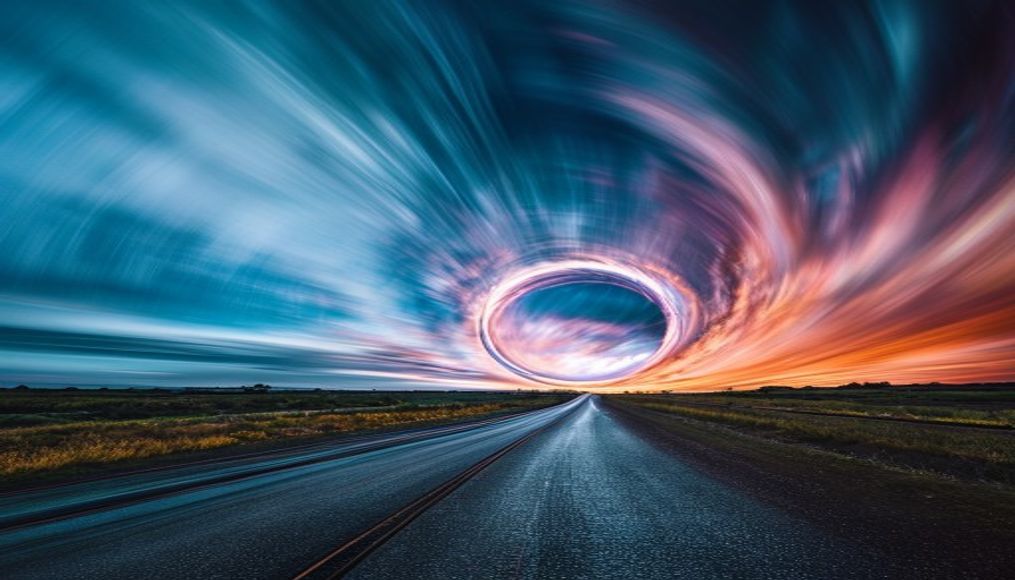
Solar prominence eruption
1344×768 · AVIF · CC BY 4.0

Solar prominence eruption, a gigantic phenomenon where ionized plasma is ejected from the Sun's surface into interplanetary space.
About this subject
Solar prominences are dense, cool plasma structures (relative to the surrounding corona) that extend tens of thousands of kilometers above the photosphere. They are held in place by strong magnetic fields and can persist for days or weeks. When these structures become unstable, an eruption occurs: plasma is ejected into space at high speeds, forming a coronal mass ejection (CME). These events trigger geomagnetic storms on Earth, potentially disrupting satellites, power grids, and radio communications.
The first recorded observation of a solar prominence dates back to 1185 in a Mongolian manuscript. But it was only in the 19th century that astronomers began to study them systematically, especially during total eclipses. Today, satellites like SOHO and the Solar Dynamics Observatory continuously monitor these eruptions. A single prominence can be the size of dozens of Earths lined up. The longest ever recorded, in 2015, reached about 1.5 million kilometers, more than the Sun's diameter.
Prominence eruptions are linked to the 11-year solar cycle. At solar maximum, the number of eruptions increases dramatically. For astronauts on space missions, these events pose radiation risk. In 1859, the Carrington Event, a huge solar eruption, caused auroras visible even in the Caribbean and disrupted telegraph systems. Recent studies indicate that extreme solar storms may occur once a century, but their predictability remains limited.
Frequently Asked Questions
What causes a solar prominence eruption?
The eruption occurs when the magnetic field holding the prominence becomes unstable and reconnects, releasing stored energy and ejecting plasma into space.
What is the difference between a prominence and a solar flare?
A prominence is a stable plasma structure; an eruption is a dynamic event where the prominence breaks and is launched into space, often associated with a coronal mass ejection.
How do solar eruptions affect Earth?
They can cause geomagnetic storms, disrupting navigation systems, radio communications, and power grids, as well as generating auroras at lower latitudes.
Direct URL
https://pub-c7d6a6ea828543ac903a74a341ccb2e1.r2.dev/imagens/solar-prominence-eruption-architectural-photography-p5.avifHow to credit
Include a visible link back to UtilizAí. Copy one of the snippets below:
<a href="https://xn--utiliza-eza.com/en/midia/imagens/solar-prominence-eruption-architectural-photography-p5">Solar prominence eruption</a> by <a href="https://xn--utiliza-eza.com">UtilizAí</a>, licensed under <a href="https://creativecommons.org/licenses/by/4.0/">CC BY 4.0</a>.
[Solar prominence eruption](https://xn--utiliza-eza.com/en/midia/imagens/solar-prominence-eruption-architectural-photography-p5) by [UtilizAí](https://xn--utiliza-eza.com), CC BY 4.0
License: CC-BY-4.0