Show jumping arena empty
1344×768 · AVIF · CC BY 4.0
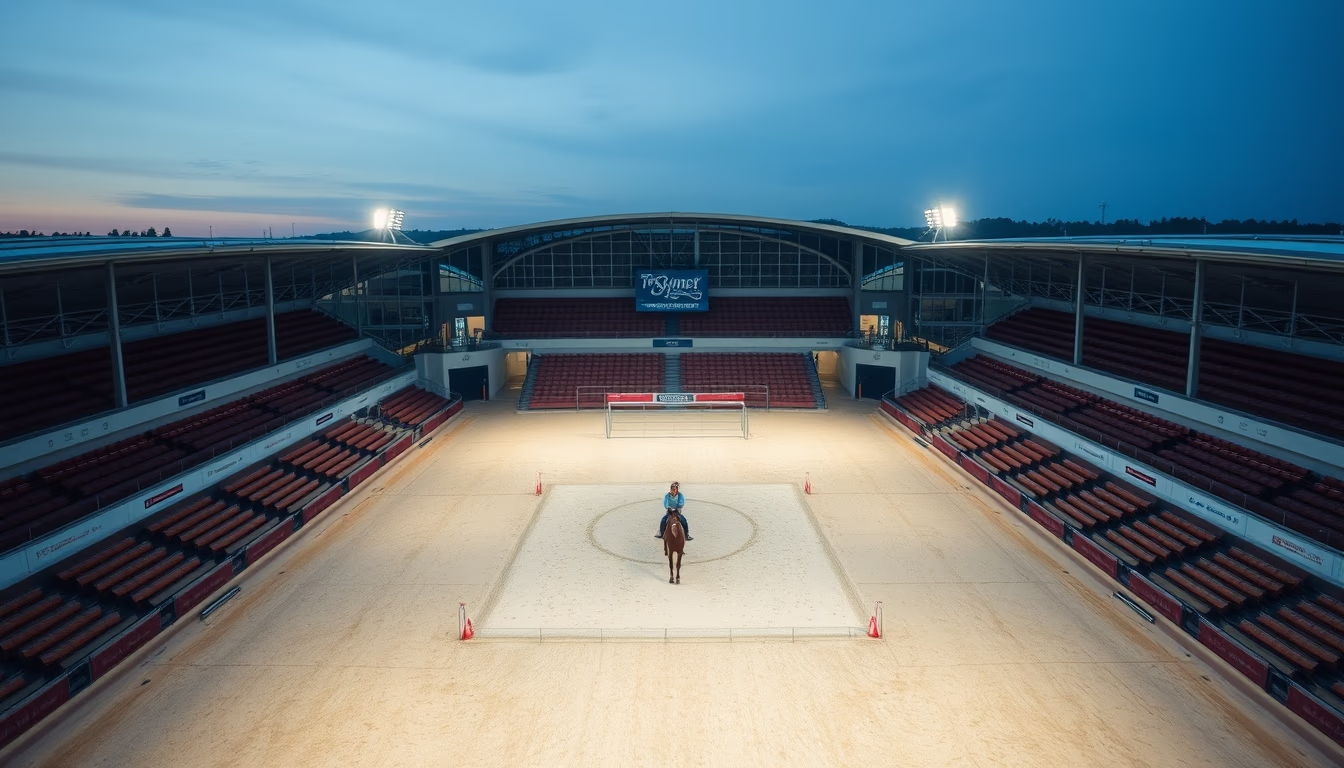
An empty show jumping arena viewed from above reveals the precise geometry of obstacles and the design of a professional equestrian field.
About this subject
A show jumping arena is the stage for equestrian show jumping competitions, one of the most popular equestrian disciplines worldwide. Official competition dimensions typically range from 60 to 90 meters in length and 30 to 50 meters in width, with a surface composed of sand, synthetic fibers, and rubber to ensure traction and shock absorption. The empty arena clearly reveals the arrangement of obstacles, including verticals, oxers, combinations, and water jumps, each painted with distinct colors and numbers for identification and course sequencing.
The obstacles are built with lightweight poles and cups that can easily fall upon contact, prioritizing horse safety. Height and width vary by class, from 0.80 m for beginners to over 1.60 m at Olympic level. Arena maintenance is strict: the surface is leveled and regularly watered to prevent dust and maintain consistency. Jumping breeds such as the Brazilian Sport Horse and Hanoverian are trained to navigate technical tracks requiring power, agility, and precision.
Historically, show jumping became an Olympic sport at the 1900 Paris Games, and its popularity grew with events like the World Show Jumping Championships and the Nations Cup. The International Equestrian Federation (FEI) sets rigorous rules for arena design, including distances between obstacles and course times. Interestingly, an empty arena highlights the meticulous planning of the course designer, who creates challenging combinations that test horse-rider communication even in the absence of athletes.
Frequently Asked Questions
What is the standard size of a show jumping arena in official competitions?
In FEI official competitions, the jumping arena must be at least 60 m long by 30 m wide, and can be up to 90 by 50 m. The minimum total area is 2,500 m² for classes up to 1.30 m and 4,500 m² for Grand Prix.
How are obstacles numbered and colored?
Each obstacle has a visible number (usually on a white panel with black numerals) and may be painted in various colors for contrast. Colors help riders and spectators identify the course; there is no fixed standard, but shades of red, yellow, and blue are common.
Why is the arena surface so important?
The surface must provide stable traction and shock absorption to protect horses' legs during landings after jumps. The ideal mix contains 60-70% washed sand, 20-30% synthetic fiber (e.g., polyester), and 5-10% granulated rubber, maintained at 12-15% moisture.
Direct URL
https://pub-c7d6a6ea828543ac903a74a341ccb2e1.r2.dev/imagens/show-jumping-arena-empty-aerial-drone-shot-fresh11.avifHow to credit
Include a visible link back to UtilizAí. Copy one of the snippets below:
<a href="https://xn--utiliza-eza.com/en/midia/imagens/show-jumping-arena-empty-aerial-drone-shot-fresh11">Show jumping arena empty</a> by <a href="https://xn--utiliza-eza.com">UtilizAí</a>, licensed under <a href="https://creativecommons.org/licenses/by/4.0/">CC BY 4.0</a>.
[Show jumping arena empty](https://xn--utiliza-eza.com/en/midia/imagens/show-jumping-arena-empty-aerial-drone-shot-fresh11) by [UtilizAí](https://xn--utiliza-eza.com), CC BY 4.0
License: CC-BY-4.0