Saturn rings detail
1344×768 · AVIF · CC BY 4.0
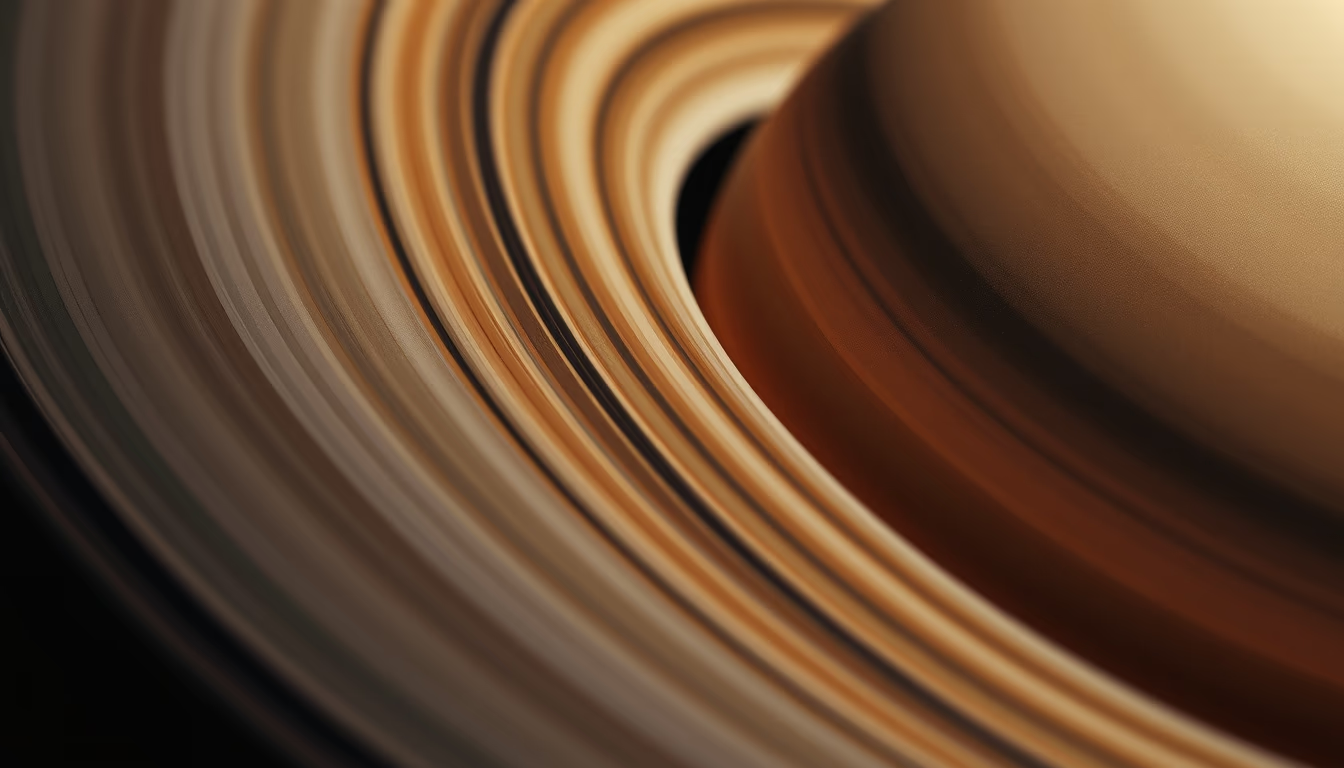
Saturn's rings are composed mainly of ice and rock, with particles ranging from micrometers to meters, and are divided into seven groups labeled A through G.
About this subject
Saturn's rings, one of the most iconic features of the Solar System, are composed of billions of water ice particles, with small amounts of dust and rocky debris. These particles range in size from tiny grains to mountain-sized chunks. The rings extend about 282,000 km from Saturn's equator but are astonishingly thin, only tens of meters thick in some regions.
Discovered by Galileo Galilei in 1610, the rings were initially mistaken for moons or handles. Christiaan Huygens correctly described them as a disk surrounding the planet in 1655. The ring structure is complex, with visible gaps such as the Cassini Division, a 4,800 km gap between the A and B rings, identified by Giovanni Cassini in 1675. This gap is not empty but contains particles in unstable orbits due to resonance with the moon Mimas.
The origin of the rings is debated: they may be remnants of a moon shattered by impact or tidal forces, or leftover material from Saturn's formation. Shepherd moons like Prometheus and Pandora help maintain the rings' shape through gravitational influence. The Cassini spacecraft, which studied Saturn from 2004 to 2017, revealed extraordinary details such as density waves and vertical structures. The rings are gradually losing material to Saturn, suggesting they may be relatively young, with some models indicating an age less than 100 million years.
Frequently Asked Questions
How many rings does Saturn have?
Saturn has seven main ring groups, labeled A, B, C, D, E, F, and G, with numerous divisions and substructures.
What are Saturn's rings made of?
The rings are composed mainly of water ice, with small amounts of dust and rocky debris.
Are Saturn's rings permanent?
No. The rings are gradually losing material to Saturn, and they may disappear in a few tens of millions of years.
Direct URL
https://pub-c7d6a6ea828543ac903a74a341ccb2e1.r2.dev/imagens/saturn-rings-detail-magazine-editorial-p4.avifHow to credit
Include a visible link back to UtilizAí. Copy one of the snippets below:
<a href="https://xn--utiliza-eza.com/en/midia/imagens/saturn-rings-detail-magazine-editorial-p4">Saturn rings detail</a> by <a href="https://xn--utiliza-eza.com">UtilizAí</a>, licensed under <a href="https://creativecommons.org/licenses/by/4.0/">CC BY 4.0</a>.
[Saturn rings detail](https://xn--utiliza-eza.com/en/midia/imagens/saturn-rings-detail-magazine-editorial-p4) by [UtilizAí](https://xn--utiliza-eza.com), CC BY 4.0
License: CC-BY-4.0