Saturn rings detail
1344×768 · AVIF · CC BY 4.0
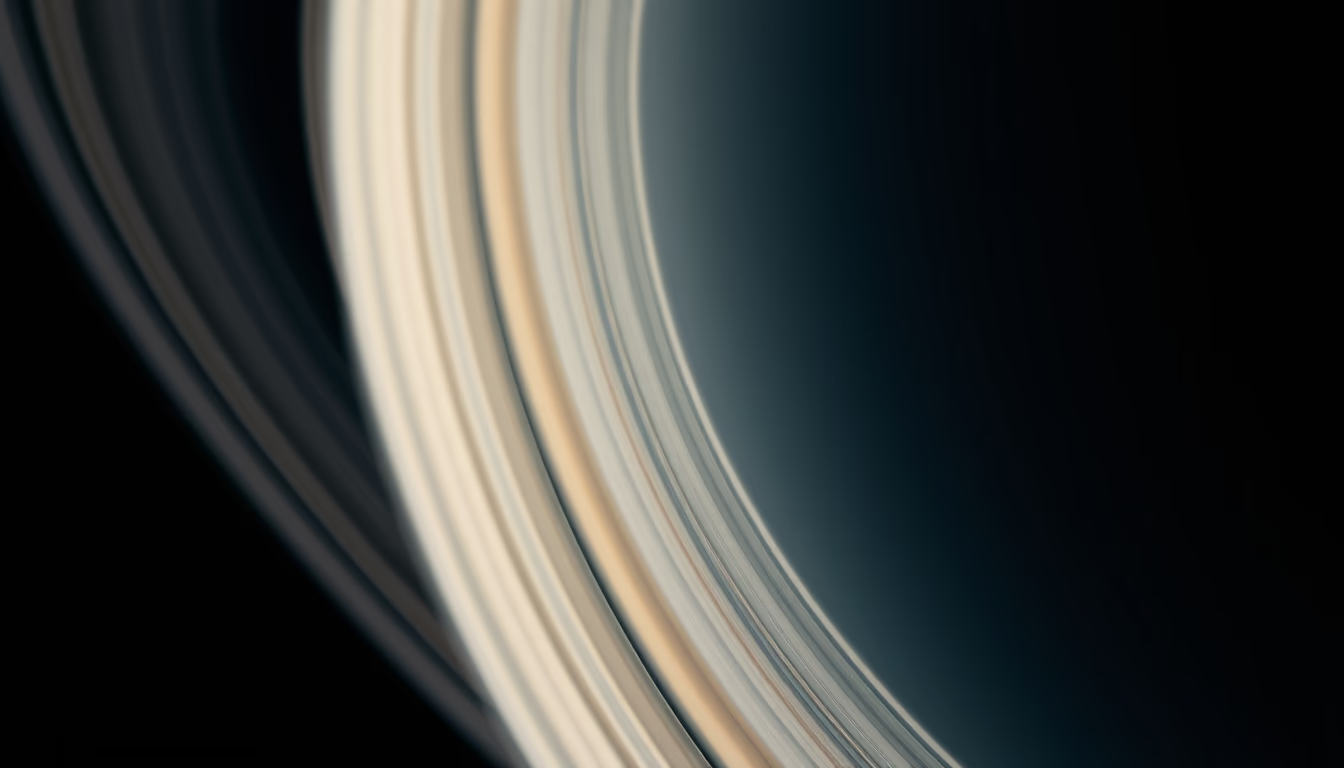
Saturn's rings consist of billions of ice and rock particles, forming a complex system of thousands of concentric rings.
About this subject
Saturn's rings are one of the most breathtaking sights in the Solar System. Contrary to appearances, they are not solid bodies but a vast collection of particles ranging from microscopic grains to mountain-sized chunks. Composed predominantly of water ice with traces of dust and rocky material, these fragments orbit Saturn at speeds reaching tens of thousands of kilometers per hour.
The ring system is divided into seven main groups labeled A through G, with the A and B rings being the brightest and most extensive. Between them lies the Cassini Division, a gap about 4,800 kilometers wide discovered by astronomer Giovanni Cassini in 1675. This gap is not empty but contains sparser material, shaped by the gravitational influence of the moon Mimas.
The origin of the rings remains debated. The leading hypothesis suggests they formed from the destruction of a moon or comet that strayed too close to Saturn, torn apart by tidal forces. The ring system is estimated to be only a few hundred million years old, young in geological terms. Missions such as Voyager and Cassini have revealed incredible details, including wave-like structures and small shepherd moons that maintain the rings' shape.
Interestingly, the rings are gradually losing material to Saturn, indicating they may disappear in less than 100 million years, a cosmic blink of an eye. Today, studying these structures continues to provide insights into planetary formation and orbital dynamics.
Frequently Asked Questions
What are Saturn's rings made of?
They are composed mostly of water ice, with small amounts of dust and rock. Particles range from microscopic to mountain-sized chunks.
How many rings does Saturn have?
The system is divided into seven main groups (A, B, C, D, E, F, and G), but within them there are thousands of individual rings and gaps.
Will Saturn's rings disappear?
Yes, they are gradually losing material to the planet and may completely dissipate in about 100 million years.
Direct URL
https://pub-c7d6a6ea828543ac903a74a341ccb2e1.r2.dev/imagens/saturn-rings-detail-macro-closeup-p1.avifHow to credit
Include a visible link back to UtilizAí. Copy one of the snippets below:
<a href="https://xn--utiliza-eza.com/en/midia/imagens/saturn-rings-detail-macro-closeup-p1">Saturn rings detail</a> by <a href="https://xn--utiliza-eza.com">UtilizAí</a>, licensed under <a href="https://creativecommons.org/licenses/by/4.0/">CC BY 4.0</a>.
[Saturn rings detail](https://xn--utiliza-eza.com/en/midia/imagens/saturn-rings-detail-macro-closeup-p1) by [UtilizAí](https://xn--utiliza-eza.com), CC BY 4.0
License: CC-BY-4.0