Saturn rings detail
1344×768 · AVIF · CC BY 4.0
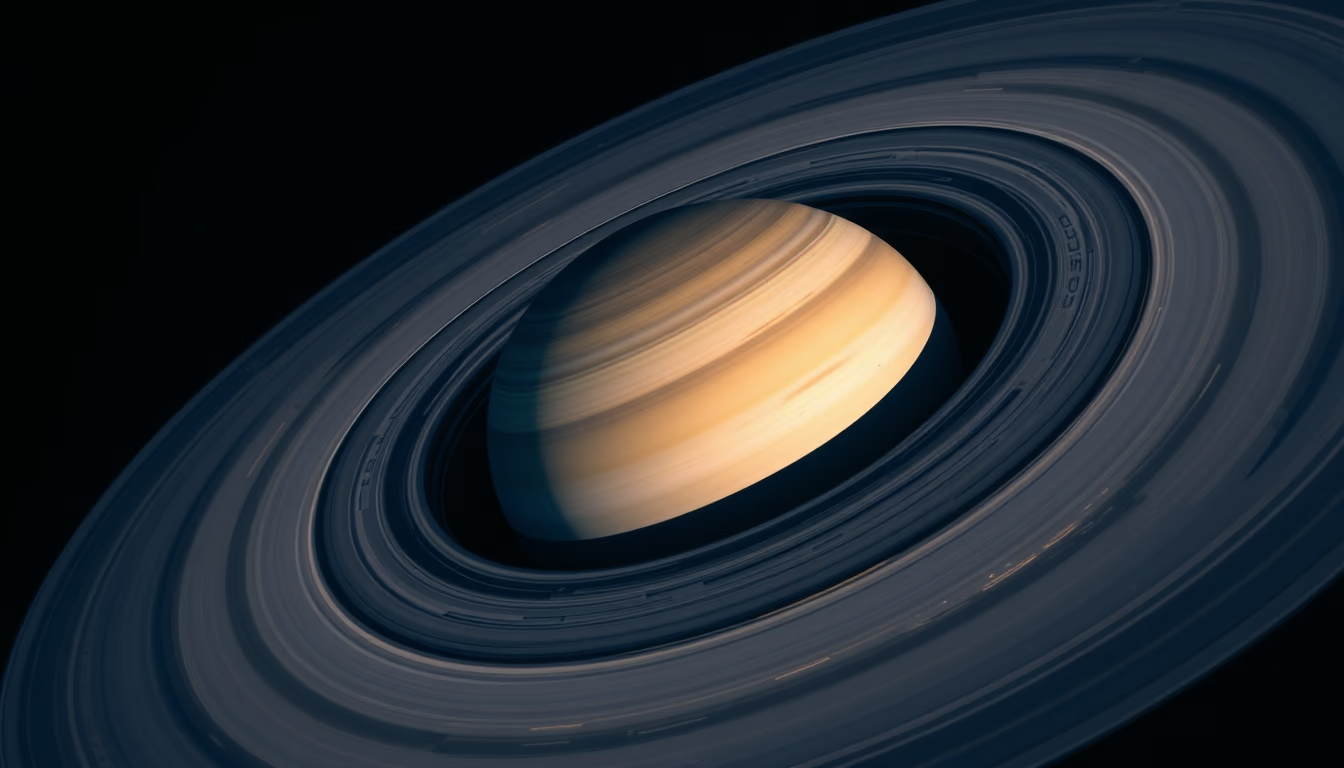
Saturn's rings: composition, structure, and origin as revealed by space probes.
About this subject
Saturn's rings are among the most captivating features in the Solar System. Composed of billions of ice and rock particles, they range in size from dust grains to mountain-sized chunks. Their origin likely stems from shattered moons or leftover debris from Saturn's formation. The Cassini-Huygens mission, which orbited Saturn from 2004 to 2017, revealed stunning details: the rings are incredibly thin, only about 10 meters thick in some places, yet span up to 282,000 kilometers in diameter.
The ring structure is complex, divided into seven main groups (A, B, C, D, E, F, G) with gaps like the Cassini Division, visible even through amateur telescopes. The composition is predominantly water ice (about 99%), with traces of rocky material and organic compounds. Interestingly, the rings are not static; they are gravitationally influenced by Saturn's moons, creating waves and distortions. The shepherd moon Prometheus, for example, confines particles in the F ring.
The age of the rings is still debated. While some scientists propose they are as old as Saturn (4.6 billion years), recent Cassini evidence suggests a younger age, between 10 and 100 million years. This is based on the amount of dark material accumulated, which would be less if the rings were older. The mission also detected a rain of ring particles onto Saturn, a phenomenon that may cause the rings to disappear gradually in about 300 million years.
Observing Saturn's rings is possible with simple telescopes, but fine details require larger instruments or space probes. The title image, captured by a probe or high-resolution telescope, shows the granular texture and color variations that indicate differences in particle size distribution and composition. This celestial beauty continues to inspire astronomers and enthusiasts, revealing secrets about planet formation and debris disk dynamics.
Frequently Asked Questions
How thin are Saturn's rings?
Saturn's rings are extremely thin, averaging about 10 meters thick in some areas, though they can reach 1 kilometer in denser regions. This thinness is remarkable given their diameter of hundreds of thousands of kilometers.
What are Saturn's rings made of?
About 99% of the rings are composed of water ice, with small amounts of rocky material and organic compounds. Particles range from microscopic dust to chunks several meters across.
Are Saturn's rings disappearing?
Yes, evidence from the Cassini probe indicates that the rings are losing material due to particle rain onto Saturn. They are estimated to vanish completely in about 300 million years.
Direct URL
https://pub-c7d6a6ea828543ac903a74a341ccb2e1.r2.dev/imagens/saturn-rings-detail-aerial-drone-shot-p0.avifHow to credit
Include a visible link back to UtilizAí. Copy one of the snippets below:
<a href="https://xn--utiliza-eza.com/en/midia/imagens/saturn-rings-detail-aerial-drone-shot-p0">Saturn rings detail</a> by <a href="https://xn--utiliza-eza.com">UtilizAí</a>, licensed under <a href="https://creativecommons.org/licenses/by/4.0/">CC BY 4.0</a>.
[Saturn rings detail](https://xn--utiliza-eza.com/en/midia/imagens/saturn-rings-detail-aerial-drone-shot-p0) by [UtilizAí](https://xn--utiliza-eza.com), CC BY 4.0
License: CC-BY-4.0